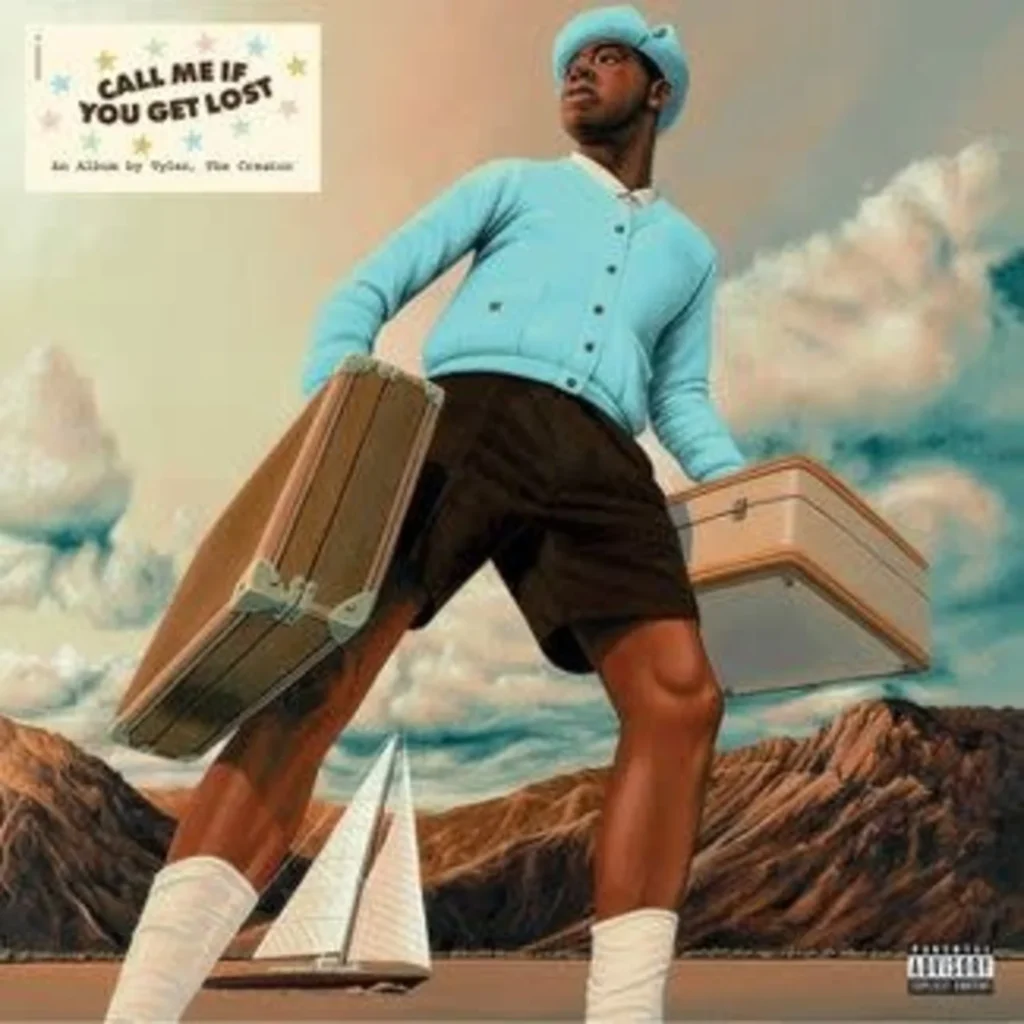
By the time Call Me If You Get Lost arrived in 2021, Tyler, the Creator had already completed one of the most remarkable artistic transformations in modern hip-hop. Once dismissed by many as merely an outrageous provocateur, he had steadily evolved into one of the genre’s most imaginative producers, writers, and conceptual artists. Flower Boy revealed a newfound emotional openness, while IGOR pushed him into genre-defying territory and earned the Grammy Award for Best Rap Album.
Rather than simply making IGOR 2, Tyler pivoted once again.
Call Me If You Get Lost combines the emotional maturity of his later work with the lyrical aggression and technical rapping that defined his early career. Framed as a luxurious globe-trotting travelogue narrated by legendary mixtape host DJ Drama, the album celebrates success, wealth, romance, heartbreak, ambition, and self-confidence while never losing sight of the insecurities lurking beneath Tyler’s larger-than-life persona.
The result is an album that feels like both a victory lap and another artistic reinvention. It pays tribute to the classic mixtape era of the 2000s while sounding unmistakably modern, proving once again that Tyler refuses to stand still creatively.
Album Overview
At first glance, Call Me If You Get Lost appears to be Tyler’s most straightforward rap album in years.
The beats hit harder.
The bars come faster.
Guest rappers receive more room to shine.
DJ Drama’s energetic narration evokes the classic Gangsta Grillz mixtapes that influenced Tyler as a teenager.
Yet beneath that familiar framework lies another carefully constructed concept album.
Travel serves as both a literal and symbolic theme.
Luxury vacations.
Private jets.
Designer luggage.
Passport stamps.
Exotic destinations.
They represent more than wealth—they reflect freedom, escape, and Tyler’s desire to move beyond limitations, both personal and artistic.
The album constantly shifts between celebration and introspection.
One moment Tyler is boasting about his success.
The next he is wrestling with unrequited love, loneliness, jealousy, or uncertainty.
That emotional contrast gives the album considerably more depth than its luxurious exterior initially suggests.
Musically, Tyler blends soulful samples, jazz, boom bap, West Coast influences, neo-soul, funk, and lush orchestration into one of the richest sonic palettes of his career.
Songwriting
Tyler’s songwriting continues to grow more sophisticated with every release.
His trademark humor remains intact, but it now exists alongside genuine emotional vulnerability.
Rather than separating confidence and insecurity into different songs, Tyler often explores both within the same verse.
“CORSO” opens the album with swagger and technical precision, immediately reminding listeners that Tyler remains one of rap’s most gifted writers.
“LUMBERJACK” strips things back to hard-hitting drums and razor-sharp punchlines, serving as one of the album’s purest displays of lyrical skill.
“WILSHIRE” stands as the emotional centerpiece.
Over a minimalist instrumental, Tyler spends nearly eight uninterrupted minutes recounting a complicated love triangle with extraordinary honesty. The storytelling feels conversational rather than performative, allowing awkward details and emotional contradictions to remain intact.
“MASSA” explores identity, fame, and artistic independence, reflecting on Tyler’s journey from controversial outsider to respected cultural figure.
“SWEET / I THOUGHT YOU WANTED TO DANCE” brilliantly contrasts romantic fantasy with painful reality, evolving through multiple musical movements that showcase Tyler’s growing ambition as a songwriter.
Even songs built around luxury and success frequently reveal underlying dissatisfaction.
No matter how successful Tyler becomes, complete contentment always seems slightly out of reach.
That emotional complexity elevates the album far beyond a collection of boastful rap songs.
Performance
Tyler delivers one of the strongest performances of his career.
His rapping has become dramatically sharper over the years.
Flows constantly evolve.
Cadences shift effortlessly.
Punchlines land with confidence.
He sounds completely comfortable switching between technical displays and conversational storytelling.
His vocal versatility also deserves recognition.
Tyler frequently changes pitch, tone, and delivery depending on the emotional needs of each track.
He can sound aggressive on “LUMBERJACK.”
Reflective on “MASSA.”
Heartbroken during “WILSHIRE.”
Playful throughout “HOT WIND BLOWS.”
Confident on “CORSO.”
These transitions happen naturally, preventing the album from ever becoming monotonous.
The guest appearances are equally outstanding.
Lil Wayne delivers one of the album’s finest verses on “HOT WIND BLOWS.”
42 Dugg provides memorable energy on “LEMONHEAD.”
YoungBoy Never Broke Again surprises with a restrained and emotionally effective contribution to “WUSYANAME.”
Teezo Touchdown, Brent Faiyaz, Domo Genesis, Pharrell Williams, and others all contribute meaningful performances without distracting from Tyler’s vision.
DJ Drama’s narration deserves special mention.
Initially, his constant interjections may surprise listeners unfamiliar with the Gangsta Grillz tradition, but his enthusiastic commentary ultimately becomes an essential part of the album’s personality.
Production
Tyler has become one of hip-hop’s premier producers, and Call Me If You Get Lost further strengthens that reputation.
The production is remarkably diverse while maintaining complete cohesion.
Soul samples blend seamlessly with lush orchestration.
Jazz harmonies drift beneath hard-hitting drums.
Synthesizers quietly support live instrumentation.
Unexpected beat switches keep songs feeling fresh.
“SWEET / I THOUGHT YOU WANTED TO DANCE” demonstrates Tyler’s extraordinary arranging abilities, evolving through multiple musical sections without losing momentum.
“HOT WIND BLOWS” pairs luxurious jazz textures with breezy percussion that perfectly captures the album’s travel motif.
“WUSYANAME” transforms a classic soul sample into one of Tyler’s smoothest productions.
“LUMBERJACK” proves he can still create stripped-down rap beats with enormous impact.
Every instrumental contains subtle details waiting to be discovered on repeated listens.
Background vocal layers.
Unexpected chord changes.
Hidden percussion.
Creative sample manipulation.
Few contemporary producers demonstrate this level of musical curiosity across an entire album.
Standout Tracks
Although the album maintains impressive consistency, several songs rank among Tyler’s finest work.
“CORSO” serves as a thrilling opener, combining aggressive production with one of Tyler’s sharpest lyrical performances.
“LUMBERJACK” strips everything down to pure confidence and technical skill, reminding listeners that Tyler can still dominate traditional rap production.
“HOT WIND BLOWS” captures the album’s luxurious travel aesthetic perfectly while featuring a spectacular guest verse from Lil Wayne.
“WUSYANAME” blends soulful production with emotional vulnerability, creating one of Tyler’s most accessible and memorable songs.
“SWEET / I THOUGHT YOU WANTED TO DANCE” is arguably the album’s masterpiece. Its ambitious structure, beautiful melodies, and emotional storytelling showcase Tyler at the height of his creative powers.
“WILSHIRE” may not be the easiest listen, but its brutally honest storytelling makes it one of the most compelling narrative tracks in Tyler’s catalog.
Weak Points
At over 50 minutes, Call Me If You Get Lost occasionally feels slightly overextended.
A handful of tracks could have been tightened without sacrificing the album’s central themes.
DJ Drama’s constant narration, while essential to the mixtape aesthetic, may initially distract listeners unfamiliar with that tradition.
“WILSHIRE,” despite its extraordinary storytelling, intentionally sacrifices musical variation for narrative focus. Some listeners may find its nearly eight-minute runtime challenging despite its emotional impact.
Additionally, following the highly conceptual IGOR, some fans initially viewed this album as a stylistic step backward due to its stronger emphasis on traditional rapping. Over time, however, it has become clear that the shift represents another evolution rather than a retreat.
These criticisms remain relatively minor given the album’s remarkable ambition and consistency.
Legacy
Call Me If You Get Lost reinforced Tyler’s position as one of the most important artists of his generation.
Winning the Grammy Award for Best Rap Album for a second consecutive solo release, it demonstrated that Tyler could dominate both conceptual art-pop and traditional hip-hop without compromising his creative identity.
The album also helped reintroduce the classic mixtape aesthetic to a new generation. DJ Drama’s energetic presence, once a defining feature of 2000s rap, suddenly felt relevant again within a modern context.
Perhaps most importantly, the album proved Tyler no longer needed to choose between lyrical excellence and artistic experimentation.
He could excel at both simultaneously.
Few artists evolve this dramatically while maintaining such a distinctive creative voice.
With Call Me If You Get Lost, Tyler confirmed that his remarkable artistic growth was no accident.
It had become the standard.
Final Score: 9.5/10
Call Me If You Get Lost is a triumphant celebration of everything Tyler, the Creator has become as an artist. Combining elite lyricism, imaginative production, compelling storytelling, and a richly realized concept, it balances confidence with vulnerability in ways few contemporary rap albums achieve.
Its luxurious travel aesthetic, outstanding guest performances, and remarkable musical diversity make it one of the most rewarding hip-hop albums of the 2020s, while Tyler’s continued evolution as both a producer and songwriter ensures that every revisit uncovers new details.
Just shy of absolute perfection, Call Me If You Get Lost stands as one of Tyler’s finest achievements and further cements his place among the most innovative and consistently fascinating artists in modern music.
This post has already been read 4 times!