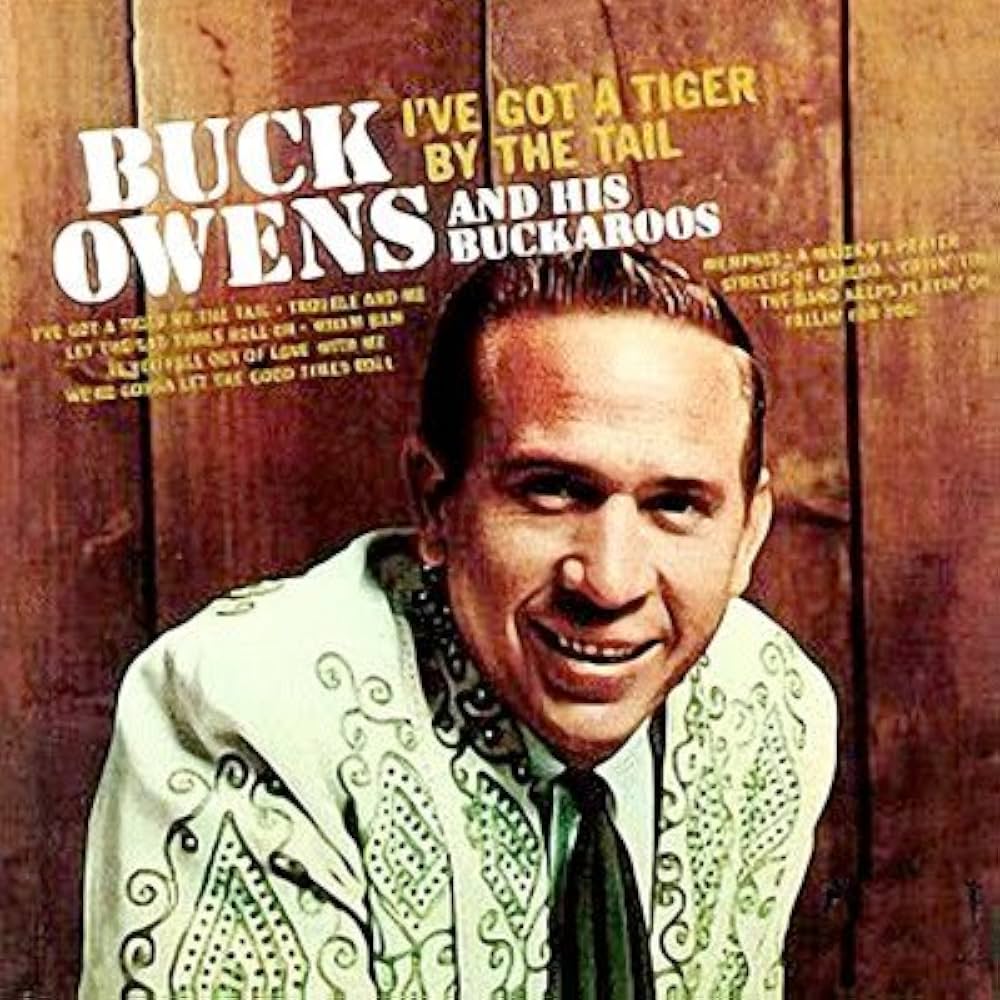
During the mid-1960s, country music found itself at a crossroads. Nashville’s polished “Countrypolitan” sound was dominating the charts, with lush string arrangements and pop-influenced production becoming increasingly common. On the opposite side of the country, however, Buck Owens was leading a musical revolution from Bakersfield, California. Rejecting orchestras and elaborate studio production, Owens embraced twanging Telecaster guitars, driving rhythms, steel guitar, and straightforward storytelling that placed the music’s raw energy front and center.
Released in 1965, I’ve Got a Tiger by the Tail stands as one of the defining statements of the Bakersfield Sound. It captures Owens and his Buckaroos at the absolute peak of their powers, combining infectious honky-tonk rhythms, unforgettable melodies, and some of the finest musicianship in country music. By this point, Owens was no longer simply competing with Nashville—he had become one of the genre’s biggest stars while proving that traditional country could remain commercially successful without sacrificing its identity.
The title track became one of Owens’ signature songs, but the album surrounding it is far more than a vehicle for a hit single. It is a remarkably consistent collection of country music that helped reshape the genre and influence generations of artists, from Dwight Yoakam and Marty Stuart to modern Americana musicians.
Few albums define an entire movement quite as completely as I’ve Got a Tiger by the Tail.
Album Overview
One of the album’s greatest strengths is its remarkable consistency.
There is no unnecessary ornamentation.
No oversized orchestras.
No attempts to chase contemporary pop trends.
Everything revolves around the essentials.
Strong songs.
Outstanding musicians.
Memorable melodies.
Irresistible rhythms.
The Bakersfield Sound differs noticeably from the smoother Nashville productions of the era.
Electric guitars sit prominently in the mix.
Don Rich’s Telecaster provides crisp, melodic leads.
Tom Brumley’s pedal steel guitar adds emotional depth without becoming sentimental.
The rhythm section swings with almost rock-and-roll energy.
The result is country music that feels lively, direct, and refreshingly honest.
Although heartbreak remains a recurring subject, the album never becomes emotionally heavy.
Owens balances sadness with humor, resilience, and an easygoing charm that keeps the record endlessly enjoyable.
Even the slower songs retain an underlying sense of optimism.
That balance gives the album tremendous replay value.
Songwriting
Buck Owens had a remarkable gift for writing songs that sounded simple while revealing extraordinary craftsmanship beneath the surface.
The title track remains the obvious masterpiece.
“I’ve Got a Tiger by the Tail” transforms the familiar expression into a playful metaphor for a relationship that has become impossible to control. Its unforgettable chorus and clever lyric helped make it one of country music’s defining songs.
“Cryin’ Time,” later famously covered by Ray Charles, showcases Owens’ ability to write heartbreaking ballads without relying on melodrama. The emotional impact comes through understatement rather than exaggerated sentiment.
“Memphis” brings a rock-and-roll energy that fits naturally within the Bakersfield aesthetic, while “Trouble and Me” balances catchy melodies with relatable storytelling.
“Wham Bam” injects humor and infectious rhythm into the album, reminding listeners that country music could be fun without becoming novelty music.
Throughout the record, Owens consistently favors concise songwriting.
There are no wasted verses.
No unnecessary repetition.
Every melody feels purposeful.
Every chorus arrives exactly when it should.
That economy becomes one of the album’s defining virtues.
Performance
Buck Owens delivers one of the strongest vocal performances of his career.
His voice lacks the dramatic theatricality of George Jones or the smooth elegance of Jim Reeves, but it possesses something equally valuable.
Authenticity.
Every lyric sounds believable.
Whether celebrating romance or mourning its loss, Owens sings with relaxed confidence rather than exaggerated emotion.
His partnership with Don Rich remains one of the greatest collaborations in country music.
Rich’s harmony vocals blend beautifully with Owens, while his lead guitar work ranks among the finest ever recorded in the genre.
His melodic fills become almost secondary vocal lines, responding naturally to Owens’ singing.
Tom Brumley’s pedal steel playing deserves equal recognition.
His tasteful performances provide emotional shading without overwhelming the songs.
The Buckaroos themselves function as one of country music’s tightest bands.
Every groove feels effortless.
Every transition lands perfectly.
Years of touring together had forged remarkable chemistry, and it shows throughout the album.
Production
Produced by Ken Nelson, I’ve Got a Tiger by the Tail remains a textbook example of how country music can sound both polished and natural.
The production avoids unnecessary studio tricks.
Instead, it captures the band exactly as listeners would have heard them on stage.
The guitars remain bright and clear.
The steel guitar occupies its own space.
Owens’ vocals sit comfortably at the center of the mix.
Nothing feels cluttered.
Unlike many Nashville productions of the era, the arrangements leave room for individual instruments to breathe.
That openness gives the music tremendous energy.
More than sixty years later, the recording continues to sound fresh precisely because it never chased fashionable production techniques.
Its simplicity has become timeless.
Standout Tracks
Although the album maintains exceptional consistency, several songs stand among the defining recordings of Buck Owens’ remarkable career.
“I’ve Got a Tiger by the Tail” is one of country music’s greatest singles. Its clever lyric, unforgettable melody, and infectious Bakersfield groove make it an enduring classic.
“Cryin’ Time” demonstrates Owens’ gift for emotional restraint, delivering heartbreak through subtle storytelling rather than excessive sentimentality.
“Trouble and Me” combines irresistible rhythm with sharp songwriting, highlighting the remarkable chemistry between Owens and the Buckaroos.
“Wham Bam” showcases the playful side of Bakersfield country, pairing lively instrumentation with one of the album’s catchiest performances.
“Memphis” injects a welcome dose of rock-and-roll energy while preserving the album’s unmistakable country identity.
Weak Points
Finding significant weaknesses proves challenging.
Listeners who prefer the lush orchestration of Nashville’s Countrypolitan sound may find the album’s stripped-down arrangements somewhat sparse.
Because Owens consistently favors concise songwriting, a few tracks conclude just as they seem ready to expand further.
Additionally, the album rarely ventures beyond the stylistic boundaries of Bakersfield country, offering refinement rather than experimentation.
These qualities, however, are central to its appeal.
The album succeeds because it remains completely committed to its musical identity.
Legacy
I’ve Got a Tiger by the Tail stands among the definitive albums of the Bakersfield Sound and helped permanently alter the direction of country music.
Its success proved that audiences still embraced raw, guitar-driven country at a time when Nashville productions were becoming increasingly polished.
The album’s influence can be heard across decades of country music.
Dwight Yoakam.
Marty Stuart.
Vince Gill.
Brad Paisley.
Countless artists have drawn inspiration from Owens’ combination of traditional songwriting, exceptional musicianship, and infectious energy.
Perhaps its greatest achievement is how effortlessly enjoyable it remains.
Historical importance alone cannot sustain an album for generations.
Great songs can.
I’ve Got a Tiger by the Tail possesses plenty of them.
Final Score: 9.5/10
I’ve Got a Tiger by the Tail is one of the crowning achievements of classic country music and one of the finest expressions of the Bakersfield Sound ever recorded. Buck Owens combines exceptional songwriting, warm yet confident vocals, and a remarkable supporting band into an album that remains as vibrant today as it was upon release.
Every element works in harmony. The production is timeless, the musicianship is outstanding, and the songs consistently balance humor, heartbreak, and irresistible melodies with remarkable economy.
Few country albums have influenced the genre so profoundly while remaining this consistently entertaining. I’ve Got a Tiger by the Tail is not only a landmark recording but one of the essential country albums of the 1960s.
This post has already been read 46 times!