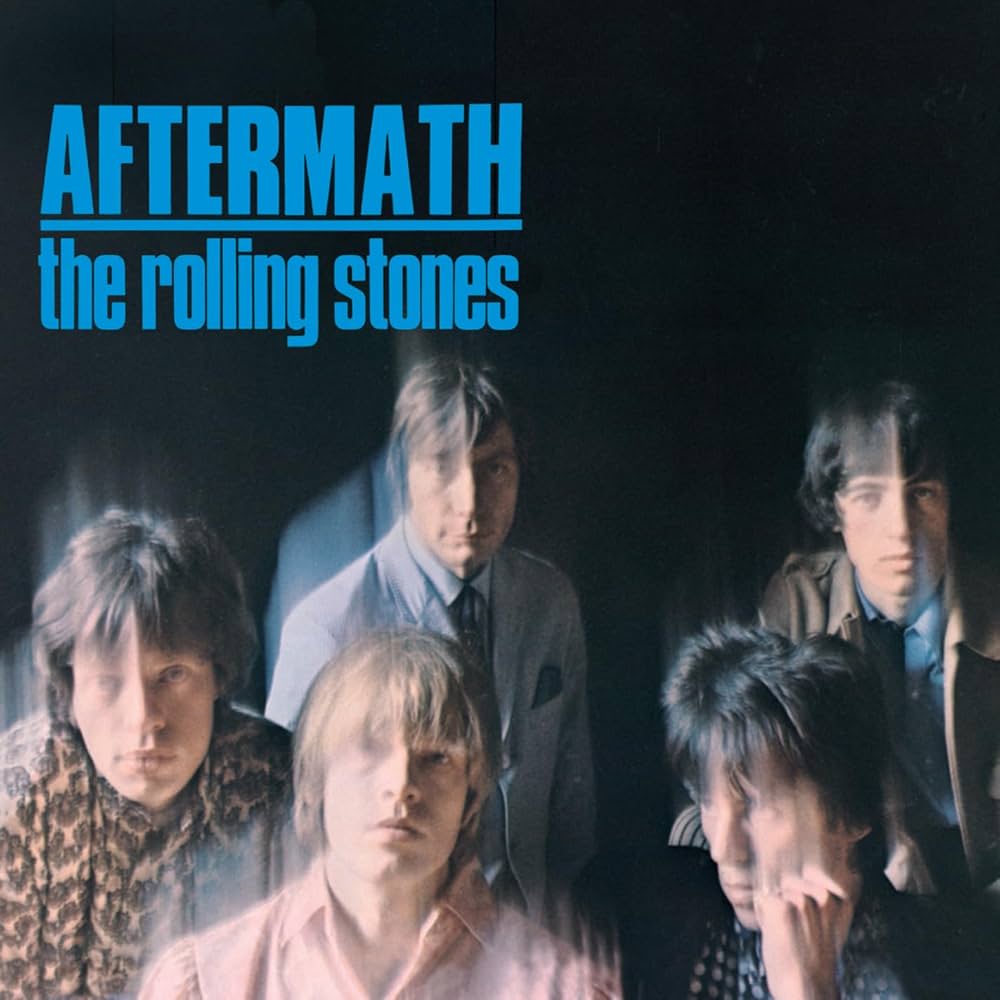
By 1966, the Rolling Stones had already established themselves as Britain’s most dangerous rock band. Their early records were rooted in Chicago blues, rhythm and blues, and Chuck Berry-style rock and roll, earning them comparisons to their American heroes while serving as the rebellious counterpart to the Beatles’ cleaner public image. Yet despite their growing success, much of their recorded output still leaned heavily on cover songs and familiar influences.
Aftermath changed that forever.
Released in April 1966 in the United Kingdom, it was the first Rolling Stones album composed entirely of original songs by Mick Jagger and Keith Richards. More than just a songwriting milestone, it marked the moment the band fully stepped out of their influences’ shadows and began developing a musical identity unlike anyone else’s.
Rather than simply writing blues-inspired rock songs, Jagger and Richards embraced folk, baroque pop, Eastern influences, country, psychedelia, and biting social commentary while Brian Jones expanded the group’s sonic palette with an astonishing collection of unconventional instruments. The result is an album that captures the Stones at the exact moment they transformed from an outstanding blues band into one of rock music’s most creative forces.
Although often overshadowed by later classics like Beggars Banquet, Let It Bleed, and Exile on Main St., Aftermath remains one of the most important turning points in the band’s remarkable career.
Album Overview
One of the album’s greatest strengths is its sense of discovery.
Every song feels like the band exploring new possibilities.
The blues remains an important foundation, but it no longer dictates every musical decision.
Instead, Aftermath constantly surprises.
Acoustic guitars.
Dulcimers.
Marimbas.
Sitars.
Harpsichords.
Unusual percussion.
Everything finds a place without making the album feel experimental simply for the sake of experimentation.
Brian Jones deserves enormous credit for much of this musical expansion.
Rather than functioning solely as the band’s guitarist, he becomes a one-man orchestra, adding colors and textures that dramatically broaden the Rolling Stones’ sound.
Lyrically, the album is equally adventurous.
Mick Jagger writes with increasing confidence, balancing satire, romance, frustration, arrogance, humor, and observation in ways that hint at the extraordinary songwriter he would soon become.
While the album occasionally feels longer than necessary, its willingness to embrace risk makes it one of the most fascinating records of the mid-1960s.
Songwriting
Aftermath represents the true beginning of the Jagger-Richards songwriting partnership.
No longer content to imitate American blues standards, they begin writing songs that sound unmistakably like the Rolling Stones.
“Mother’s Little Helper” opens the album with biting social commentary, examining prescription drug dependence among suburban housewives with surprising wit and little sympathy.
“Lady Jane” introduces Renaissance-inspired melodies and delicate instrumentation that reveal an entirely different side of the band.
“Under My Thumb” remains one of the album’s defining tracks, built around an unforgettable marimba riff and one of the Stones’ strongest grooves. Its lyrics have inspired decades of debate, but its musical brilliance remains undeniable.
“Out of Time” combines soulful melodies with sharp emotional observations, while “I Am Waiting” explores folk influences through one of the album’s most beautiful arrangements.
The sprawling “Goin’ Home” deserves special recognition.
Stretching beyond eleven minutes, it became one of the first extended rock jams ever released on a major studio album. Although later artists would push improvisation much further, the track represented a bold step toward expanding the possibilities of rock music.
Throughout the album, Jagger and Richards display remarkable growth.
The melodies become stronger.
The lyrics become sharper.
The arrangements become increasingly adventurous.
The songwriting partnership that would define classic rock truly begins here.
Performance
Every member of the Rolling Stones contributes significantly to the album’s success.
Mick Jagger sounds increasingly comfortable as both a vocalist and frontman.
His confidence has grown dramatically since the band’s earliest recordings.
Whether delivering sarcastic observations or vulnerable ballads, he controls each performance with remarkable charisma.
Keith Richards continues evolving into one of rock’s great rhythm guitarists.
Rather than chasing flashy solos, he focuses on riffs, groove, and feel.
Many of the album’s strongest moments owe as much to his rhythmic playing as to its melodies.
Brian Jones may be the album’s secret weapon.
His mastery of numerous instruments transforms nearly every arrangement.
The marimba on “Under My Thumb.”
The dulcimer on “Lady Jane.”
The sitar on “Paint It, Black” would soon follow shortly afterward on the American edition.
His contributions make Aftermath one of the most sonically adventurous albums of its era.
Bill Wyman’s bass playing remains understated but consistently effective, while Charlie Watts once again proves why he ranks among rock’s finest drummers.
His swing, restraint, and impeccable timing anchor even the album’s most adventurous moments.
Production
Produced by Andrew Loog Oldham, Aftermath successfully balances experimentation with accessibility.
The production remains relatively straightforward compared to the psychedelic excesses that would soon dominate rock music, yet there is far greater attention to instrumental texture than on previous Stones records.
Every instrument occupies its own space.
Acoustic and electric guitars blend naturally.
Percussion remains crisp.
Vocals stay prominent without overwhelming the arrangements.
Perhaps most impressive is the clarity with which Brian Jones’ many instrumental contributions are presented.
Each unusual sound feels purposeful rather than gimmicky.
While later Rolling Stones albums would benefit from more sophisticated recording techniques, Aftermath possesses an immediacy that perfectly suits the band’s restless creativity.
Standout Tracks
Although the album is remarkably consistent, several songs rank among the defining recordings of the Rolling Stones’ early career.
“Mother’s Little Helper” opens the album with sharp social commentary, infectious melodies, and one of the band’s cleverest early lyrics.
“Under My Thumb” remains a masterpiece of rhythm and arrangement, pairing Brian Jones’ unforgettable marimba with one of Mick Jagger’s most confident vocal performances.
“Lady Jane” reveals an unexpectedly elegant side of the Stones, blending folk influences with Renaissance-inspired instrumentation into one of the band’s most beautiful early compositions.
“Out of Time” showcases the growing sophistication of the Jagger-Richards partnership through memorable melodies and emotional complexity.
“I Am Waiting” combines atmospheric production with outstanding songwriting, demonstrating just how quickly the band was expanding beyond its blues roots.
“Goin’ Home” deserves recognition for its ambition alone, anticipating the extended improvisational approach that would soon become common in rock music.
Weak Points
As historically important as Aftermath is, it occasionally reveals its transitional nature.
At nearly 54 minutes in its UK configuration, the album feels somewhat overlong, with a handful of songs not matching the brilliance of its strongest material.
Some lyrics also reflect attitudes toward women that feel dated and uncomfortable today, particularly when viewed outside their original cultural context.
Additionally, while “Goin’ Home” is undeniably groundbreaking, its extended runtime occasionally feels more historically significant than consistently compelling.
These shortcomings prevent Aftermath from reaching the absolute highest tier of Rolling Stones albums, but they do little to diminish its enormous artistic importance.
Legacy
Aftermath marks one of the most significant turning points in rock history.
It established Jagger and Richards as elite songwriters capable of filling an entire album with original material.
It expanded the Rolling Stones’ musical vocabulary beyond blues.
It demonstrated that rock bands could embrace unusual instrumentation without sacrificing commercial appeal.
Without Aftermath, it is difficult to imagine the creative breakthroughs that followed.
Between the Buttons.
Beggars Banquet.
Let It Bleed.
Sticky Fingers.
Exile on Main St.
All owe something to the confidence the band discovered here.
The album also stands as Brian Jones’ finest hour within the Rolling Stones.
His musical imagination shapes nearly every track, leaving an artistic legacy that often receives less recognition than it deserves.
Today, Aftermath remains essential listening—not simply because of its historical importance, but because its songs continue to sound inventive, energetic, and unmistakably alive.
Final Score: 9.5/10
Aftermath is the album where the Rolling Stones truly became the Rolling Stones. By abandoning cover songs and embracing entirely original material, they discovered a creative identity that would define rock music for decades. Outstanding songwriting, adventurous arrangements, inspired performances, and Brian Jones’ remarkable instrumental contributions combine to create one of the most important albums of the 1960s.
While its length and a handful of uneven moments keep it just shy of absolute perfection, its influence and artistic ambition are impossible to overstate. The album captures a legendary band in the middle of a breathtaking creative leap, laying the groundwork for one of the greatest runs of albums in rock history.
Overshadowed only by the masterpieces that followed, Aftermath remains an essential chapter in the Rolling Stones’ evolution and one of the finest rock albums of its era.
This post has already been read 48 times!