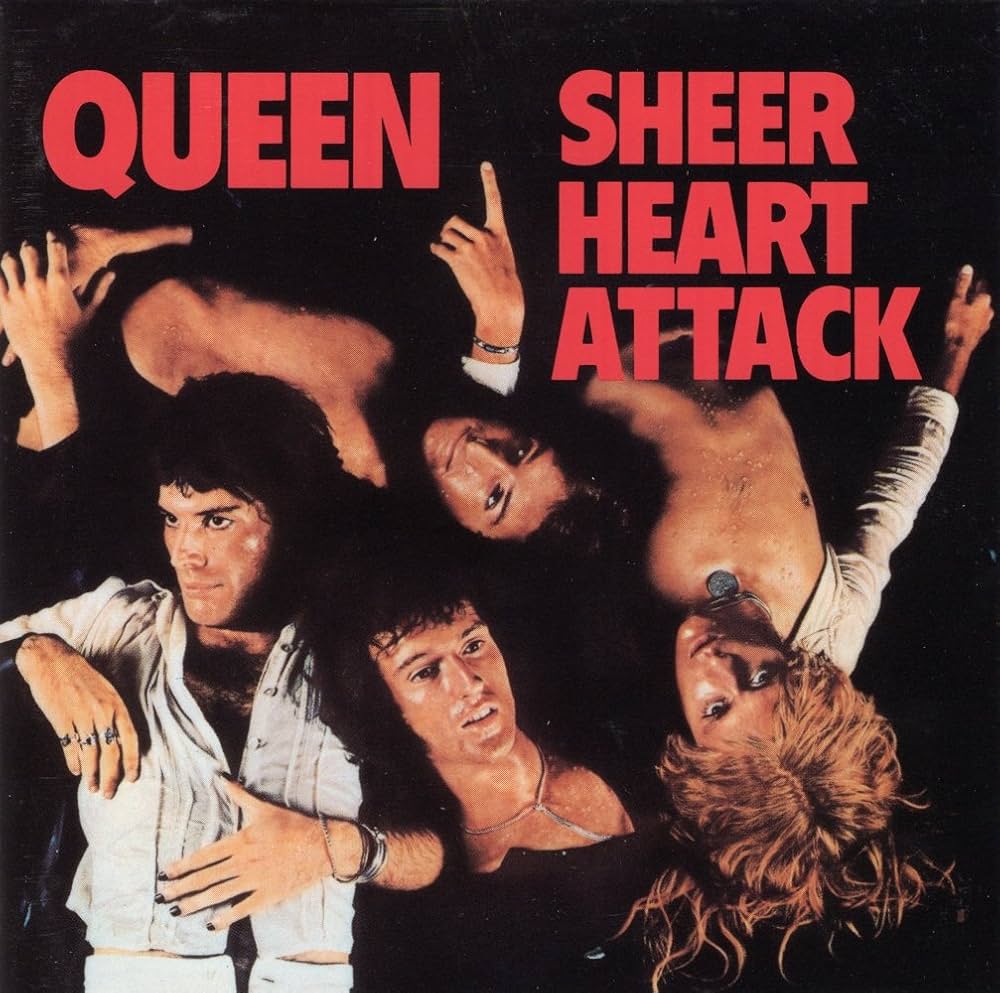
Before A Night at the Opera made Queen international superstars, there was Sheer Heart Attack. Released in 1974, the band’s third album captures Freddie Mercury, Brian May, Roger Taylor, and John Deacon at the exact moment their extraordinary ambition finally caught up with their equally remarkable talent. While the first two Queen albums established the group’s flair for hard rock and progressive arrangements, Sheer Heart Attack broadened their musical vocabulary dramatically, introducing glam rock, music hall, pop, heavy metal, folk, and even proto-punk influences into a dazzlingly eclectic collection of songs.
The album also arrived under difficult circumstances. Brian May was hospitalized with hepatitis during part of the recording sessions, forcing the band to adapt their working methods. Rather than slowing them down, the challenge seemed to inspire even greater creativity. Every member contributed memorable material, and the band emerged sounding more adventurous, more confident, and more unmistakably like Queen than ever before.
Although it is often overshadowed by the legendary albums that followed, Sheer Heart Attack is arguably the record where Queen truly became Queen. It contains some of their finest early songwriting, their most adventurous arrangements to date, and enough stylistic variety to hint at the limitless possibilities that lay ahead.
It remains one of the essential rock albums of the 1970s.
Album Overview
One of the album’s greatest achievements is its fearless diversity.
Most bands would struggle to make such wildly different musical styles coexist.
Queen makes it sound effortless.
Heavy guitar rock sits beside delicate acoustic ballads.
Vaudeville-inspired piano songs lead into blistering hard rock.
Complex vocal harmonies blend naturally with straightforward pop melodies.
Despite this variety, Sheer Heart Attack never feels unfocused.
Every song reflects the personalities of the four musicians.
Freddie Mercury’s theatrical imagination.
Brian May’s melodic guitar work.
Roger Taylor’s explosive energy.
John Deacon’s understated sophistication.
Together they create an album that constantly surprises while maintaining remarkable cohesion.
The pacing is exceptional.
The record rarely stays in one mood for long.
Just as listeners become comfortable, Queen shifts direction entirely.
Those dramatic contrasts become one of the album’s defining strengths.
Songwriting
By their third album, Queen had become one of rock’s most versatile songwriting teams.
Freddie Mercury contributes several of the album’s defining moments.
“Killer Queen” remains one of the finest pop songs of the decade, combining witty lyrics, unforgettable melodies, and extraordinary vocal arrangements into a perfectly constructed masterpiece.
“Flick of the Wrist” balances theatrical drama with biting social commentary, while “Lily of the Valley” provides one of Mercury’s most beautiful piano ballads.
Brian May’s “Now I’m Here” captures the excitement of the band’s growing success through one of the album’s strongest guitar-driven performances.
“Brighton Rock” opens the album with remarkable ambition, featuring one of May’s earliest extended guitar showcases.
Roger Taylor’s title track deserves special recognition.
“Sheer Heart Attack,” although not completed until the following album, anticipated much of punk rock’s aggressive energy years before the genre formally emerged.
John Deacon contributes “Misfire,” demonstrating the melodic instincts that would later produce classics like “You’re My Best Friend” and “Another One Bites the Dust.”
Perhaps most impressive is the consistency.
There is no filler.
Every songwriter brings something valuable.
Every composition expands the album’s musical world.
Performance
Few bands have ever displayed chemistry equal to Queen during their creative peak.
Freddie Mercury delivers one of the strongest vocal performances of his career.
His extraordinary range allows him to move effortlessly between delicate ballads, aggressive hard rock, and sophisticated pop.
More importantly, he understands exactly what each song requires.
Brian May remains one of rock’s most distinctive guitarists.
His soaring tone, lyrical phrasing, and orchestral approach to overdubbing transform even relatively simple arrangements into something far grander.
His solo during “Brighton Rock” remains one of the album’s defining moments.
Roger Taylor contributes exceptional drumming throughout.
His explosive playing drives the heavier material while displaying remarkable restraint during quieter songs.
His powerful backing vocals also become an essential component of Queen’s signature sound.
John Deacon’s bass playing quietly anchors the entire album.
His melodic approach allows the increasingly elaborate arrangements to remain grounded.
Together, the four musicians perform with astonishing precision.
No matter how ambitious the music becomes, they never lose sight of melody or groove.
Production
Produced by Queen and Roy Thomas Baker, Sheer Heart Attack represents a major leap forward in the band’s studio development.
The layered vocal harmonies become increasingly sophisticated.
Guitar overdubs expand the arrangements without overwhelming them.
Every instrument remains clearly defined.
The production constantly balances complexity with clarity.
Whether presenting delicate acoustic passages or thunderous rock anthems, the recording never becomes cluttered.
The album also demonstrates growing confidence in the studio as an instrument.
Sound effects.
Multi-tracked vocals.
Dynamic shifts.
Everything serves the songs rather than existing merely for spectacle.
Many of the production techniques perfected here would later reach even greater heights on A Night at the Opera.
Their foundations are already firmly in place.
Standout Tracks
Although the album contains remarkable consistency throughout, several songs rank among Queen’s greatest achievements.
“Brighton Rock” opens the album with breathtaking ambition, combining hard rock, intricate harmonies, and one of Brian May’s most memorable guitar showcases.
“Killer Queen” is one of the greatest pop-rock songs ever written. Its elegant melody, clever lyrics, and flawless arrangement announced Queen as one of the world’s most exciting bands.
“Now I’m Here” delivers one of the album’s most powerful rock performances, driven by Brian May’s unforgettable guitar work and Freddie Mercury’s commanding vocals.
“Flick of the Wrist” showcases Queen’s theatrical side while maintaining tremendous emotional intensity and musical sophistication.
“Stone Cold Crazy” deserves special recognition for its blistering speed and aggression, anticipating elements of thrash metal more than a decade before the genre emerged.
Weak Points
The album’s extraordinary stylistic diversity occasionally prevents it from achieving the seamless conceptual flow of some later Queen albums.
A handful of shorter songs feel more like brilliant sketches than fully developed compositions.
Listeners expecting straightforward hard rock may also find the frequent stylistic shifts initially disorienting.
These are relatively minor observations.
If anything, the album’s willingness to embrace so many different musical ideas became one of Queen’s defining characteristics.
Legacy
Sheer Heart Attack marked Queen’s breakthrough into international success and established the creative formula that would soon produce some of rock’s greatest albums.
It demonstrated that the band could combine technical brilliance, commercial songwriting, theatrical ambition, and fearless experimentation without sacrificing accessibility.
Its influence stretches across hard rock, glam rock, heavy metal, progressive rock, power pop, and even punk.
“Stone Cold Crazy” has been cited by countless metal musicians as an important influence, while “Killer Queen” remains one of the defining singles of the 1970s.
More importantly, the album proved that Queen could accomplish virtually anything stylistically.
There were no musical boundaries they seemed unwilling—or unable—to cross.
That creative fearlessness would define the remainder of their remarkable career.
Final Score: 9.5/10
Sheer Heart Attack is the album where Queen’s limitless ambition truly came into focus. Combining extraordinary songwriting, dazzling performances, adventurous production, and fearless stylistic experimentation, it captures one of rock’s greatest bands on the verge of worldwide superstardom.
While it lacks the singular cultural impact of A Night at the Opera, many of the qualities that made that album legendary first appear here in fully realized form. Every member contributes memorable material, the musicianship is exceptional throughout, and the sheer variety of ideas remains astonishing even decades later.
Overshadowed only by the masterpieces that followed, Sheer Heart Attack stands as one of the finest rock albums of the 1970s and an essential chapter in Queen’s extraordinary catalog.
This post has already been read 48 times!