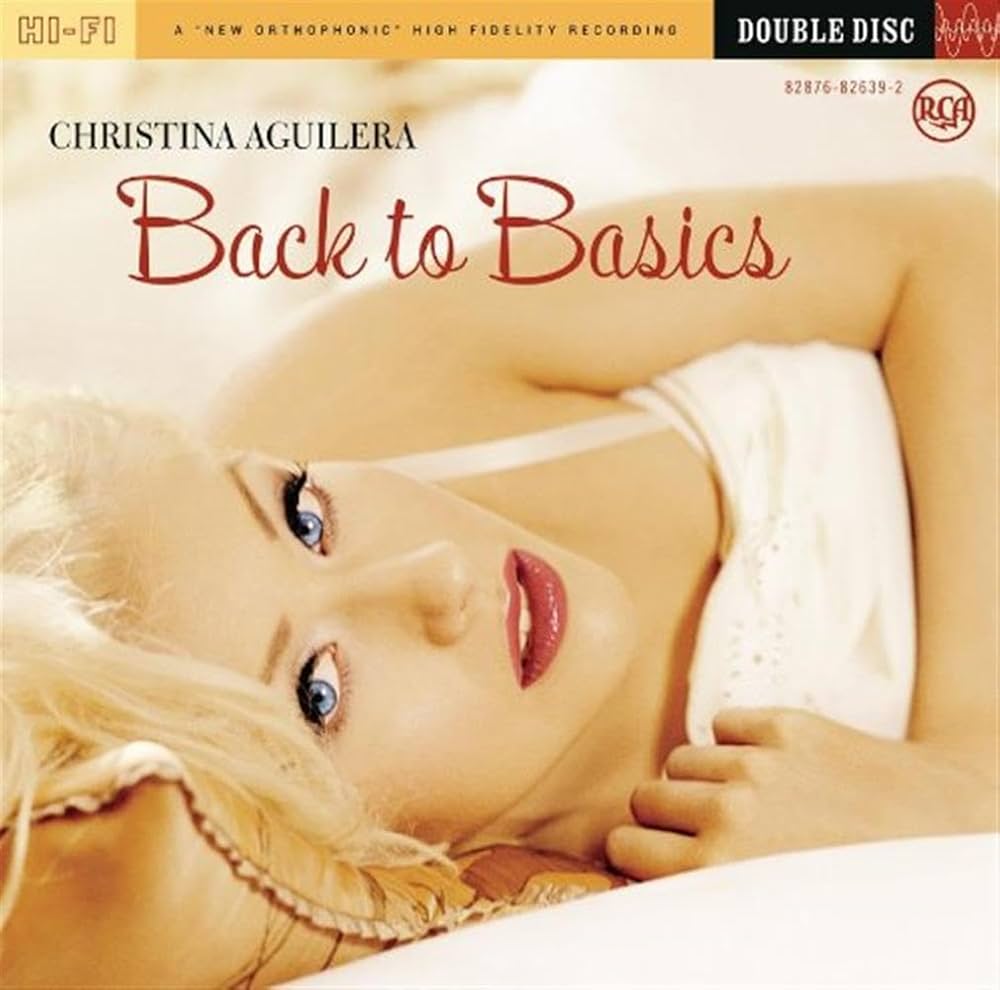
By 2006, Christina Aguilera had nothing left to prove as a vocalist. Since emerging alongside Britney Spears, Jessica Simpson, and Mandy Moore during the late 1990s teen-pop explosion, she had steadily separated herself from her peers through sheer vocal ability. Her 2002 album Stripped showcased a newfound artistic independence and helped redefine her public image, but it also raised an important question: where could she go next?
Instead of chasing contemporary pop trends, Aguilera looked backward.
Released on August 11, 2006, Back to Basics is an ambitious double album inspired by jazz, blues, soul, swing, gospel, and early rhythm and blues. Drawing influence from legends such as Etta James, Billie Holiday, Otis Redding, and Marvin Gaye, Aguilera attempted something few mainstream pop stars were willing to try—combining vintage musical traditions with modern production techniques.
The result is one of the most ambitious projects of her career.
At its best, Back to Basics successfully bridges generations, paying tribute to classic American music while remaining firmly rooted in 21st-century pop. At its weakest, its enormous scope occasionally works against it. Even so, the album stands as an impressive artistic statement from one of pop music’s finest vocalists.
Album Overview
Divided into two distinct discs, Back to Basics explores two complementary musical directions.
The first half, largely produced by DJ Premier, Mark Ronson, and others, builds contemporary pop songs around vintage jazz, blues, and soul samples. Old recordings are chopped, looped, and transformed into modern beats that still retain the warmth of their original performances.
The second disc moves toward fuller live instrumentation, embracing orchestral arrangements, big-band influences, gospel choirs, and classic soul production. The transition creates the feeling of two related but distinct albums housed within one package.
Throughout both halves, Aguilera’s voice remains the central attraction.
The production is consistently rich, blending brass sections, pianos, strings, horns, live drums, and modern programming into arrangements that often sound lavish without becoming overwhelming.
The biggest challenge is length.
With over twenty songs and nearly eighty minutes of music, Back to Basics demands a considerable time commitment.
Songwriting
Aguilera demonstrates impressive growth as both a songwriter and interpreter.
“Intro (Back to Basics)” and “Makes Me Wanna Pray” immediately establish the album’s vintage aesthetic with gospel influences and lush production.
“Ain’t No Other Man” explodes with energy. Built around a brilliantly sampled horn arrangement, it remains one of Aguilera’s finest singles and one of the defining pop songs of the 2000s.
“Understand” reveals a more restrained emotional side, while “Slow Down Baby” channels retro swing with infectious enthusiasm.
“Oh Mother” stands among Aguilera’s most personal recordings, offering a heartfelt reflection on family and resilience.
“Hurt” provides one of the album’s emotional high points. Its dramatic orchestration and soaring vocal performance make it one of her greatest ballads.
“Candyman” injects playful big-band energy into the second half of the album. Inspired by the Andrews Sisters, it demonstrates Aguilera’s willingness to fully embrace the vintage concept while maintaining mainstream appeal.
Tracks like “Mercy on Me,” “Without You,” and “The Right Man” continue showcasing her remarkable vocal range and stylistic versatility.
Unfortunately, the album’s consistency suffers somewhat because of its size. Several songs are enjoyable but don’t quite justify the project’s expansive running time.
Performance
Few pop singers possess Christina Aguilera’s technical ability.
Throughout Back to Basics, she demonstrates extraordinary control, power, range, and emotional expression. Whether belting over brass sections or delivering delicate ballads, she remains completely in command of every performance.
At times, however, Aguilera’s greatest strength becomes a slight weakness.
She occasionally favors vocal acrobatics where greater restraint might have served the songs more effectively. While her impressive runs and sustained notes are undeniably remarkable, some performances feel designed to showcase technique rather than emotional intimacy.
Fortunately, songs like “Hurt” and “Oh Mother” strike an excellent balance between technical brilliance and genuine feeling.
The musicians throughout the album also deserve recognition. Live horns, strings, pianos, choirs, and rhythm sections contribute enormously to the record’s authentic atmosphere.
Production
The production is among the album’s greatest achievements.
DJ Premier, Mark Ronson, Linda Perry, and the other producers successfully blend vintage samples with contemporary pop production without allowing either influence to dominate.
The arrangements consistently sound rich and expensive. Horn sections burst from the speakers, pianos resonate naturally, and orchestral elements provide cinematic grandeur throughout the second half.
Unlike many retro-inspired albums that merely imitate older styles, Back to Basics actively modernizes its influences.
Even twenty years later, much of the production continues to sound fresh because it emphasizes timeless instrumentation rather than fleeting studio trends.
Standout Tracks
“Ain’t No Other Man”
One of Aguilera’s greatest singles. Bold, infectious, and vocally spectacular.
“Hurt”
A stunning power ballad featuring one of the finest vocal performances of her career.
“Candyman”
Playful, energetic, and brilliantly executed, it perfectly captures the album’s vintage inspiration.
“Oh Mother”
An emotionally honest ballad that demonstrates Aguilera’s maturity as both a vocalist and songwriter.
“Makes Me Wanna Pray”
A powerful opening statement that successfully introduces the album’s ambitious concept.
Weak Points
The album’s biggest flaw is unquestionably its length.
At nearly eighty minutes, Back to Basics contains enough excellent material for a superb single album, but several songs blur together during the second half. Trimming five or six tracks would have significantly strengthened the overall experience.
Aguilera’s occasional tendency to oversing also becomes more noticeable across such a lengthy project. While her vocal ability is extraordinary, moments of greater restraint might have created even stronger emotional impact.
Finally, the two-disc structure, while conceptually interesting, sometimes makes the album feel slightly uneven.
Legacy
Although it never achieved the cultural dominance of Stripped, Back to Basics remains one of Christina Aguilera’s most ambitious artistic achievements.
The album demonstrated that mainstream pop artists could successfully revisit classic American musical traditions without simply producing nostalgia. It also reinforced Aguilera’s reputation as one of the premier vocalists of her generation.
Songs like “Ain’t No Other Man,” “Hurt,” and “Candyman” continue to rank among her signature recordings, while the album itself has gained greater appreciation over time for its musical ambition and craftsmanship.
Many later artists exploring retro-inspired pop owe at least a small creative debt to Back to Basics, even if few matched its scale.
It may not be flawless, but it remains one of the more adventurous major-label pop releases of the 2000s.
Final Score: 8.5/10
Back to Basics is an ambitious, beautifully produced showcase for Christina Aguilera’s extraordinary voice. Its fusion of vintage jazz, blues, soul, and modern pop creates a distinctive musical identity, while standout songs like “Ain’t No Other Man,” “Hurt,” and “Candyman” rank among the best work of her career. The album’s excessive length and occasional tendency toward vocal overindulgence keep it from true greatness, but it remains one of the strongest and most adventurous mainstream pop albums of its decade.
This post has already been read 3 times!