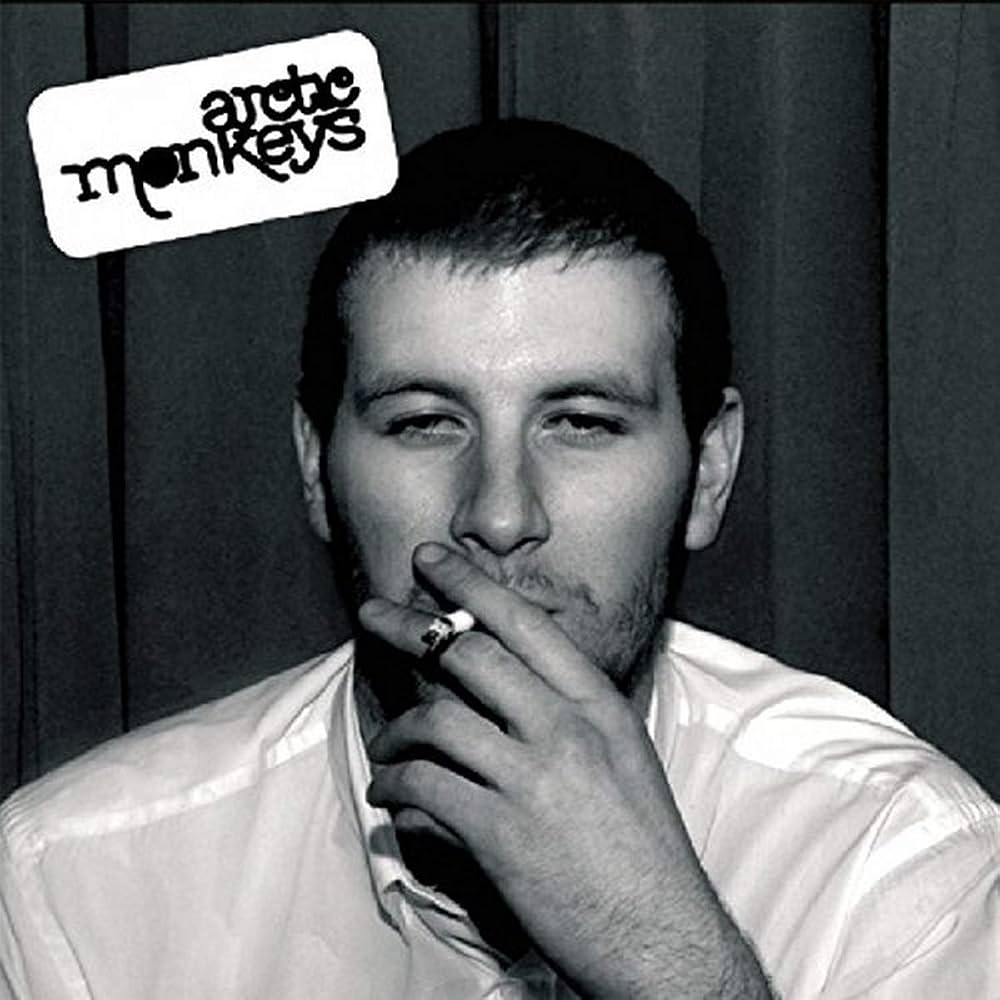
Few debut albums have arrived with as much anticipation—or delivered on it as completely—as Whatever People Say I Am, That’s What I’m Not. Released on January 23, 2006, the album became the fastest-selling debut in British chart history at the time, moving more than 360,000 copies in its first week. Yet the numbers only tell part of the story.
Arctic Monkeys were among the first bands to build a massive following through internet file sharing and social media rather than traditional music industry promotion. Fans traded homemade demos online, word spread rapidly, and by the time the band entered the studio, expectations were enormous. Instead of buckling under the pressure, the four young musicians from Sheffield delivered an album that captured everyday British nightlife with remarkable wit, energy, and authenticity.
What makes the record so enduring is its honesty. Alex Turner’s lyrics don’t romanticize youth or exaggerate its drama. He writes about taxi queues, bouncers, awkward conversations, cheap drinks, failed romances, and nights that rarely live up to expectations. Combined with razor-sharp observations and infectious garage-rock riffs, the result is one of the defining indie rock albums of the 2000s.
Nearly twenty years later, it remains a benchmark for modern British guitar music.
Album Overview
Produced by Jim Abbiss, Whatever People Say I Am, That’s What I’m Not wastes no time getting to the point.
The album is lean, direct, and remarkably efficient. Clocking in at just under forty-one minutes, there isn’t a wasted moment. Every song bursts with urgency, fueled by tight performances and Turner’s rapid-fire storytelling.
Musically, the record blends garage rock revival, post-punk revival, indie rock, and British guitar pop. While comparisons to The Strokes and Franz Ferdinand were inevitable at the time, Arctic Monkeys quickly establish their own identity through Turner’s distinctive songwriting and the band’s relentless energy.
The production wisely avoids over-polishing the material. Guitars retain their rough edges, the rhythm section feels punchy and immediate, and the band sounds like four musicians playing together in the same room rather than a heavily constructed studio project.
That rawness perfectly complements the subject matter.
Songwriting
Alex Turner’s songwriting is astonishing for a 20-year-old.
“The View from the Afternoon” opens the album with frantic energy, immediately introducing Turner’s gift for vivid storytelling and memorable hooks.
“I Bet You Look Good on the Dancefloor” became an instant classic. Its explosive riff, clever lyrics, and unstoppable momentum made it one of the defining indie singles of the decade.
“Fake Tales of San Francisco” delivers a witty critique of musicians trying too hard to appear authentic, showcasing Turner’s observational humor.
“Dancing Shoes” captures youthful anticipation with remarkable precision, while “You Probably Couldn’t See for the Lights but You Were Staring Straight at Me” combines an unforgettable title with equally memorable songwriting.
The album’s emotional center arrives with “Mardy Bum,” a charming and surprisingly tender portrait of a relationship built on everyday frustrations. It remains one of the band’s most beloved songs.
“When the Sun Goes Down” shifts toward darker territory, using cinematic storytelling to examine life on Sheffield’s streets without becoming sensationalized.
“A Certain Romance” provides one of the finest closing tracks of the 21st century. Beginning as a sharp social observation before evolving into an uplifting instrumental finale, it perfectly summarizes the album’s affection for the flawed world it portrays.
Remarkably, there is virtually no filler.
Performance
Alex Turner immediately establishes himself as one of Britain’s finest lyricists.
His rapid vocal delivery fits naturally within the songs, and his unmistakable Sheffield accent gives every story additional authenticity. Rather than chasing polished vocal perfection, Turner prioritizes personality and narrative.
Jamie Cook’s guitar work emphasizes memorable riffs over technical showmanship. His interplay with bassist Andy Nicholson creates much of the album’s relentless forward momentum.
Matt Helders deserves special recognition.
His drumming is exceptional throughout the record, combining punk energy with funk-inspired precision. His inventive fills and dynamic playing elevate nearly every song, making him one of indie rock’s most underrated drummers.
Collectively, the band performs with remarkable confidence for a debut album.
They already sound like a fully formed unit.
Production
Jim Abbiss deserves considerable credit for recognizing that these songs required immediacy rather than perfection.
The production captures the excitement of Arctic Monkeys’ live performances without sacrificing clarity. Every instrument occupies its own space while retaining enough grit to preserve the band’s youthful energy.
Importantly, the album avoids many production trends that quickly dated mid-2000s indie rock.
Instead, it relies on strong performances, natural dynamics, and straightforward arrangements.
As a result, Whatever People Say I Am, That’s What I’m Not still sounds remarkably fresh.
Standout Tracks
“I Bet You Look Good on the Dancefloor”
One of the defining indie rock singles of the 2000s. Explosive, witty, and endlessly exciting.
“A Certain Romance”
A spectacular closing track whose emotional depth and soaring finale make it one of the band’s greatest achievements.
“Mardy Bum”
A beautifully observed portrait of young love that balances humor, nostalgia, and genuine affection.
“When the Sun Goes Down”
Sharp storytelling and memorable melodies combine to create one of the album’s most compelling songs.
“The View from the Afternoon”
A thrilling opener that immediately announces Arctic Monkeys as a major new force in British rock.
Weak Points
Finding significant flaws is surprisingly difficult.
The album’s relentless pace leaves relatively little room for dynamic contrast, meaning some songs can blur together during casual listening. A quieter moment or two may have added additional emotional variety.
Additionally, some of the album’s cultural references are deeply rooted in British nightlife, meaning international listeners may occasionally miss certain nuances in Turner’s writing.
Neither criticism meaningfully diminishes the listening experience.
Legacy
Few debut albums have influenced British indie rock as profoundly as Whatever People Say I Am, That’s What I’m Not.
It helped redefine how new bands could build audiences through the internet, proved that observational storytelling remained commercially viable, and inspired an entire generation of guitar bands.
Alex Turner emerged as one of Britain’s greatest modern songwriters, while Arctic Monkeys continued evolving with each subsequent release rather than repeating themselves.
Although later albums such as AM achieved even greater international popularity, many fans still consider this debut the band’s finest artistic statement because of its immediacy, wit, and youthful authenticity.
Its influence remains unmistakable across indie rock today.
Final Score: 9.5/10
Whatever People Say I Am, That’s What I’m Not is one of the greatest debut albums in modern rock. Alex Turner’s brilliant songwriting, the band’s explosive performances, and Jim Abbiss’ perfectly restrained production combine to create an album that captures youth, nightlife, and everyday life with extraordinary clarity and humor. While its relentless energy occasionally leaves little room to breathe, the consistency of the songwriting and the sheer number of classic tracks make it an enduring masterpiece of 21st-century indie rock.
This post has already been read 48 times!