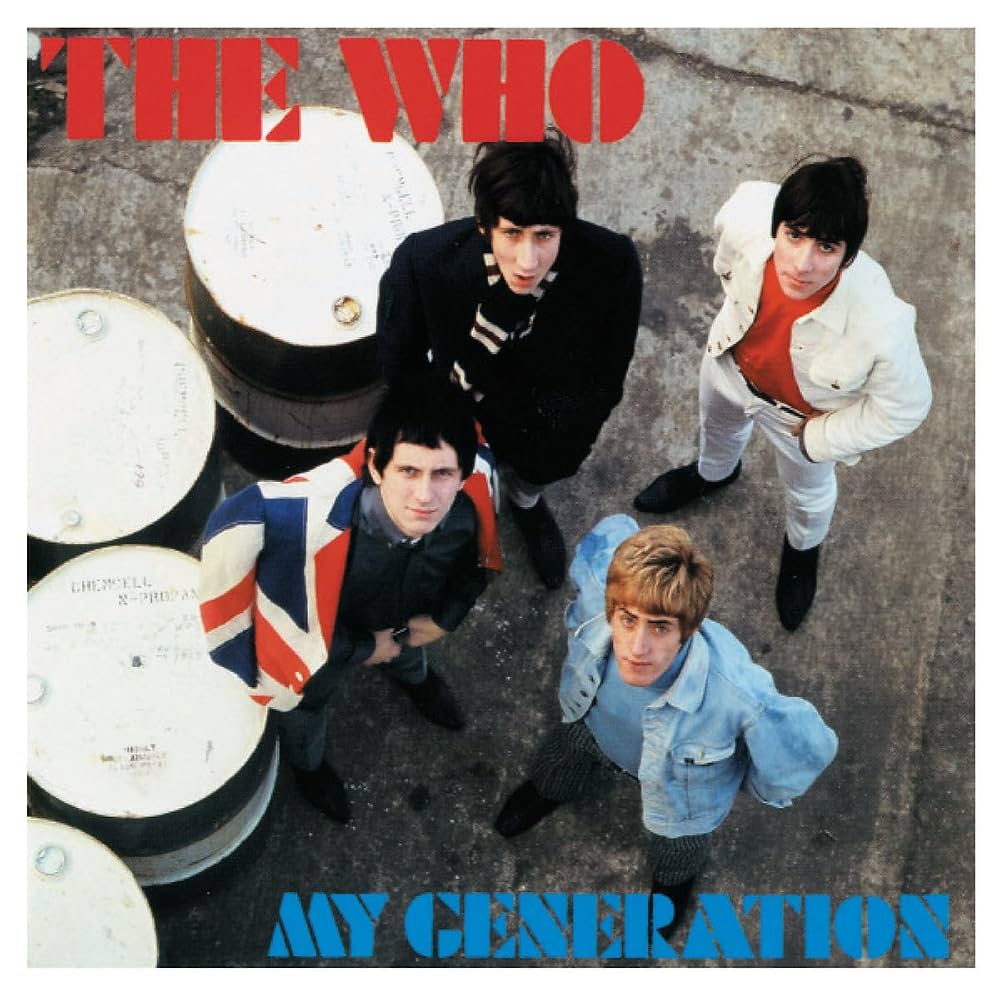
In late 1965, a four-piece band from London took the raw energy of American rhythm and blues, ran it through a wall of customized Marshall amplifiers, and systematically weaponized it against the British establishment. The Who’s debut album, My Generation, stands as a landmark achievement in the history of rock and roll—the precise moment where the polite, melodic sensibilities of the early-60s British Invasion were violently shoved aside by the destructive, feedback-drenched realities of Mod youth culture. Pete Townshend, Roger Daltrey, John Entwistle, and Keith Moon did not merely release a collection of pop songs; they recorded an aggressive, highly volatile sonic manifesto that captured the frustration, arrogance, and speed-fueled paranoia of working-class teenagers who felt entirely invisible to the post-war world.
The record remains a stunning achievement because it completely disrupted the established power dynamics of popular music. Up until this point, rock-and-roll bands were largely structured around a melodic singer and a prominent lead guitarist, with the rhythm section providing a steady, unobtrusive background frame. The Who completely inverted this blueprint. In their hands, every single instrument became a lead instrument, locked in a ferocious, near-constant state of musical civil war. My Generation is the document of a band teetering on the absolute edge of collapse, translating their internal personal friction into a brand new, highly influential sonic language that effectively laid down the structural foundations for punk rock, power pop, and heavy metal a decade before they had names.
The Cacophony of the Four-Headed Beast
To understand the sheer sonic violence of My Generation, one must look at the individual virtuosity and unhinged chemistry of the musicians involved. Under the calculating guidance of American producer Shel Talmy, the band recorded the tracks with an unprecedented level of volume and distortion, pushing the tube equipment of London’s IBC Studios into the red until the magnetic tape practically bled.
The opening track, “Out in the Street,” immediately establishes this sonic warfare. It begins with Pete Townshend’s jagged, percussive rhythm guitar playing, but it is instantly hijacked by Keith Moon’s explosive drum style. Moon did not play traditional rock beats; he played constant, rolling drum fills that traveled across his entire kit like a sequence of controlled explosions, ignoring the conventional boundaries of timekeeping. Alongside him, John Entwistle pioneered an entirely new way to play the bass guitar. Utilizing a custom set of wire-wound strings and playing with a hyper-aggressive, treble-heavy attack, Entwistle transformed the bass from a background timekeeper into a roaring, growling lead instrument that filled the sonic spaces traditionally reserved for a second guitarist.
This collective dissonance reaches its absolute, historic peak on the monolithic title track, “My Generation.” Built on a driving, call-and-response blues structure, the song serves as the ultimate anthem of teenage defiance. Roger Daltrey delivers his vocals with an inspired, rhythmic stutter—a brilliant stylistic choice meant to mimic the frustrated, amphetamine-fueled speech patterns of the London Mod scene. The song features not one, but multiple blazing bass solos from Entwistle, each one louder and more distorted than the last. As the track barrels toward its conclusion, Townshend’s guitar devolves into a wall of pure, avant-garde audio feedback, while Moon’s drumming disintegrates into a manic, tribal frenzy. It is the sound of a band actively destroying their instruments in the studio, a sonic representation of the stage auto-destruction that would soon make them infamous worldwide.
The R&B Roots and the Subversion of Pop
While the album is rightfully remembered for its aggressive, proto-punk title track, the remainder of the record reveals a band deeply indebted to American rhythm and blues, yet entirely desperate to twist those sounds into something far colder and more industrial.
The Who’s covers of James Brown’s “Please, Please, Please” and “I Don’t Mind” are fascinating, uncomfortable highlights of the album. Rather than attempting a smooth, faithful recreation of Brown’s soulful vocal delivery, Daltrey sings with a rough, distinctly British grit, while the band strips away the fluid swing of the original tracks, replacing it with a tense, mechanical rigidity. It was a fascinating cultural transmutation; they took the warm, emotional foundations of American soul music and ran them through the gray, rainy, asphalt reality of mid-60s London.
This tension between pop commercialism and underlying aggression defines Townshend’s original compositions across the record. Tracks like “The Kids Are Alright” are masterpieces of early power pop, featuring gorgeous, shimmering jangle-guitar chords and pristine, cascading vocal harmonies that rivaled The Beatles. Yet, beneath the bright, radio-friendly veneer lies a profound sense of paranoia and emotional alienation. The lyrics do not celebrate teenage romance; instead, they capture a fractured world of mistrust, codependency, and a desperate need for a safe space away from the adult world. Townshend was already proving himself to be a pop composer of immense psychological depth, pairing infectious melodies with a deep, underlying sense of existential anxiety.
The Industrial Blueprint of Power Pop and Metal
The back half of My Generation deepens the band’s sonic experimentation, showcasing an obsession with rhythmic propulsion and mechanical textures that was years ahead of its time. The instrumental track “The Ox,” named after Entwistle’s imposing nickname, is a terrifyingly heavy garage-rock workout that serves as a direct blueprint for the birth of heavy metal.
Driven by a pounding, frantic piano line from studio guest Nicky Hopkins, the track is a relentless, four-way sonic assault. Townshend drops all pretense of melody to deliver a barrage of scraping, industrial noise and heavily distorted power chords, while Entwistle’s bass growls like a chainsaw beneath Moon’s apocalyptic drum fills. The song moves with a terrifying, mechanical momentum, completely devoid of the polite blues-rock conventions that governed the era. It is a stunning display of pure sonic weight that proved The Who could out-groove, out-volume, and out-threaten any of their contemporaries on either side of the Atlantic.
Even on more conventional tracks like “It’s Not True” and “A Legal Matter,” the band maintains an underlying sense of cynical bite. “A Legal Matter,” which features Pete Townshend’s first lead vocal performance on a record, is a remarkably dark, uptempo song about fleeing a marriage to avoid legal and financial entrapment. It stands as a sharp, misanthropic contrast to the idealized, romantic pop singles dominating the charts in 1965, establishing The Who as a band that refused to peddle comfortable, sanitized illusions to their audience.
The Explosive Architecture of a New Era
The cultural fallout of My Generation permanently altered the trajectory of rock music, establishing a direct line of creative heredity that would eventually explode into the punk movement of the mid-1970s. The record’s absolute refusal to compromise on volume, its celebrate-your-own-flaws attitude, and its open embrace of teenage angst became the foundational tenets for bands like The Stooges, The Ramones, and The Sex Pistols.
Beyond its historical context, the album’s technical innovations revolutionized the music industry’s approach to recording and live performance. The Who’s demand for custom, high-powered amplification forced manufacturers to develop the massive amplifier stacks that defined the arena-rock era of the 1970s. They proved that distortion, feedback, and sonic chaos were not technical errors to be mixed out of a record; they were legitimate, deeply expressive artistic tools that could capture the volatile internal landscape of a generation in crisis.
Conclusion: The Timelessness of Teenage Rage
My Generation remains an extraordinary, white-hot artifact of rock history because it captures the pure, lightning-in-a-bottle energy of a band completely unconcerned with their own artistic survival. It is an album born out of an intense, immediate need to scream into the void before the youth culture that sustained them faded away.
It demands to be heard in its original, punchy, high-voltage mono format—the exact way it was engineered to blow out the cheap speaker systems of British teenagers in 1965. In an era where pop music was expected to be a polite, highly commercialized escape from reality, The Who delivered a raw, unvarnished mirror that reflected the sweat, the pills, the violence, and the desperate ambition of the London streets. It is an immaculate, chaotic monument to the necessity of youth rebellion—a timeless document of the exact moment popular music lost its innocence and found its teeth.
Final Score: 9.5 / 10
This post has already been read 54 times!