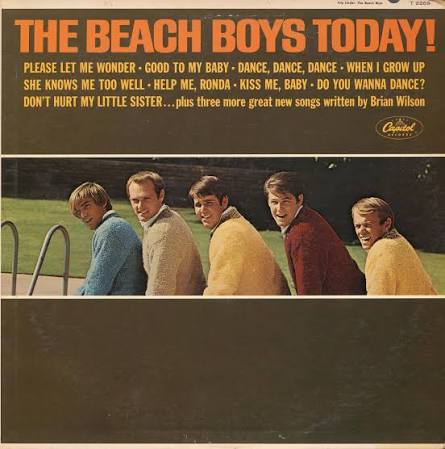
In March 1965, popular music was mutating at an uncontrollable velocity, but few anticipated that the most radical catalyst for change would emerge from the sunny, idealized world of Southern California surf culture. Prior to the release of The Beach Boys Today!, the band was primarily viewed by critics and the industry as a highly lucrative, beautifully harmonized singles machine—the ultimate soundtrack for a teenage utopia of hot rods, summer romance, and pristine coastlines. But beneath the commercial polish, twenty-two-year-old Brian Wilson was experiencing an existential and creative awakening. Overwhelmed by the psychological toll of the road, Wilson made the historic decision in late December 1964 to quit touring entirely, retreating into the sanctuary of Los Angeles’s finest recording studios while his bandmates headed out to play concerts.
The immediate fruit of that studio isolation was The Beach Boys Today!, an extraordinary, transitional masterpiece that effectively marks the birth of progressive pop music. It is a record explicitly split into two distinct emotional halves: a bright, rhythmically sophisticated A-side that elevated their traditional pop formulas to their absolute zenith, and a stark, deeply melancholic B-side consisting entirely of introspective, baroque ballads. By replacing the uncomplicated optimism of their early work with complex harmonic structures and vulnerable, adult psychological themes, Wilson did not just set the stage for Pet Sounds—he fundamentally redefined the studio album as an unified, high-art canvas capable of mapping the deepest fractures of the human psyche.
The Studio Sanctuary and the Wrecking Crew Blueprint
To understand the immense sonic leap executed on The Beach Boys Today!, one must look at how Brian Wilson transformed his workspace. No longer constrained by the necessity of writing songs that could be easily replicated by a four-piece band on a live stage, Wilson began treating Gold Star and Western Studios as his private laboratory. He took full command of the legendary collective of session musicians known as The Wrecking Crew, using their immense technical versatility to construct dense, symphonic textures that went far beyond the standard guitar-bass-drums framework of mid-sixties rock and roll.
Wilson’s arrangements on this record began to display an unprecedented obsession with instrumental layering and unusual tonal combinations. He began doubling basslines, pairing an acoustic upright bass with an electric bass to give the low-end an unprecedented, warm punch. He introduced autoharps, french horns, sleigh bells, oboes, and timpanis into traditional pop arrangements, weaving them together so tightly that the individual instruments dissolved into a singular, shimmering wall of sound.
This sophisticated studio control is immediately apparent in the album’s opening track, a explosive cover of Bobby Freeman’s “Do You Wanna Dance?” Rather than delivering a simple, straightforward rockabilly interpretation, Wilson transforms the song into a thundering, magnificent juggernaut. Driven by Dennis Wilson’s ferocious, heavy lead vocal, the track relies on a massive wall of percussion, multiple grand pianos, and acoustic guitars strumming in unison, creating an immense, physical momentum. The brightness of the track is counterbalanced by an underlying acoustic density that makes it feel heavy, almost overwhelming. Wilson was taking a lightweight dance standard and engineering it with the structural weight of a classical symphony.
Side One: The Apex of Sophisticated Pop Energy
The first half of the album functions as a masterclass in the evolution of upbeat pop craftsmanship, showcasing a band taking their signature vocal harmonies and pairing them with increasingly complex, jazz-inflected chord progressions. These tracks maintain the infectious energy that made the band famous, but they strip away the superficiality of the early surf singles in favor of a more mature, musically demanding framework.
The undeniable peak of this side is “Dance, Dance, Dance,” a track that features some of the most intricate rhythmic and harmonic interplay of the era. Co-written with Carl Wilson and Mike Love, the song opens with a brilliant, driving twelve-string guitar riff that immediately hooks the listener. As the track progresses, Wilson introduces an astonishing array of instrumentation, including a baritone saxophone, castanets, and a sleigh-bell rhythm that gives the song a joyous, driving holiday energy. The vocal arrangements are jaw-droppingly complex, utilizing rapid shifting leads, weaving contrapuntal backing vocals, and sudden modulations that challenge the ear while remaining completely accessible to the casual listener. It was a flawless realization of the power-pop blueprint, executed with a level of harmonic sophistication that left their contemporaries scrambling to keep pace.
This transitional energy extends to the original album version of “Help Me, Ronda” (later re-recorded as a smoother, chart-topping single). This early incarnation is looser, rougher, and possesses a fascinating, organic studio charm. Built around a bluesy acoustic guitar strum and a driving, percussive groove, the track showcases Al Jardine’s exceptional, earnest lead vocal. What makes this version notable is its extended, improvisational fade-out, where the musicians shout encouragement, clap, and play around the central melody, offering a rare glimpse into the communal, joyful spirit of Wilson’s tracking sessions right before his studio obsession turned entirely insular and solitary.
Side Two: The Masterpiece of Melancholy
If the first half of The Beach Boys Today! represents the ultimate refinement of the band’s initial pop era, the second half stands as an entirely new artistic paradigm. Consisting of five consecutive, heartbreakingly beautiful ballads, Side Two is a thematic suite that explores the anxieties, self-doubt, and profound emotional vulnerability of young adulthood. It is here that the ghost of Pet Sounds truly resides, as Wilson strips away all commercial pretense to craft a deeply personal, psychological diary.
The transition begins with the breathtaking “Please Let Me Wonder.” Written on the very night Wilson decided to cease touring, the song is a pristine monument to romantic vulnerability and fear of reality. The arrangement is extraordinarily delicate, built around a sparkling, muted guitar line, a soft organ bed, and the ethereal, ghostly wail of a distant horn. Wilson delivers the lead vocal in a fragile, hushed falsetto that feels incredibly intimate, as if he is whispering his deepest insecurities directly to the listener. When the band’s trademark harmonies swell behind him during the chorus—singing lines of profound harmonic suspension—the song achieves a state of pure, transcendent beauty. It is a song that explicitly begs for an illusion to remain unbroken, capturing the exact moment where the innocence of youth confronts the terrifying complexities of real love.
This emotional intensity deepens on “Kiss Me, Baby,” a agonizingly honest portrait of a late-night lovers’ quarrel. The song features a brilliant, shifting time signature and a bassline that moves with a heavy, jazz-like sophistication. The vocal counterpoint between Brian Wilson’s vulnerable lead and Mike Love’s deep, anchoring bass vocal creates an immense dramatic tension. The lyric captures the modern, adult reality of regret, as the narrator lies awake in the dark, desperately wishing to undo a foolish argument. The arrangement is dense with psychological weight, using French horns and subtle vibes to color the spaces between the vocals, creating a rich, nocturnal atmosphere that perfectly mirrors the lonely, insular nature of the lyric.
The Unresolved Depths of the Mind
The emotional climax of the album’s ballad suite arrives with “She Knows Me Too Well” and the hauntingly avant-garde closing track, “In the Back of My Mind.” These tracks push the psychological and musical boundaries of pop music into entirely uncharted territory, exploring dark themes of jealousy, paranoia, and existential dread.
In “She Knows Me Too Well,” Wilson delivers a shocking confession of male insecurity and emotional instability. The song bounces with a deceptive, mid-tempo rhythm, but the lyrics describe a narrator who is intensely jealous, insecure, and emotionally manipulative toward a lover who understands his flaws completely. The vocal harmonies are remarkably dense and sharp, hitting unexpected, dissonant chords that mirror the internal friction of the lyric. Wilson’s falsetto leaps across octaves, sounding both triumphant and deeply wounded, executing a level of raw, unvarnished emotional exposure that was completely unprecedented for a major pop release in early 1965.
The album draws to a formal close with “In the Back of My Mind,” a track that stands as one of the most radical, forward-thinking compositions of Brian Wilson’s entire career. Sung with immense, ragged soulfulness by Dennis Wilson, the song completely discards the traditional verse-chorus structure of popular songwriting. Instead, it is arranged like a sweeping, cinematic tone poem, driven by an unsettling, unresolving orchestral backing that includes sweeping strings, an oboe, a shifting jazz drum pattern, and a deep, mourning organ chord. The lyric is a terrifyingly mature meditation on the transience of happiness—a confession that even in moments of perfect love, the narrator is haunted by the underlying, existential fear that everything will eventually fall apart. It is a dark, breathtaking conclusion that left the bright world of surf music completely behind, stranded in the complex shadows of the modern human condition.
The Blueprint for the Concept Album Era
The cultural and historical fallout of The Beach Boys Today! permanently altered the structural DNA of the music industry. By organizing the album around a deliberate, curated emotional trajectory—culminating in a unified suite of thematic ballads—Wilson broke the established industry rule that pop albums were merely filler meant to support two hit singles.
This structural innovation directly paved the way for the landmark concept albums of the late 1960s. It was the record that signaled to peers like The Beatles, Bob Dylan, and Phil Spector that the album format could be used as a cohesive, long-form artistic statement. The rich, orchestral pop textures pioneered across Side Two became the foundational blueprint for the entire baroque-pop movement, directly influencing the mid-sixties work of acts like The Left Banke, The Zombies, and later generations of chamber-pop and indie artists from Elliott Smith to High Llamas. Wilson proved that pop music could harbor an immense, symphonic weight, using the recording studio not just to capture a song, but to manifest an entire internal universe.
Conclusion: The Horizon of Genius
The Beach Boys Today! remains an astonishing, vital masterpiece because it captures the precise, lightning-in-a-bottle moment of transformation. It is the sound of an artist outgrowing the very pop-star machinery that created him, utilizing the immense wealth and studio power at his disposal to dismantle the comfortable formulas of his youth and forge an entirely new, adult artistic vocabulary.
It demands to be heard in its original, punchy, high-fidelity monaural format—the exact way Brian Wilson mixed it to ensure that the dense orchestral layers and complex vocal harmonies functioned as a singular, unified force. In a historical landscape that often treats Pet Sounds as an isolated, miraculous anomaly, The Beach Boys Today! stands as the definitive, indispensable proof of the evolutionary process. It is a immaculate, emotionally devastating, and structurally flawless monument to the possibilities of popular song—a timeless document of the exact moment a boy left the beach behind and stepped into the horizon of pure genius.
Final Score: 9.5 / 10
This post has already been read 41 times!