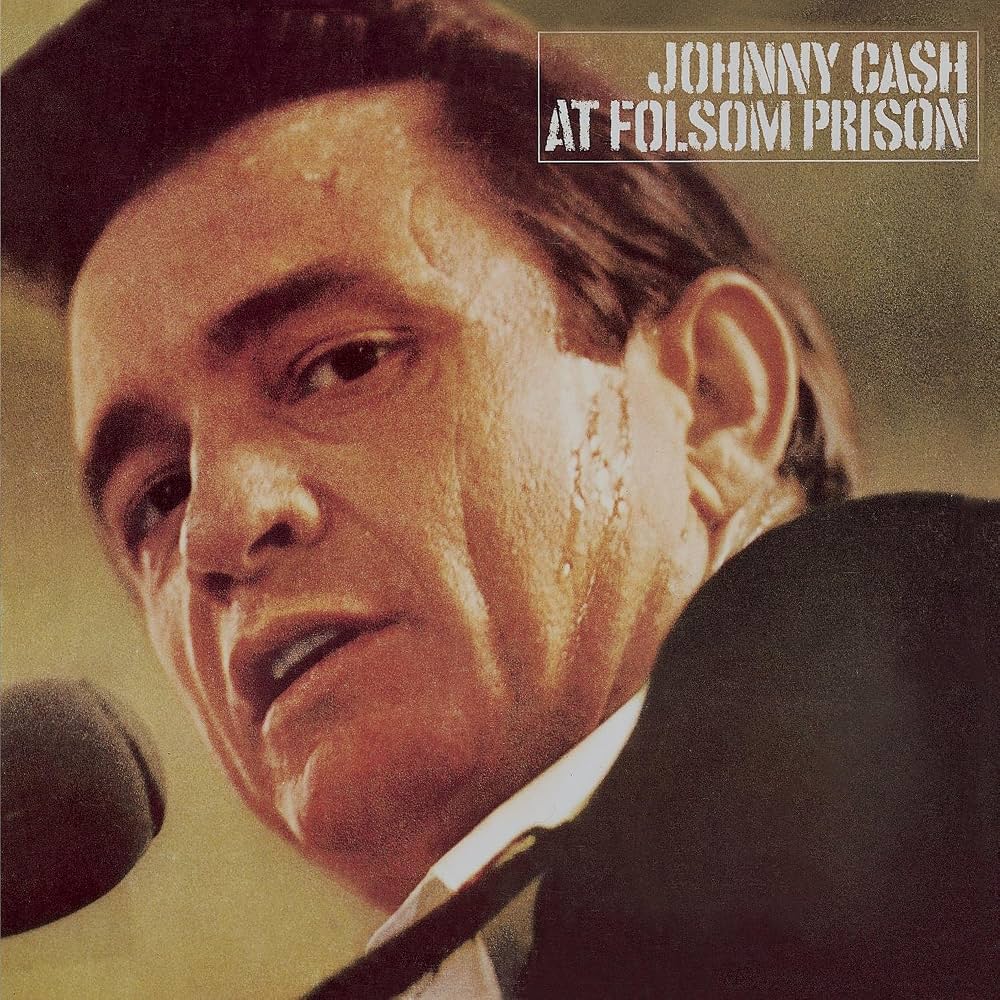
There are live albums, and then there are cultural landmarks. Johnny Cash’s At Folsom Prison, released in 1968, belongs firmly in the latter category. More than just a concert recording, it revitalized Cash’s struggling career, reshaped his public image, and became one of the defining albums in the history of country music.
By the late 1960s, Cash’s commercial momentum had begun to fade. Years of relentless touring, personal struggles, and substance abuse had taken their toll. Although he remained a respected figure, his chart success had slowed, and many wondered whether his best days were behind him. Then came an idea he had been considering for years: record a live album inside a prison.
On January 13, 1968, Cash and the Tennessee Three walked into California’s Folsom State Prison and delivered one of the greatest performances ever captured on tape. The setting was more than a gimmick. Cash had long identified with society’s outsiders, and his songs about prisoners, working people, and the forgotten members of society resonated deeply with the inmates. The audience responded with enthusiasm unlike anything heard on a typical live album, creating an atmosphere that remains electrifying nearly sixty years later.
At Folsom Prison isn’t simply Johnny Cash’s greatest live album.
It is one of the greatest live recordings ever made.
Album Overview
Few albums establish their atmosphere as quickly as At Folsom Prison.
Cash’s famous opening words—
“Hello, I’m Johnny Cash.”
—are among the most iconic introductions in music history.
From that moment forward, the performance never loses its momentum.
Unlike many live albums that simply recreate studio versions of familiar songs, At Folsom Prison feels alive.
The audience isn’t passive.
Their cheers.
Their laughter.
Their applause.
Their emotional reactions.
All become essential parts of the recording.
Cash instinctively understands his audience.
He knows when to joke.
When to sympathize.
When to let the songs speak for themselves.
The pacing is exceptional.
Up-tempo country numbers balance emotional ballads.
Humorous moments ease the tension before darker material arrives.
The result is a remarkably complete concert experience rather than merely a collection of performances.
Perhaps most importantly, the album feels authentic.
Nothing sounds manufactured.
Nothing feels staged.
Listeners aren’t simply hearing a performance.
They’re witnessing a genuine connection between artist and audience.
Songwriting
Cash had always excelled at selecting songs that reflected ordinary people’s struggles, and At Folsom Prison brings those themes into sharper focus than ever.
“Folsom Prison Blues” becomes something entirely different inside an actual prison.
Lines that once seemed like clever storytelling suddenly carry extraordinary emotional weight.
The inmates’ reaction to the famous lyric about shooting a man in Reno remains one of the most unforgettable moments in live recording history.
“Cocaine Blues” bursts with energy while continuing the album’s exploration of crime and consequence.
“Dark as the Dungeon” introduces a more reflective mood, honoring miners and the hardships of working-class life.
“25 Minutes to Go” balances gallows humor with remarkable storytelling.
“Greystone Chapel,” written by inmate Glen Sherley, becomes the emotional climax of the album.
Cash’s decision to perform the song demonstrates the empathy that made him such a beloved figure.
Throughout the concert, the songwriting consistently focuses on redemption rather than judgment.
Even the darkest stories contain traces of hope.
That humanity defines the album.
Performance
Johnny Cash delivers one of the finest performances of his remarkable career.
His deep baritone has never sounded more commanding.
Every lyric feels believable.
Every pause carries weight.
Every joke lands naturally.
Cash never overacts.
He simply tells stories.
The Tennessee Three provide the perfect musical foundation.
Luther Perkins’ distinctive guitar style had been central to Cash’s sound for years, and although Perkins had passed away before the album’s release, Carl Perkins joins the performance on several songs, while the remaining musicians maintain the group’s unmistakable rhythmic precision.
June Carter contributes warmth, humor, and chemistry whenever she appears, while the Statler Brothers add rich vocal harmonies that elevate several performances without overshadowing Cash himself.
What truly separates this performance from countless other live recordings is Cash’s relationship with his audience.
He never talks down to the inmates.
He never exploits them.
Instead, he treats them with dignity and respect.
That mutual understanding gives every performance unusual emotional depth.
Production
Producer Bob Johnston wisely keeps the production remarkably straightforward.
The prison itself becomes part of the recording.
Concrete walls create natural echoes.
Audience reactions remain prominent.
Applause and laughter are preserved rather than minimized.
Cash’s voice stays front and center throughout the mix.
The instruments remain clear without sacrificing the feeling of being inside the room.
Unlike many live albums that rely heavily on overdubs or post-production polishing, At Folsom Prison embraces its imperfections.
Those rough edges enhance the authenticity.
The recording still sounds immediate decades later.
Listeners feel present inside the prison auditorium.
Very few live albums create such a convincing sense of place.
Standout Tracks
Although every performance contributes to the album’s extraordinary impact, several songs stand among the defining moments of Cash’s career.
“Folsom Prison Blues” reaches its definitive version here. The interaction between Cash and the inmate audience transforms an already classic song into something legendary.
“Cocaine Blues” explodes with energy, demonstrating Cash’s remarkable ability to combine dark storytelling with irresistible momentum.
“25 Minutes to Go” delivers one of the album’s most entertaining performances, balancing humor and suspense through outstanding vocal delivery.
“Dark as the Dungeon” provides a moving tribute to working-class resilience, highlighting Cash’s extraordinary empathy as an interpreter.
“Greystone Chapel” closes the album on an unforgettable note, introducing the world to Glen Sherley’s songwriting while reinforcing the album’s themes of hope and redemption.
Weak Points
Finding meaningful weaknesses proves difficult.
The recording occasionally reflects the technical limitations of live recording equipment available in 1968.
Some audience noise briefly obscures instrumental details, while the setlist naturally favors Cash’s prison and outlaw material over other aspects of his catalog.
Listeners unfamiliar with classic country music may also find the arrangements relatively sparse compared to modern productions.
These observations do little to diminish the album’s extraordinary emotional power.
Its authenticity matters far more than technical perfection.
Legacy
Few albums have reshaped an artist’s career as dramatically as At Folsom Prison.
The album became a commercial triumph, returned Cash to the top of the charts, and permanently established him as country music’s voice for society’s outsiders.
Its influence extends well beyond country.
Rock.
Folk.
Americana.
Singer-songwriters across countless genres have drawn inspiration from Cash’s storytelling, honesty, and willingness to perform for audiences often ignored by mainstream entertainment.
The album also changed perceptions of live recordings.
Rather than serving as simple concert souvenirs, live albums could become defining artistic statements.
More than half a century later, At Folsom Prison remains the benchmark against which nearly every live country album is measured.
Its humanity has never faded.
Neither has its power.
Final Score: 10/10
At Folsom Prison is one of the greatest live albums ever recorded and one of the defining achievements of American music. Johnny Cash delivers a performance of extraordinary honesty, warmth, and authority, supported by outstanding musicians and one of the most engaged audiences ever captured on record.
Every aspect of the album succeeds. The songs gain new meaning within the prison setting, the performances surpass their studio counterparts, and the production preserves the raw authenticity of the occasion without unnecessary embellishment.
Only a handful of live albums permanently change both an artist’s career and the history of popular music. At Folsom Prison is one of those rare masterpieces—a timeless recording that demonstrates the transformative power of empathy, storytelling, and genuine human connection.
This post has already been read 65 times!