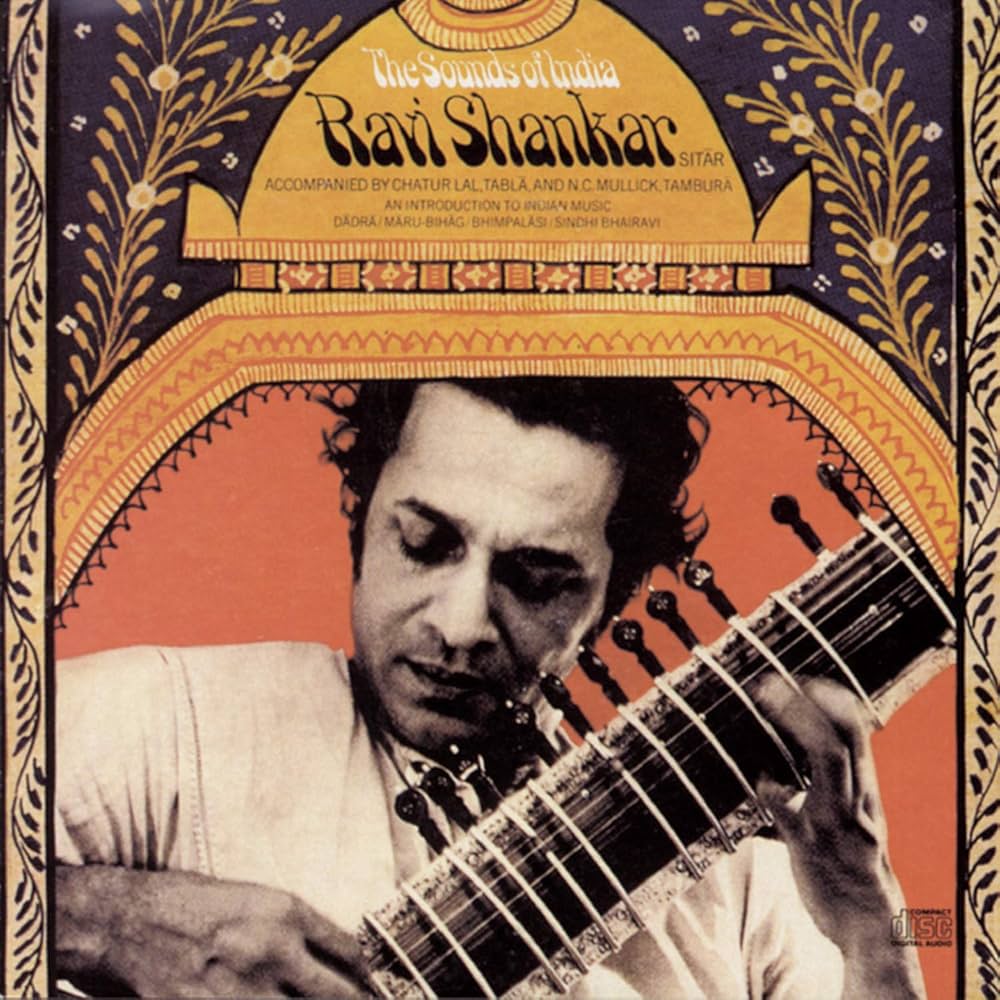
By the late 1950s, Indian classical music remained largely unfamiliar to Western audiences. While jazz, classical, and folk traditions had begun crossing cultural boundaries, the intricate ragas and rhythmic sophistication of Hindustani music were still considered mysterious to most listeners outside South Asia. That began to change with artists like Ravi Shankar, whose extraordinary musicianship and tireless dedication to education transformed him into one of the world’s most influential cultural ambassadors.
Released in 1958, The Sounds of India was designed to do more than simply present a collection of performances. Narrated by Ravi Shankar himself, the album serves as both an introduction to Indian classical music and a demonstration of its remarkable depth. Rather than assuming listeners already understood ragas, talas, or the roles of different instruments, Shankar patiently explains the traditions before allowing the music to speak for itself.
The result is one of the most accessible entry points into Indian classical music ever recorded. While later albums would showcase longer and more adventurous performances, The Sounds of India remains invaluable because it welcomes newcomers without compromising the authenticity of the tradition.
Decades later, it continues to stand as both an educational masterpiece and a captivating musical experience.
Album Overview
Unlike a conventional studio album, The Sounds of India functions almost like a guided musical lesson. Ravi Shankar introduces the instruments, explains the structure of Indian classical performance, and describes concepts that would have been unfamiliar to most Western audiences in the 1950s.
Far from interrupting the listening experience, these spoken introductions enhance it. By providing cultural and musical context, Shankar invites listeners to appreciate subtleties they might otherwise overlook.
The performances themselves are rooted firmly in the Hindustani classical tradition. The sitar remains the central voice, accompanied by the rich resonance of the tambura and the intricate rhythmic patterns of the tabla.
The pacing reflects the philosophy of Indian classical music rather than Western expectations. Instead of rushing toward climactic moments, the ragas develop gradually, allowing themes, rhythms, and emotions to unfold naturally.
Although the album was intended as an introduction, it never feels simplified. Shankar treats his audience with respect, trusting that curiosity and careful listening will reward them.
Songwriting
Applying Western ideas of songwriting to The Sounds of India requires a shift in perspective.
Rather than presenting fixed compositions with verses and choruses, the album explores ragas—melodic frameworks that provide the foundation for improvisation and emotional expression. Each raga carries its own mood, character, and traditional associations with particular times of day or seasons.
Shankar’s explanations help listeners understand that the beauty of the music lies not in predictable structures but in gradual development and spontaneous creativity.
The melodic ideas evolve patiently, often beginning with unaccompanied exploration before rhythm enters and the performance gains momentum.
Although the music follows centuries-old traditions, every performance feels fresh because improvisation plays such a central role. No two interpretations of a raga are ever exactly alike.
For listeners willing to embrace this different musical philosophy, the album reveals remarkable complexity and emotional richness.
Performance
Ravi Shankar’s playing throughout the album is extraordinary.
His command of the sitar is breathtaking, combining flawless technique with expressive subtlety. Fast passages display astonishing dexterity, yet he never allows virtuosity to overshadow the emotional character of the music.
Equally impressive is his sense of patience. Rather than rushing through melodic ideas, Shankar allows every phrase to breathe, gradually building tension and release with remarkable control.
The accompanying musicians deserve equal recognition. The tabla performances demonstrate incredible rhythmic precision while remaining remarkably conversational, responding naturally to every shift in Shankar’s improvisation.
The tambura provides the continuous harmonic foundation essential to Indian classical performance, creating a rich sonic landscape upon which the melodies unfold.
Perhaps the album’s greatest achievement is the sincerity with which Shankar presents his musical heritage. He performs not simply as a virtuoso but as a teacher eager to share an artistic tradition with new audiences.
Production
For a recording released in 1958, The Sounds of India remains remarkably clear and natural.
The production wisely emphasizes authenticity over embellishment. Every instrument is captured with warmth and detail, allowing listeners to appreciate the distinctive tonal qualities of the sitar, tabla, and tambura.
The balance between narration and music is handled exceptionally well. Shankar’s spoken explanations remain clear without feeling intrusive, while the performances retain their full emotional impact.
Unlike heavily produced studio recordings, the album preserves the intimacy of musicians performing together in the same space.
Modern remasters have enhanced the recording’s clarity while respecting its original character, making it easier than ever for contemporary audiences to experience the music as Shankar intended.
Standout Tracks
Because the album functions as a unified educational experience, individual highlights are closely connected to the broader presentation.
“An Introduction to Indian Music” provides one of the clearest explanations of Hindustani musical traditions ever recorded, making the subsequent performances far more rewarding.
The demonstrations of different ragas showcase Shankar’s remarkable ability to balance technical mastery with emotional communication.
The extended sitar performances reveal his extraordinary improvisational skills while allowing the accompanying tabla player to contribute equally compelling rhythmic ideas.
Throughout the album, the greatest highlight is Shankar’s gift for making an unfamiliar musical tradition feel welcoming rather than intimidating.
Every performance serves both artistic and educational purposes with equal success.
Weak Points
The Sounds of India is not without limitations, though most stem from its educational mission.
Listeners already deeply familiar with Indian classical music may find the introductory narration unnecessary, particularly on repeated listening.
Those expecting concise Western-style songs may also struggle with the gradual development of the ragas, which reward patience rather than immediate gratification.
Additionally, because the album is designed as an introduction, some performances are necessarily shorter and less expansive than those found on Shankar’s later recordings.
These are minor observations, however, and reflect the album’s purpose rather than genuine artistic shortcomings.
Legacy
The Sounds of India played a crucial role in introducing Indian classical music to Western audiences.
Long before Ravi Shankar became internationally famous through his collaborations and friendships with artists like George Harrison and The Beatles, this album demonstrated that Indian music could be appreciated by listeners with no previous exposure to the tradition.
Its educational approach influenced countless musicians, educators, and ethnomusicologists, proving that cultural exchange could occur without compromising artistic authenticity.
The album also helped lay the foundation for the growing interest in world music during the 1960s and beyond, inspiring generations of performers to explore musical traditions outside their own cultural backgrounds.
Today, The Sounds of India remains one of the finest introductory recordings ever produced for any musical tradition. It succeeds equally as a lesson, a cultural document, and a beautiful collection of performances.
Final Score
9.0/10
The Sounds of India is a remarkable introduction to one of the world’s richest musical traditions. Ravi Shankar combines extraordinary musicianship with genuine warmth as both performer and teacher, creating an album that remains informative, accessible, and deeply rewarding. While its educational format and introductory focus make it somewhat less expansive than some of Shankar’s later masterpieces, its cultural importance and consistently beautiful performances make it an essential recording for anyone interested in Indian classical music or the history of world music.