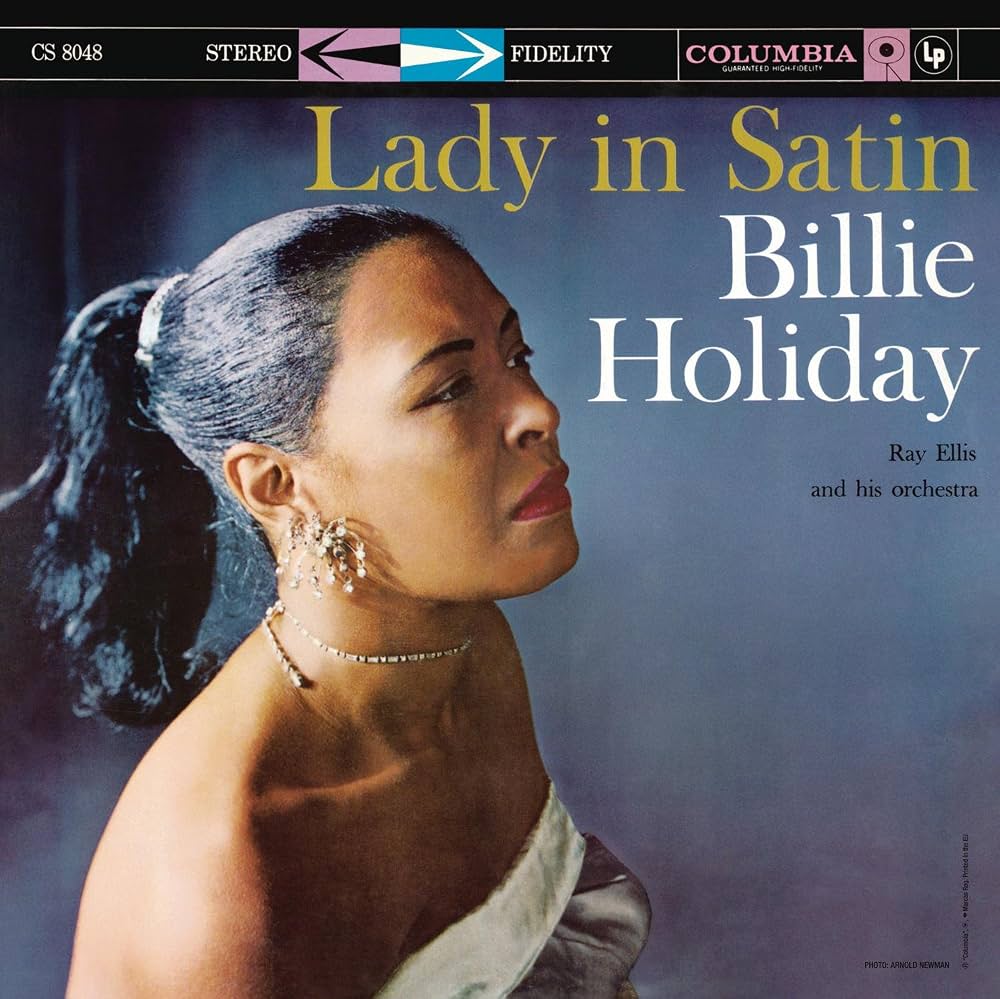
When Lady in Satin was released in 1958, Billie Holiday was nearing the end of a career that had forever changed the art of jazz singing. The voice that had captivated audiences in the 1930s and 1940s had been profoundly altered by years of personal hardship, declining health, and substance abuse. Gone was the youthful clarity heard on classics like God Bless the Child or Strange Fruit. In its place was a fragile, weathered instrument that divided critics at the time but has since become one of the album’s greatest strengths.
Rather than attempting to hide the limitations of Holiday’s aging voice, producer Irving Townsend and arranger Ray Ellis embraced them. Surrounded by lush orchestral arrangements, Holiday delivers performances that are less about technical perfection than emotional truth. Every crack in her voice, every breath, and every slight hesitation becomes part of the storytelling, giving the album an intimacy that few recordings have ever matched.
Initially, Lady in Satin received mixed reactions. Some listeners struggled to accept how dramatically Holiday’s voice had changed. Over time, however, the album has undergone a remarkable critical reassessment. Today, it is widely regarded as one of the most moving farewell statements in jazz history, capturing an artist whose emotional depth had grown even as her vocal abilities declined.
It is not an easy album to hear, but it is one of the most unforgettable.
Album Overview
Unlike Billie Holiday’s earlier small-group recordings, Lady in Satin surrounds her with sweeping orchestral arrangements that immediately establish a sense of elegance and melancholy. Ray Ellis’ orchestra provides rich strings, subtle brass, and tasteful woodwinds that frame Holiday’s voice without attempting to overpower it.
The album maintains a remarkably consistent emotional atmosphere. Nearly every song explores themes of lost love, regret, longing, or quiet resignation. Rather than becoming repetitive, the shared mood gives the record an almost cinematic quality, as though listeners are witnessing the final chapter of a deeply personal story.
Holiday’s performances demand patience and empathy. Listeners expecting the effortless phrasing of her younger years may initially find the voice difficult to adjust to. Yet as the album progresses, it becomes clear that technical beauty is no longer the point. Every song feels lived rather than merely performed.
The pacing is deliberate, allowing each performance room to breathe. There are no dramatic tempo shifts or show-stopping moments intended to impress. Instead, the album unfolds with quiet dignity, inviting listeners into one of the most emotionally revealing recordings ever made.
Songwriting
Lady in Satin draws almost entirely from the Great American Songbook, selecting standards that perfectly complement Holiday’s mature interpretive style.
Songs such as “I’m a Fool to Want You,” “You Don’t Know What Love Is,” and “For Heaven’s Sake” deal with emotional vulnerability in ways that seem almost autobiographical when sung by Holiday.
Although she did not write the material, her ability to inhabit each lyric is extraordinary. She never treats these songs as standards to be faithfully reproduced. Instead, every phrase feels deeply personal, as though she is recalling memories rather than performing compositions.
“I’m a Fool to Want You” becomes almost unbearable in its honesty. Holiday transforms a familiar torch song into a confession filled with resignation and lingering affection.
Likewise, “You’ve Changed” and “I Get Along Without You Very Well” gain new emotional dimensions through her fragile delivery. Lyrics that might sound merely romantic in another singer’s hands become devastating reflections on love, loss, and acceptance.
The songwriting itself is exceptional, but Holiday’s interpretive genius elevates every selection.
Performance
No discussion of Lady in Satin can avoid addressing Billie Holiday’s voice.
Technically, this is not the Billie Holiday of twenty years earlier. Her range is noticeably reduced, sustained notes require greater effort, and her once-effortless tone has become rough and fragile.
Yet emotionally, these performances may represent the peak of her career.
Holiday understood that singing was never simply about hitting the correct notes. It was about telling a story. On Lady in Satin, every imperfection reinforces the emotional weight of the lyrics. Rather than distracting from the music, her vulnerability becomes its greatest strength.
She phrases with extraordinary intelligence, often delaying or stretching lines in ways that heighten their emotional impact. Even when her voice struggles, her musical instincts remain impeccable.
Ray Ellis deserves enormous credit for constructing arrangements that support rather than compete with Holiday. The orchestra never attempts to compensate for her limitations. Instead, it gently surrounds her voice, allowing its emotional honesty to remain the focal point.
The result is one of the most courageous vocal performances ever preserved on record.
Production
The production is among the finest of Holiday’s career.
Recorded in stereo during the late 1950s, Lady in Satin possesses a warmth and spaciousness that complements its orchestral arrangements beautifully.
Ray Ellis’ orchestrations are rich without becoming sentimental. Strings provide emotional depth while subtle brass and woodwinds add color without overwhelming Holiday’s delicate vocals.
Producer Irving Townsend wisely keeps Holiday’s voice front and center throughout the album. Every breath, every whisper, and every crack remains audible, emphasizing authenticity over technical perfection.
The recording quality has aged exceptionally well. Modern remasters reveal remarkable detail while preserving the intimacy that defines the original sessions.
It is a production built entirely around emotional communication, and it succeeds magnificently.
Standout Tracks
The album contains numerous unforgettable performances.
“I’m a Fool to Want You” is the emotional centerpiece. Holiday delivers one of the most heartbreaking vocal performances ever recorded, transforming the song into a deeply personal confession.
“For Heaven’s Sake” showcases her remarkable ability to communicate vulnerability through even the smallest vocal inflections.
“You’ve Changed” becomes a quiet meditation on love and disappointment, while “You Don’t Know What Love Is” perfectly captures the album’s atmosphere of bittersweet reflection.
“I Get Along Without You Very Well” closes with understated grace, leaving listeners with a profound sense of emotional resolution rather than dramatic finality.
Every track contributes to the album’s remarkable consistency.
Weak Points
Lady in Satin is not an album for every listener.
Those seeking the vibrant, youthful Billie Holiday of the 1930s may find these performances difficult to accept. Her diminished vocal range and roughened tone are impossible to ignore.
Similarly, the lush orchestral arrangements occasionally border on overly sentimental, particularly when compared to the smaller jazz ensembles that accompanied Holiday earlier in her career.
The album’s consistently melancholic atmosphere may also feel emotionally exhausting during repeated listening.
Yet these characteristics are inseparable from the album’s artistic identity. Attempting to disguise Holiday’s condition would have resulted in a far less honest recording.
Legacy
Over the decades, Lady in Satin has evolved from one of Billie Holiday’s most controversial albums into one of her most admired.
Modern listeners and critics increasingly recognize that the album’s emotional impact stems precisely from the fragility that initially divided audiences. Holiday demonstrated that technical perfection is not the sole measure of artistic greatness. Authentic emotional communication can be even more powerful.
The album has influenced generations of vocalists, including Nina Simone, Cassandra Wilson, Diana Krall, and Madeleine Peyroux, all of whom have embraced Holiday’s philosophy that interpretation matters more than technical display.
More broadly, Lady in Satin stands as one of the most honest farewell albums ever recorded. Holiday would pass away just over a year after its release, giving the record an added poignancy that continues to resonate with listeners.
It remains one of jazz’s most emotionally devastating—and ultimately rewarding—masterpieces.
Final Score
9.5/10
Lady in Satin is not Billie Holiday’s easiest album to hear, but it may be her most emotionally profound. While her voice had undeniably deteriorated by the time of these recordings, her interpretive brilliance had never been greater. Supported by Ray Ellis’ elegant orchestrations, Holiday transforms familiar standards into deeply personal expressions of love, regret, and resilience. It is a heartbreaking, courageous, and unforgettable recording that stands among the greatest vocal jazz albums ever made, proving that emotional truth can transcend technical perfection.