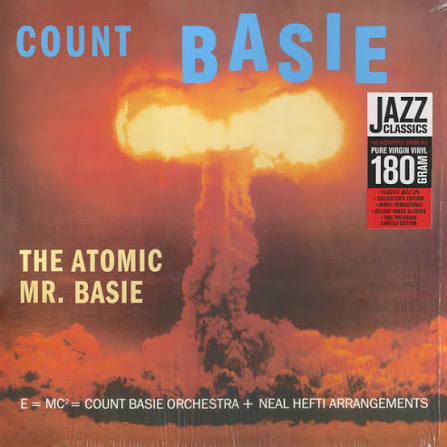
By the late 1950s, Count Basie had already secured his place among the giants of jazz. His original orchestra had defined the Kansas City swing sound during the 1930s, producing timeless recordings and launching the careers of some of the greatest musicians in jazz history. Yet rather than simply revisiting past successes, Basie spent the 1950s rebuilding his orchestra into one of the tightest, most disciplined big bands ever assembled. The culmination of that effort arrived in 1958 with The Atomic Mr. Basie.
Featuring a collection of dazzling arrangements by Neal Hefti, the album remains one of the greatest achievements in big band jazz. Every section of the orchestra performs with astonishing precision while never sacrificing the effortless swing that made Basie’s music legendary. Rather than emphasizing extended solo showcases, the record highlights the incredible power of ensemble playing, where every trumpet blast, saxophone phrase, and drum accent fits together with almost mathematical precision.
More than sixty-five years after its release, The Atomic Mr. Basie continues to serve as a benchmark for jazz orchestras around the world. It is not only one of Basie’s finest albums but also one of the definitive statements of the modern big band.
Album Overview
From the opening notes, The Atomic Mr. Basie announces itself with remarkable confidence. The orchestra sounds crisp, energetic, and completely unified, delivering performances that combine technical brilliance with irresistible swing.
Unlike many big band recordings that rely heavily on featured soloists, this album succeeds because every member of the orchestra contributes to the overall sound. The brass section is explosive without becoming overpowering, the saxophones glide effortlessly through Hefti’s intricate arrangements, and the rhythm section provides the relaxed pulse that became Basie’s trademark.
The album never feels repetitive despite maintaining a consistent musical identity. Hefti’s arrangements continually introduce fresh rhythmic ideas, dynamic contrasts, and unexpected harmonic colors that keep each performance engaging.
Perhaps the album’s greatest strength is its balance. It is sophisticated enough to reward serious jazz listeners while remaining immediately enjoyable for anyone who appreciates outstanding musicianship and infectious swing.
Every track reinforces the sense that this was an orchestra performing at the absolute peak of its abilities.
Songwriting
While Count Basie’s orchestra is naturally the album’s primary attraction, Neal Hefti’s compositions and arrangements deserve equal recognition.
Rather than writing overly complicated charts simply to impress musicians, Hefti created pieces built around memorable melodies, powerful rhythmic figures, and impeccable orchestral balance.
“The Kid from Red Bank” opens the album with tremendous energy, using Basie’s economical piano style as the launching point for one of the most exciting performances in the big band repertoire.
“Flight of the Foo Birds” combines elegant melodic writing with subtle harmonic sophistication, while “Whirly-Bird” showcases Hefti’s remarkable ability to create momentum through carefully layered ensemble passages.
Even slower selections maintain a sense of movement thanks to Hefti’s gift for orchestration. Every instrument serves a purpose, and no arrangement feels overcrowded despite the orchestra’s considerable size.
The writing demonstrates that great big band music depends as much on composition and arrangement as improvisation.
Performance
The performances throughout The Atomic Mr. Basie are extraordinary.
Count Basie’s piano remains wonderfully understated. Rather than dominating the music, he contributes concise, perfectly timed phrases that anchor the orchestra while allowing the ensemble to flourish around him.
The real stars, however, are the members of the orchestra itself.
The trumpet section performs with breathtaking precision, delivering brilliant high-register passages that remain powerful without becoming harsh. The saxophones blend seamlessly, while the trombones provide warmth and depth that enrich every arrangement.
The rhythm section exemplifies Basie’s famous philosophy of “less is more.” Freddie Green’s incomparable rhythm guitar, Eddie Jones’ steady bass, Sonny Payne’s explosive yet controlled drumming, and Basie’s minimalist piano combine to create one of the finest rhythm sections in jazz history.
Individual solos are outstanding, but what truly distinguishes the album is the collective discipline of the orchestra. Every musician listens, responds, and contributes to a unified musical vision.
The performances feel effortless, even though the technical demands placed on the musicians are immense.
Production
For a 1958 recording, The Atomic Mr. Basie sounds remarkably vibrant.
The engineers capture the orchestra with impressive clarity, allowing listeners to appreciate the intricate interplay between every section.
The brass possesses tremendous impact without overwhelming the reeds, while the rhythm section remains clearly defined throughout the album.
The recording also preserves the natural dynamics of the orchestra. Quiet passages retain warmth and detail, while the explosive climaxes maintain their excitement without distortion.
Because the production emphasizes faithful documentation rather than studio manipulation, the album has aged exceptionally well. Modern remasters reveal even greater detail while preserving the warmth and immediacy of the original sessions.
It remains one of the best-recorded big band albums of its era.
Standout Tracks
The album is remarkably consistent, but several performances have become genuine jazz classics.
“The Kid from Red Bank” is an exhilarating opener that immediately establishes the orchestra’s extraordinary precision and energy.
“Flight of the Foo Birds” remains one of Neal Hefti’s greatest achievements, balancing sophisticated orchestration with effortless swing.
“Li’l Darlin'” is perhaps the album’s most famous recording. Its relaxed tempo and understated elegance demonstrate that swing has little to do with speed and everything to do with feel.
“Whirly-Bird” bursts with excitement, featuring some of the album’s finest ensemble playing.
“Splanky” perfectly captures Basie’s signature style, combining blues influences, impeccable rhythm, and joyful musicianship into one unforgettable performance.
Weak Points
Finding meaningful flaws in The Atomic Mr. Basie is difficult, though a few observations can be made.
Listeners who prefer small-group jazz built around extended improvisation may find the emphasis on tightly arranged ensemble performances somewhat limiting. Individual soloists receive fewer opportunities than they might on a typical bebop recording.
Similarly, because the orchestra performs with such astonishing precision, some listeners may initially overlook the spontaneity that exists beneath the polished surface.
Finally, the album remains firmly rooted in the big band tradition. Those seeking the harmonic experimentation of contemporaries like Miles Davis or Thelonious Monk may find Basie’s approach comparatively conservative.
None of these points diminish the album’s artistic success. They simply reflect its commitment to a particular musical vision.
Legacy
The Atomic Mr. Basie is widely regarded as one of the greatest big band albums ever recorded.
It revitalized interest in large jazz orchestras during an era when smaller ensembles were increasingly dominating the genre, proving that the big band format still possessed enormous artistic potential.
Neal Hefti’s arrangements became required study for generations of jazz composers and arrangers, while Basie’s orchestra set a standard for precision and ensemble balance that remains virtually unmatched.
The album has influenced countless musicians, including Quincy Jones, Sammy Nestico, Gordon Goodwin, and Maria Schneider, all of whom drew inspiration from the remarkable combination of sophisticated writing and effortless swing showcased here.
Even today, high school, college, and professional jazz orchestras continue to perform selections from The Atomic Mr. Basie, a testament to the album’s enduring musical importance.
Far more than a historical document, it remains one of the finest examples of what a jazz orchestra can achieve when exceptional musicians, brilliant arrangements, and inspired leadership come together.
Final Score
10/10
The Atomic Mr. Basie is a towering achievement in big band jazz and one of the finest orchestra recordings ever made. Count Basie’s understated leadership, Neal Hefti’s masterful arrangements, and the breathtaking precision of the orchestra combine to create an album that is both technically flawless and endlessly enjoyable. Every performance swings with effortless confidence, every arrangement reveals new details upon repeated listening, and the entire record stands as a masterclass in ensemble playing. It remains an essential jazz classic and one of the definitive recordings of the big band era.