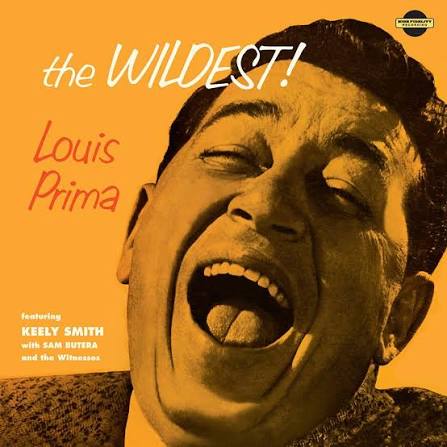
Few entertainers have ever embodied pure joy quite like Louis Prima. A singer, trumpeter, bandleader, comedian, and consummate showman, Prima built his reputation on performances that blurred the line between concert and party. By the time The Wildest! arrived in 1956, he had already spent nearly two decades in the music business, moving from swing-era jazz to Las Vegas lounges while continually reinventing himself. Rather than chasing changing musical trends, Prima leaned into his larger-than-life personality, creating a style that was equal parts jazz, jump blues, Italian-American humor, and early rock and roll.
The Wildest! is often regarded as the definitive Louis Prima album, and for good reason. Backed by the incomparable saxophonist Sam Butera and The Witnesses, along with vocalist Keely Smith, Prima captured the energy of his live act better than almost anyone else of the era. The record doesn’t sound polished in the traditional sense—it sounds alive. Every track bursts with laughter, shouting, audience interaction, and musicians who appear to be having the time of their lives.
While it may never receive the same historical attention as albums by Frank Sinatra or Elvis Presley, The Wildest! occupies a unique place in American popular music. It bridges the gap between big band swing and the raw excitement that would soon define rock and roll, all while remaining unmistakably Louis Prima.
Album Overview
Listening to The Wildest! feels like stepping into a packed Las Vegas showroom in the middle of the 1950s. The atmosphere is electric from the opening moments, and the album never lets its foot off the accelerator for very long.
Unlike carefully sequenced concept albums of the same era, The Wildest! succeeds through personality rather than narrative. Every song feels like another chapter in an unforgettable stage performance, complete with comic banter, audience participation, and explosive instrumental solos.
The chemistry between Prima, Sam Butera, and Keely Smith is the album’s greatest asset. Prima provides boundless enthusiasm, Butera contributes muscular saxophone playing that frequently threatens to steal the show, while Smith serves as the perfect straight-faced counterpart to Prima’s endless antics.
The arrangements combine elements of swing, Dixieland, rhythm and blues, jump blues, and early rock, resulting in a sound that refuses to fit neatly into any single category. Even today, it remains difficult to classify—and that’s part of its charm.
The album moves at a brisk pace, alternating between danceable swingers and slightly more relaxed novelty numbers without ever losing momentum. It’s impossible to imagine anyone remaining still while listening to much of this record.
Songwriting
Like many performers of his era, Prima relied on a mixture of original material, jazz standards, traditional songs, and popular tunes. What makes The Wildest! memorable isn’t necessarily the songwriting itself but the way Prima transforms familiar material into something unmistakably his own.
“Just a Gigolo/I Ain’t Got Nobody” serves as the album’s centerpiece. Although both songs existed long before Prima recorded them, his decision to combine them into a seamless medley created one of the most recognizable performances of his career. The gradual transformation from melancholy ballad to exuberant party anthem is brilliantly executed.
“Oh Marie” turns a traditional Italian favorite into an infectious singalong, while “Buona Sera” celebrates Prima’s Italian heritage with irresistible charm.
Many of the lyrics prioritize entertainment over emotional depth. Clever jokes, playful call-and-response passages, and humorous storytelling dominate much of the album. That lighter approach perfectly suits Prima’s personality and keeps the record from taking itself too seriously.
Although few songs rival the lyrical sophistication of the Great American Songbook, they don’t need to. Their purpose is simple: make listeners smile, dance, and join the fun.
Performance
If there has ever been an entertainer who sounded like he was having more fun than Louis Prima, it’s difficult to name one.
Prima attacks every song with seemingly limitless enthusiasm. His vocals may not possess the technical precision of Frank Sinatra or the emotional subtlety of Nat King Cole, but they overflow with charisma. Every shout, laugh, trumpet flourish, and improvised aside feels completely genuine.
His trumpet playing remains excellent throughout the album, reminding listeners that before becoming a Las Vegas icon, Prima was a respected jazz musician.
Sam Butera nearly steals the record. His saxophone solos inject tremendous energy into every performance, often pushing the music toward early rock and roll territory. The Witnesses provide equally spirited accompaniment, functioning less like a backing band and more like enthusiastic participants in an ongoing celebration.
Keely Smith deserves enormous praise as well. Her calm, understated vocals provide the perfect contrast to Prima’s manic exuberance. Their musical chemistry is effortless, and their playful interactions become some of the album’s funniest moments.
Collectively, the performances create an atmosphere that feels spontaneous, even if much of it was carefully rehearsed.
Production
For an album built around recreating a live performance, the production succeeds remarkably well.
Rather than aiming for pristine studio perfection, the recording embraces a certain looseness that enhances the overall experience. The musicians sound as though they’re sharing the same room, feeding off one another’s energy in real time.
The balance between vocals and instruments is excellent, allowing Butera’s saxophone, Prima’s trumpet, and the rhythm section to shine without overwhelming the singers.
Considering the recording technology available in 1956, the album retains impressive clarity. The brass has punch, the rhythm section drives every arrangement forward, and the vocals remain consistently prominent.
Some modern listeners may notice occasional rough edges compared to contemporary productions, but those imperfections contribute to the album’s charm. Smoothing everything out would have diminished the sense of excitement that defines the record.
Standout Tracks
The album is packed with memorable performances, but several songs stand above the rest.
“Just a Gigolo/I Ain’t Got Nobody” is the obvious highlight. It remains Prima’s signature recording and one of the most entertaining performances in American popular music history.
“Buona Sera” is impossible to resist, combining infectious rhythm with Prima’s unmistakable sense of humor.
“Oh Marie” showcases the band’s chemistry beautifully while celebrating Prima’s Italian roots with warmth and enthusiasm.
“Jump, Jive an’ Wail” lives up to its title, delivering nonstop energy that would later introduce Prima to an entirely new generation after its revival in the 1990s.
“Body and Soul” offers a reminder that beneath all the comedy and showmanship was an exceptionally skilled musician capable of handling more traditional jazz material.
Weak Points
As entertaining as The Wildest! is, it isn’t without limitations.
Because the album emphasizes energy above all else, it occasionally sacrifices emotional variety. Most songs aim for excitement or humor, leaving relatively little room for introspection or quieter moments.
Listeners who prefer tightly structured studio albums may also find the loose, live-performance atmosphere somewhat chaotic. Prima’s spontaneous interjections and comedic banter are integral to his style, but they won’t appeal to everyone.
Additionally, a handful of novelty numbers feel slightly less memorable than the record’s biggest classics, creating a small dip in consistency during the middle portion of the album.
Still, these are relatively minor criticisms of an album that fully accomplishes exactly what it sets out to do.
Legacy
The Wildest! helped cement Louis Prima’s status as one of America’s greatest entertainers while preserving one of the most exciting stage acts of the 1950s.
The album’s influence reaches far beyond traditional jazz. Its fusion of swing, jump blues, humor, and rock-and-roll energy inspired artists ranging from Brian Setzer and The Stray Cats to David Lee Roth, whose hit version of “Just a Gigolo/I Ain’t Got Nobody” introduced Prima’s signature performance to a new audience.
The album also enjoyed renewed popularity during the swing revival of the 1990s, when bands rediscovered the infectious energy that had made Prima a legend decades earlier.
Beyond its musical influence, The Wildest! serves as a reminder that technical excellence and pure entertainment don’t have to exist separately. Prima proved that musicianship, comedy, and audience engagement could coexist without compromising artistic quality.
Nearly seventy years after its release, the album remains exactly what its title promises: wild, joyful, and endlessly entertaining.
Final Score
9.0/10
The Wildest! is one of the most exuberant and enjoyable albums of the 1950s. Louis Prima, Sam Butera, Keely Smith, and The Witnesses deliver a nonstop celebration of swing, jazz, and early rock and roll with infectious enthusiasm and world-class musicianship. While it doesn’t possess the emotional depth or artistic cohesion of the era’s greatest concept albums, it was never trying to. Instead, it captures the thrill of an unforgettable live performance, making it one of the most fun records ever released. Its energy remains undiminished, proving that great entertainment never goes out of style.