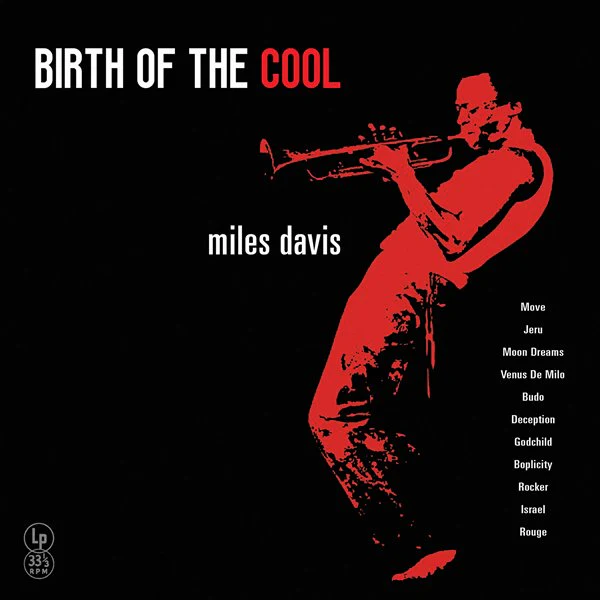
Few albums have altered the course of jazz as profoundly as Birth of the Cool. Although the recordings were made between 1949 and 1950 and weren’t collected into a full LP until 1957, the album represents one of the most important turning points in modern jazz. At a time when bebop was defined by blistering tempos, dazzling virtuosity, and dense improvisation, a young Miles Davis proposed a radically different approach—one built on balance, subtlety, carefully crafted arrangements, and emotional restraint.
Working alongside visionary arrangers and composers such as Gil Evans, Gerry Mulligan, and John Lewis, Davis assembled a nine-piece ensemble unlike anything jazz audiences had heard before. The unconventional instrumentation—including French horn and tuba—produced a rich, orchestral sound that bridged the gap between big band swing and modern small-group jazz.
The album’s title would eventually lend its name to an entire movement. Cool jazz became one of the defining styles of the 1950s, influencing countless musicians and proving that jazz could be intellectually sophisticated without sacrificing accessibility or emotion.
Today, Birth of the Cool remains not only one of Miles Davis’ greatest achievements but one of the foundational recordings of modern jazz.
Album Overview
Unlike many jazz albums built primarily around extended improvisation, Birth of the Cool emphasizes ensemble interplay and meticulous arrangement. Every instrument has a clearly defined role, creating textures that feel remarkably sophisticated without becoming overly complicated.
The nine-piece ensemble allows Davis and his collaborators to explore colors rarely heard in jazz at the time. Rather than overwhelming listeners with constant solos, the music shifts gracefully between ensemble passages and improvisation, giving every performance a sense of architectural balance.
Despite being recorded across several sessions, the album possesses remarkable consistency. Every track reflects the same artistic vision: elegance over excess, subtlety over spectacle.
There is a remarkable sense of space throughout the record. Silence becomes as important as sound, and no musician feels compelled to fill every available moment. That restraint gives the album an atmosphere unlike the frenetic energy of contemporary bebop recordings.
The pacing also deserves praise. Up-tempo numbers are balanced with slower pieces, allowing the album to breathe while maintaining a cohesive emotional identity from beginning to end.
Songwriting
Although Birth of the Cool features contributions from several composers, the writing consistently serves a unified musical philosophy.
Pieces such as “Move” and “Budo” retain bebop’s harmonic sophistication while presenting it through smoother, more carefully structured arrangements.
“Jeru,” composed by Gerry Mulligan, exemplifies the album’s cool aesthetic with its flowing melodic lines and understated elegance.
“Moon Dreams,” arranged by Gil Evans, introduces lush orchestral textures rarely associated with small-group jazz, creating an almost cinematic atmosphere.
The writing throughout the album avoids flashy complexity for its own sake. Instead, each composition emphasizes melody, balance, and ensemble interaction.
Repeated listening continually reveals new details. Countermelodies, harmonic subtleties, and carefully constructed instrumental conversations emerge more clearly with every play, rewarding attentive listeners without alienating newcomers.
Performance
Miles Davis was only in his early twenties when these recordings were made, yet his musical personality was already unmistakable.
Rather than attempting to match the blistering technical fireworks of contemporaries like Charlie Parker or Dizzy Gillespie, Davis developed a lyrical approach built around phrasing, tone, and emotional precision. Every note feels intentional.
His trumpet playing throughout the album is remarkably restrained, allowing the melodies to unfold naturally instead of overwhelming them with technical display.
The supporting musicians are equally exceptional. Gerry Mulligan’s baritone saxophone provides warmth and depth, Lee Konitz’s alto saxophone contributes graceful lyricism, while Max Roach anchors the rhythm section with extraordinary sensitivity.
Perhaps the album’s greatest strength lies in its ensemble playing. Individual solos are outstanding, but the real magic occurs when all nine musicians interact as a single musical organism.
The performances remain remarkably fresh because they prioritize communication over competition. Every player serves the music first.
Production
Considering these recordings date from 1949 and 1950, the sound quality remains surprisingly impressive.
The mono recording naturally lacks the spaciousness of later stereo jazz albums, but the engineers successfully capture the ensemble’s unique instrumental balance.
The unusual combination of trumpet, trombone, French horn, tuba, reeds, piano, bass, and drums could easily have become muddy, yet every instrument retains its own identity within the mix.
Producer Pete Rugolo and the engineering team wisely emphasized clarity over excessive volume, allowing the intricate arrangements to remain intelligible even during denser passages.
Modern remasters have further enhanced the listening experience, bringing additional warmth and detail without sacrificing the recordings’ original character.
Although later Miles Davis albums benefited from advances in recording technology, Birth of the Cool still sounds remarkably vibrant for its era.
Standout Tracks
Nearly every performance contributes meaningfully to the album’s lasting reputation, but several stand above even this consistently outstanding collection.
“Move” opens the album with remarkable energy while immediately introducing the ensemble’s distinctive sound.
“Jeru” perfectly encapsulates the cool jazz aesthetic, balancing sophistication with effortless swing.
“Moon Dreams” remains one of Gil Evans’ finest arrangements, surrounding Davis’ trumpet with rich orchestral textures that were revolutionary for their time.
“Boplicity” is among the album’s most memorable compositions, combining elegant melodies with impeccable ensemble playing.
“Israel” closes the record with a performance that demonstrates the group’s extraordinary balance between compositional discipline and improvisational freedom.
Weak Points
Birth of the Cool has remarkably few weaknesses, though there are a couple worth mentioning.
Listeners expecting the fiery improvisation of Davis’ later quintets or the emotional intensity of albums like Kind of Blue may initially find the performances somewhat restrained.
Because the album was compiled from sessions spanning more than a year, it lacks the unified recording-session atmosphere found on some of Davis’ later masterpieces.
Additionally, the emphasis on arrangement occasionally leaves less room for extended solo exploration than traditional jazz enthusiasts might prefer.
These observations, however, reflect artistic choices rather than genuine flaws.
Legacy
The importance of Birth of the Cool cannot be overstated.
It effectively launched the cool jazz movement, influencing an entire generation of musicians who sought a more relaxed, melodic alternative to bebop. The album demonstrated that sophistication could coexist with accessibility and that emotional subtlety could be just as powerful as technical virtuosity.
Its influence extends far beyond jazz. Classical composers, film scorers, and modern chamber ensembles have all drawn inspiration from the album’s innovative instrumentation and carefully balanced arrangements.
Artists including Chet Baker, Dave Brubeck, Stan Getz, and countless others built upon ideas first fully realized here.
For Miles Davis himself, Birth of the Cool represented only the beginning. He would go on to reinvent jazz repeatedly over the following four decades, but the fearless creativity that defined his career is already fully evident in these early recordings.
Today, the album remains essential listening—not merely as an important historical document, but as a genuinely rewarding musical experience whose elegance has never faded.
Final Score
9.5/10
Birth of the Cool is one of the most influential jazz albums ever assembled and a landmark achievement in twentieth-century music. Miles Davis and his remarkable collaborators created a sound that was revolutionary without being confrontational, replacing bebop’s relentless intensity with elegance, balance, and lyrical beauty. While its compilation origins keep it from feeling quite as unified as Davis’ later studio masterpieces, the brilliance of the arrangements, the exceptional ensemble performances, and its enormous historical significance make it an indispensable album that continues to inspire musicians more than seventy years after the music was first recorded.