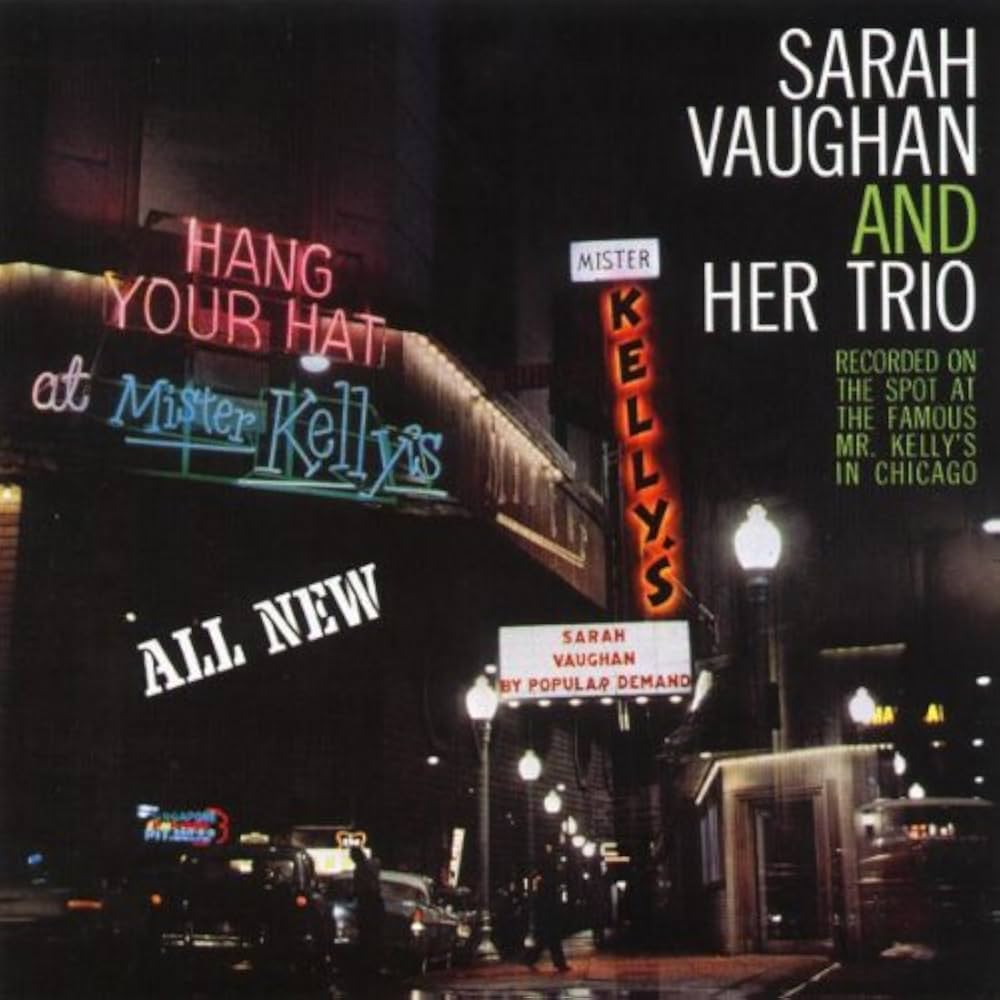
Live jazz albums often reveal an artist more completely than even the finest studio recordings. Without endless retakes or carefully edited performances, the singer is left with nothing but talent, instinct, and the ability to connect with an audience in real time. Few recordings demonstrate that magic better than At Mister Kelly’s, a remarkable live performance by Sarah Vaughan and her trio that captures one of the greatest vocalists in jazz history at the absolute height of her powers.
Recorded at Chicago’s famed Mister Kelly’s nightclub in 1957 and released the following year, the album presents Vaughan in an intimate setting with pianist Jimmy Jones, bassist Richard Davis, and drummer Roy Haynes. Rather than relying on lush orchestral arrangements, the stripped-down trio allows every nuance of Vaughan’s extraordinary voice to take center stage. The result is a performance that feels conversational, spontaneous, and astonishingly effortless.
More than six decades later, At Mister Kelly’s remains one of the essential live vocal jazz albums ever recorded. It is a masterclass in phrasing, interpretation, swing, and emotional expression that continues to inspire singers across every genre.
Album Overview
The atmosphere of Mister Kelly’s is central to the album’s success. Instead of performing in a large concert hall, Vaughan sings in a sophisticated nightclub where the audience sits only a few feet away. Their applause, laughter, and attentive silence become part of the recording, creating an intimacy that studio sessions rarely achieve.
The repertoire blends beloved standards with jazz favorites, allowing Vaughan to explore romance, heartbreak, optimism, and playful humor. Every selection feels perfectly chosen for both her voice and the relaxed environment.
Perhaps the album’s greatest accomplishment is its balance. It never feels overly formal despite the extraordinary musicianship on display. Instead, the performances unfold naturally, almost as though Vaughan is simply enjoying an evening with friends while effortlessly delivering some of the finest singing of her career.
Songwriting
Like many great jazz vocal albums of the era, At Mister Kelly’s draws heavily from the Great American Songbook. Songs by George Gershwin, Cole Porter, Richard Rodgers, Lorenz Hart, and other legendary composers provide Vaughan with material worthy of her immense gifts.
Although she was not the songwriter, Vaughan possessed an almost unmatched ability to reinterpret familiar standards. Every lyric feels newly discovered through her phrasing, timing, and emotional intelligence. Rather than simply singing melodies, she reshapes them with remarkable imagination while always respecting the original composition.
The writing itself remains timeless because it speaks to universal emotions. Love, longing, optimism, and heartbreak are expressed with elegance instead of melodrama, giving Vaughan endless opportunities for interpretation.
Performance
This album exists to showcase Sarah Vaughan’s voice, and what a voice it is. Her range seems limitless, her intonation is flawless, and her control borders on unbelievable. Yet what truly separates Vaughan from nearly every other singer is her ability to make impossible vocal passages sound completely natural.
She glides effortlessly between registers, reshapes melodies without losing their identity, and treats rhythm with the freedom of an accomplished jazz instrumentalist. Every phrase feels alive. No two choruses are approached exactly the same way.
The trio deserves enormous praise as well. Jimmy Jones provides tasteful accompaniment filled with elegant harmonic ideas. Richard Davis delivers rich, melodic bass lines that anchor every performance, while Roy Haynes supplies subtle swing without ever becoming intrusive.
The chemistry among the musicians is exceptional. Rather than merely supporting Vaughan, they engage in a continuous musical conversation that elevates every song.
Production
For a live recording made in the late 1950s, the sound quality remains impressive. The engineers capture the warmth of the room while maintaining remarkable clarity between voice and instruments.
Vaughan’s vocals remain front and center without overwhelming the trio, and the audience presence enhances rather than distracts from the performances. Modern remasters have further improved the listening experience while preserving the album’s intimate atmosphere.
The production wisely avoids unnecessary polish. Small imperfections remind listeners that they are hearing genuine live performances rather than carefully assembled studio creations.
Standout Tracks
“September in the Rain” opens the album with confidence and immediately demonstrates Vaughan’s extraordinary command of melody and rhythm.
“Willow Weep for Me” is breathtaking, combining emotional depth with astonishing vocal control.
“Just One of Those Things” swings effortlessly while showcasing Vaughan’s playful sense of timing.
“Honeysuckle Rose” highlights both her technical brilliance and her obvious joy in performing before an appreciative audience.
“How High the Moon” closes with dazzling improvisation that reminds listeners why Vaughan was admired as much by fellow musicians as by audiences.
Weak Points
There are very few genuine weaknesses. Listeners looking for elaborate orchestral arrangements may find the trio setting somewhat understated, and the informal nightclub atmosphere lacks the dramatic scale of a concert hall recording.
Additionally, because Vaughan constantly reinvents familiar melodies, those expecting faithful reproductions of well-known standards may occasionally be surprised by her adventurous interpretations.
Neither observation significantly detracts from the listening experience. They are simply characteristics of a live jazz performance built on spontaneity.
Legacy
At Mister Kelly’s has earned its reputation as one of the greatest live vocal jazz albums ever recorded. It captures Sarah Vaughan at a point where technical perfection and artistic maturity existed in complete harmony.
The album became a benchmark for jazz singers, influencing generations of performers who sought to balance technical excellence with emotional honesty. Vaughan demonstrated that virtuosity need never come at the expense of warmth or accessibility.
Even today, the album serves as an ideal introduction to her artistry. It strips away unnecessary embellishment and leaves only one of the greatest voices in recorded music interacting with an exceptional trio.
More than sixty years after its release, At Mister Kelly’s continues to sound fresh, intimate, and deeply human—a reminder that true musical greatness never goes out of style.
Final Score
9.5/10
At Mister Kelly’s captures Sarah Vaughan in magnificent form, delivering performances that combine astonishing technical precision with effortless swing and emotional depth. The intimate trio setting allows every nuance of her voice to shine, resulting in one of the finest live jazz vocal albums ever recorded. While its understated presentation may not appeal to listeners seeking larger orchestral productions, the artistry on display is nothing short of extraordinary, making this an essential recording for both jazz newcomers and longtime fans.