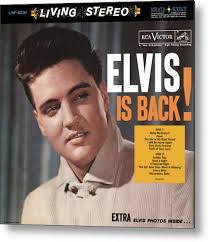
Military service temporarily interrupted Elvis Presley’s meteoric rise to superstardom, but it did nothing to diminish his talent. When he returned to the recording studio in 1960, there was understandable curiosity about what kind of artist would emerge. Would he simply recreate the rock and roll that had made him famous, or would he pursue a more mature musical direction? Elvis Is Back! answered that question with remarkable confidence.
Rather than trying to relive the raw energy of his Sun Records days, Presley delivered one of the most sophisticated performances of his career. The album effortlessly blends rock and roll, rhythm and blues, country, blues, jazz, and traditional pop, revealing a vocalist who had grown considerably during his two-year absence. His voice is richer, more controlled, and more versatile than ever before, while still retaining the charisma that made him a phenomenon in the first place.
Unlike many comeback albums that rely on nostalgia, Elvis Is Back! looks forward. It presents Presley as a mature recording artist capable of interpreting virtually any style placed before him. The confidence displayed throughout the album would influence much of the work he recorded during the first half of the 1960s.
Although it sometimes sits in the shadow of his groundbreaking 1950s recordings, many longtime fans and critics consider Elvis Is Back! to be the finest studio album of his career.
Album Overview
One of the album’s greatest strengths is its remarkable variety. Presley moves effortlessly between hard-driving rhythm and blues, romantic ballads, country influences, and sophisticated pop standards without the record ever feeling disjointed.
The opening track, “Make Me Know It,” immediately announces that Elvis has lost none of his confidence or energy. From there, the album explores a wide emotional range while maintaining a consistent level of quality.
The supporting musicians deserve enormous credit. Nashville’s finest session players provide tasteful arrangements that allow Presley’s voice to remain the focal point. Every instrument serves the songs rather than competing for attention, creating performances that feel polished without becoming sterile.
The pacing is excellent as well. Up-tempo rockers are balanced by slower, emotionally rich performances, giving the album a natural flow that rewards listening from beginning to end.
More importantly, the record never sounds like an artist searching for his identity. Presley appears completely comfortable, embracing every style with effortless authority.
Songwriting
Like many Elvis albums, Elvis Is Back! draws from a wide range of professional songwriters rather than relying on original compositions.
Fortunately, the material is consistently excellent.
“Fever” receives one of the definitive interpretations of the classic, with Presley transforming the song into a seductive, understated masterpiece through subtle phrasing and remarkable vocal control.
“The Girl of My Best Friend” combines infectious pop melodies with emotional sincerity, while “Like a Baby” showcases Presley’s deep connection to rhythm and blues.
One of the album’s most beautiful moments arrives with “Such a Night,” where Presley effortlessly blends New Orleans rhythm and blues with his unmistakable vocal style.
The album closes memorably with “Reconsider Baby,” a lengthy blues performance that allows Presley to demonstrate just how deeply he understood the genre that helped shape his musical identity.
Although the songs come from multiple writers, they fit together remarkably well because Presley inhabits every performance completely.
Performance
This may be the finest singing Elvis Presley ever committed to tape.
His voice possesses a maturity and flexibility absent from many of his earlier recordings. The youthful excitement of the 1950s remains intact, but it is now joined by greater control, confidence, and emotional subtlety.
Presley moves effortlessly between powerful rock vocals, intimate whispers, smooth pop crooning, and authentic blues phrasing without sounding forced in any setting.
His interpretation of “Fever” demonstrates extraordinary restraint. Rather than overpowering the song, he allows silence, timing, and subtle vocal inflections to create dramatic tension.
On “Reconsider Baby,” he reminds listeners that beneath the superstar image was an exceptional blues singer capable of remarkable emotional depth.
The backing musicians—including guitarist Hank Garland, pianist Floyd Cramer, drummer D.J. Fontana, bassist Bob Moore, and the Jordanaires—perform flawlessly throughout the album.
The chemistry between Presley and his band creates performances that remain vibrant more than sixty years later.
Production
The production on Elvis Is Back! represents a significant step forward from many of Presley’s earlier recordings.
Producer Steve Sholes and engineer Bill Porter captured Elvis with exceptional clarity, taking full advantage of advances in recording technology.
The stereo mix remains one of the album’s greatest strengths. Every instrument occupies its own space while Presley’s voice remains perfectly centered and consistently present.
The arrangements are tasteful and uncluttered, allowing the performances to breathe naturally.
Perhaps most impressive is the album’s warmth. Modern remasters reveal remarkable detail while preserving the rich analog character that gives the recording much of its enduring appeal.
It remains one of the best-sounding Elvis albums ever released.
Standout Tracks
The album contains numerous highlights that rank among Presley’s greatest studio performances.
“Fever” is an all-time classic, demonstrating remarkable vocal sophistication and impeccable production.
“Such a Night” captures Presley’s effortless charisma while delivering one of the album’s most joyful performances.
“Like a Baby” showcases his deep affection for rhythm and blues, while “The Girl of My Best Friend” remains one of the finest pop recordings of his early RCA years.
The closing “Reconsider Baby” is arguably the album’s crowning achievement, stretching beyond six minutes to reveal Presley as a mature blues vocalist capable of holding listeners’ attention from beginning to end.
There are remarkably few weak moments anywhere on the record.
Weak Points
Elvis Is Back! comes remarkably close to achieving perfection, but it is not entirely without flaws.
A handful of lighter pop numbers are slightly overshadowed by the extraordinary strength of the album’s blues and rhythm-and-blues performances.
Listeners expecting the raw rockabilly energy of Presley’s Sun recordings may also find this album more polished and restrained.
Additionally, because the album explores several different musical styles, it lacks the thematic unity found on later concept-driven albums.
These criticisms are relatively minor and do little to diminish the album’s overall excellence.
Legacy
Although Elvis Is Back! did not generate the same cultural shockwaves as Presley’s earliest recordings, its influence has grown steadily over the decades.
Many critics now regard it as the finest demonstration of Elvis’ vocal abilities, proving that he was far more than simply the King of Rock and Roll. He possessed the versatility to excel in blues, country, pop, gospel, and jazz-influenced material with equal conviction.
The album influenced artists including Roy Orbison, Chris Isaak, John Fogerty, and Bruce Springsteen, all of whom admired Presley’s ability to combine technical excellence with emotional authenticity.
Today, Elvis Is Back! is widely recognized as one of the strongest albums in Presley’s catalog. It captures an artist returning from military service not diminished, but revitalized and operating at the absolute peak of his vocal powers.
Final Score
9.5/10
Elvis Is Back! is the finest studio album of Elvis Presley’s career and one of the greatest vocal performances in popular music. Its exceptional production, remarkable stylistic range, and consistently outstanding singing make it a benchmark not only for Elvis himself but for early 1960s popular music as a whole. While its stylistic variety prevents it from feeling like a unified concept album, the quality of the performances is so consistently high that it remains an essential recording and one of the true masterpieces of Presley’s catalog.