By the middle of the 1950s, Frank Sinatra had already experienced more highs and lows than most artists encounter in an entire lifetime. Once the biggest singing sensation in America, his popularity had collapsed in the late 1940s before a remarkable comeback fueled by an Oscar-winning acting performance in From Here to Eternity and a new recording contract with Capitol Records. Rather than simply return to making hit singles, Sinatra embarked on something far more ambitious. He wanted to create albums that functioned as complete artistic statements.
Released in 1955, In the Wee Small Hours is widely considered the first great concept album in popular music. While earlier records had grouped songs together, Sinatra and arranger Nelson Riddle crafted an album unified by mood, theme, and emotional progression. Every song revolves around loneliness, heartbreak, regret, and quiet reflection during the sleepless hours after midnight.
More than seventy years later, the album remains one of the defining achievements of American popular music. It established the blueprint for the modern album and proved that a collection of songs could tell a larger emotional story without needing a narrative plot. Countless artists—from rock musicians to jazz vocalists and modern singer-songwriters—owe something to the artistic standards established by In the Wee Small Hours.
Album Overview
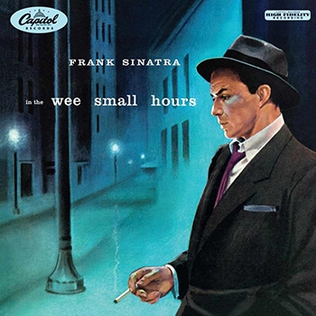
The opening image says everything. Sinatra stands alone beneath a lonely streetlamp on an empty city street, cigarette in hand, dressed in a blue suit while surrounded by darkness. Before a single note plays, listeners understand the emotional landscape they’re about to enter.
The music never rushes. Instead, it drifts like late-night thoughts that refuse to disappear. Every arrangement leaves room for silence, every phrase lingers just a little longer than expected, and every lyric feels deeply personal.
Rather than building toward dramatic emotional explosions, the album finds beauty in restraint. There are no flashy vocal moments designed to impress. Sinatra sings with remarkable intimacy, often sounding as though he’s quietly confiding in a single listener rather than performing for millions.
Nelson Riddle’s arrangements are equally restrained. Soft strings, understated woodwinds, subtle brass, and gentle rhythm sections create a rich atmosphere without overwhelming Sinatra’s voice. The orchestra doesn’t simply accompany him—it becomes another character sharing his loneliness.
The sequencing also deserves enormous credit. Every track flows naturally into the next, creating an uninterrupted emotional experience. This wasn’t an accident. It was carefully designed to feel like one long conversation with someone unable to sleep.
Songwriting
Although Sinatra didn’t write the songs himself, his gift was selecting material that perfectly matched both his voice and his emotional state. The album draws from the Great American Songbook, featuring works by legendary composers including Rodgers and Hart, Cole Porter, and Irving Berlin.
What makes these songs exceptional is their emotional honesty. None rely on melodrama or exaggerated heartbreak. Instead, they explore the quieter pain that follows the end of love.
“In the Wee Small Hours of the Morning” perfectly establishes the record’s central theme. Rather than rage against lost love, it quietly acknowledges that memories become strongest during lonely nights.
“I Get Along Without You Very Well” masterfully captures denial. The narrator repeatedly insists everything is fine while every line reveals exactly the opposite. Sinatra delivers those contradictions with heartbreaking subtlety.
“When Your Lover Has Gone” confronts emotional emptiness directly, while “Glad to Be Unhappy” explores the strange comfort people sometimes find in lingering sadness.
The lyrics throughout the album avoid clichés. They speak with sophistication, intelligence, and emotional maturity, allowing listeners to project their own experiences onto the music regardless of generation.
Performance
This may be the finest vocal performance of Sinatra’s career.
His younger recordings often emphasized vocal power and technical precision. Here, emotional interpretation becomes the priority. Every breath, pause, and slight change in phrasing serves the song rather than showcasing vocal ability.
Sinatra possessed extraordinary control over timing. He often sings just behind the beat, creating the illusion of spontaneous conversation instead of strict musical performance. That subtle technique makes every lyric feel more authentic.
His diction remains impeccable without ever sounding theatrical. Every word is crystal clear, yet nothing feels overly polished.
Perhaps most impressive is his willingness to embrace vulnerability. There’s no bravado, no swagger, and very little of the confident entertainer audiences associated with Sinatra. Instead, listeners hear a man confronting disappointment with quiet dignity.
The emotional consistency across sixteen songs is astonishing. Maintaining this atmosphere without becoming repetitive requires remarkable discipline, and Sinatra never loses focus.
His ability to communicate complex feelings through tiny vocal inflections remains almost unmatched in popular music.
Production
Recorded during the early days of high-fidelity recording, In the Wee Small Hours sounds remarkably timeless.
Producer Voyle Gilmore understood that simplicity would serve the material best. Rather than crowd the arrangements, the production emphasizes warmth, clarity, and space.
Nelson Riddle deserves enormous praise for creating orchestral arrangements that enhance every emotional nuance without drawing attention away from Sinatra. His orchestrations feel cinematic while remaining incredibly intimate.
The recording quality captures subtle dynamics beautifully. Quiet passages remain detailed, while louder moments never lose balance. Every instrument occupies its own place within the soundstage.
The album’s pacing also contributes significantly to its success. Nothing feels rushed. Each song is given room to breathe, encouraging listeners to become immersed rather than distracted.
Even by modern standards, the production feels elegant instead of dated. While recording technology has advanced dramatically, the artistic choices remain timeless.
Standout Tracks
Several songs stand above an already exceptional collection.
“In the Wee Small Hours of the Morning” serves as the perfect introduction. Few opening tracks establish an album’s emotional identity so completely.
“Mood Indigo” transforms Duke Ellington’s classic into something deeply personal. Sinatra finds melancholy without sacrificing sophistication.
“I Get Along Without You Very Well” ranks among the finest vocal interpretations ever recorded. Every repeated reassurance carries increasing emotional weight.
“Deep in a Dream” floats effortlessly between hope and resignation, supported by one of Nelson Riddle’s most beautiful arrangements.
“What Is This Thing Called Love?” introduces subtle rhythmic energy while remaining emotionally consistent with the album’s overall atmosphere.
“I’ll Be Around” closes with quiet acceptance rather than dramatic resolution, providing a fitting conclusion to the emotional journey.
Weak Points
Finding meaningful flaws in an album of this stature isn’t easy, but a few observations are worth mentioning.
Listeners expecting variety may find the consistent mood overwhelming. Nearly every song explores similar emotional territory, making the album best experienced in a reflective setting rather than casual background listening.
Its deliberate pacing can also challenge audiences accustomed to modern pop production. Songs unfold slowly, emphasizing atmosphere over immediate hooks.
Some listeners may wish for greater stylistic diversity. The arrangements intentionally remain restrained throughout, sacrificing contrast in favor of maintaining the album’s emotional unity.
These, however, are conscious artistic decisions rather than genuine shortcomings. The album succeeds precisely because it refuses to compromise its vision.
Legacy
Few albums have influenced music as profoundly as In the Wee Small Hours.
Before its release, albums were largely viewed as collections of singles. Sinatra demonstrated that an LP could function as a complete artistic experience built around a central emotional concept. That idea would later become fundamental to rock, folk, soul, jazz, and countless other genres.
Artists including The Beatles, The Beach Boys, Bob Dylan, Elton John, Billy Joel, and Bruce Springsteen all embraced the album as an artistic statement in ways that trace directly back to Sinatra’s Capitol recordings.
The partnership between Sinatra and Nelson Riddle also became one of the greatest singer-arranger collaborations ever recorded, producing several classic albums throughout the decade.
Critics continue to rank In the Wee Small Hours among the greatest albums ever made, not simply because of its historical importance but because its emotional honesty remains universally relatable.
Its themes have never become outdated. Heartbreak, loneliness, insomnia, regret, and reflection remain timeless human experiences, allowing new generations to discover the album without feeling separated by decades.
The record also permanently reshaped Sinatra’s artistic reputation. He was no longer simply a popular vocalist or movie star. He became one of the first true album artists, proving that popular music could achieve literary and emotional sophistication without sacrificing accessibility.
Final Score
10/10
In the Wee Small Hours is one of the rare albums that deserves every bit of its legendary reputation. Sinatra’s deeply human vocal performance, Nelson Riddle’s elegant arrangements, and a flawlessly curated selection of songs combine to create an album that feels less like entertainment and more like an intimate conversation in the quietest hours of the night. It not only transformed Frank Sinatra’s career but also helped redefine what an album could be. More than seven decades after its release, it remains as emotionally powerful, artistically unified, and profoundly moving as ever.