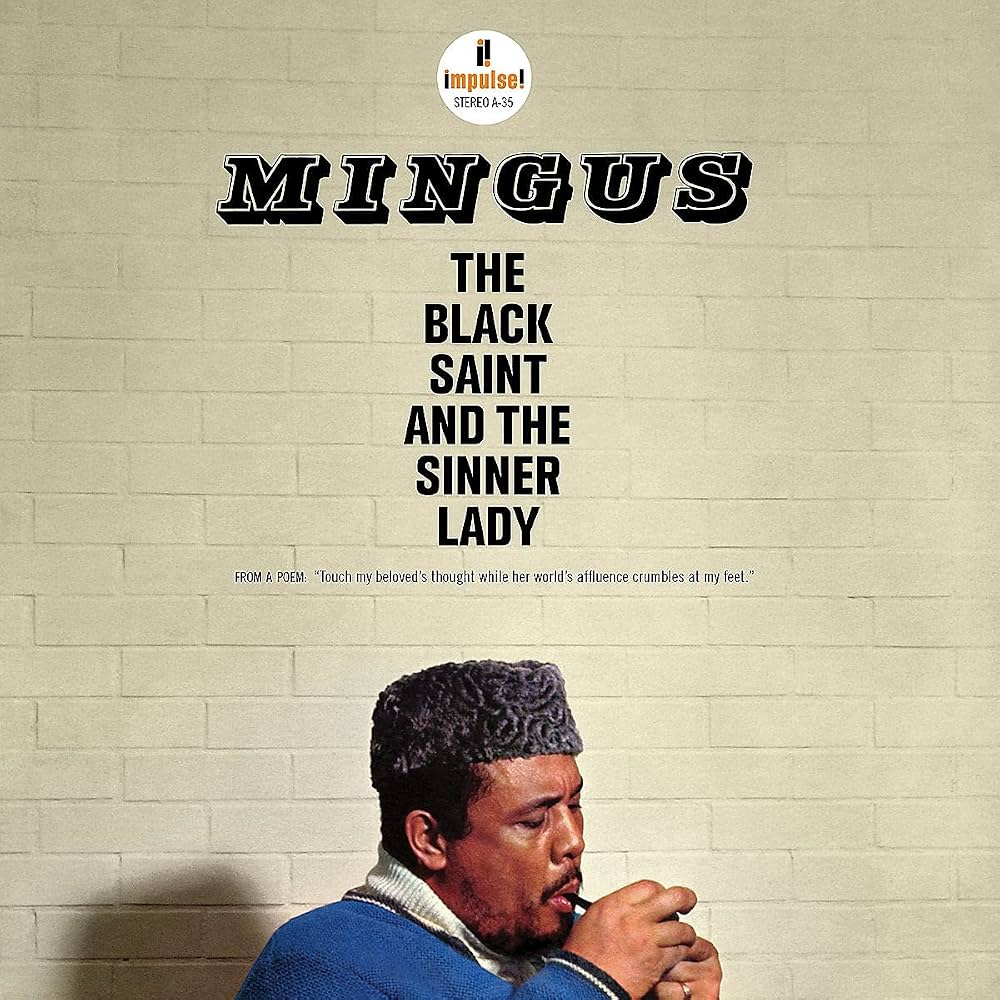
Jazz has produced countless ambitious albums, but very few rival the sheer scope of Charles Mingus’ The Black Saint and the Sinner Lady. Released in 1963, it stands as one of the boldest artistic statements ever recorded—a work that blurs the boundaries between jazz, classical music, flamenco, blues, gospel, and ballet into something entirely its own.
By this point in his career, Mingus had already established himself as one of jazz’s most fearless composers and bassists. Albums like Mingus Ah Um and Blues & Roots had demonstrated his ability to combine deep emotional expression with dazzling technical sophistication. Yet The Black Saint and the Sinner Lady pushed even further. Rather than simply assembling another collection of compositions, Mingus envisioned a continuous suite exploring human psychology, romance, conflict, passion, and inner turmoil.
The album is famously subtitled “ethnic folk-dance music,” a description that barely hints at its complexity. It unfolds less like a conventional jazz record and more like an orchestral drama, each movement flowing naturally into the next as moods shift from tenderness to violence, celebration to despair.
More than sixty years after its release, it remains one of the most extraordinary achievements in jazz history—a record that challenges listeners while rewarding them with endless discoveries.
Album Overview
Few albums demand complete attention the way The Black Saint and the Sinner Lady does.
This is not background music.
Every movement builds upon what came before.
Themes reappear.
Rhythms evolve.
Melodies transform.
The album functions as one uninterrupted emotional journey rather than a collection of individual songs.
Mingus assembles an eleven-piece ensemble capable of astonishing versatility.
At one moment, the musicians swing with irresistible momentum.
Moments later, they drift into haunting orchestral passages.
Then come explosive brass arrangements.
Delicate woodwinds.
Spanish-inspired guitar flourishes.
Blues-infused improvisation.
Nothing feels random.
Every dramatic shift serves the larger emotional narrative.
The music constantly balances discipline and spontaneity.
Mingus’ intricate compositions provide structure while allowing his musicians enough freedom to inject personality into every performance.
The result feels meticulously organized without ever sounding rigid.
It is controlled chaos at its finest.
Songwriting
As a composer, Charles Mingus reaches one of the highest peaks of his remarkable career.
Rather than writing traditional jazz standards built around familiar head-solo-head structures, he constructs extended suites that unfold almost cinematically.
The opening movement immediately establishes the album’s ambitious scale.
Themes emerge gradually before expanding into sweeping ensemble passages filled with dramatic tension.
The central sections become increasingly emotional.
Joy collides with anxiety.
Elegance gives way to disorder.
Quiet reflection suddenly erupts into explosive collective improvisation.
Throughout the album, Mingus draws upon numerous musical traditions.
Duke Ellington’s orchestral sophistication.
Gospel’s emotional intensity.
Spanish flamenco rhythms.
Blues phrasing.
Modern classical composition.
Yet none of these influences dominate.
Instead, Mingus fuses them into an unmistakably personal musical language.
Perhaps the greatest achievement of the writing is its emotional ambiguity.
The music rarely tells listeners exactly how to feel.
Instead, it invites multiple interpretations.
Beauty often exists beside violence.
Hope alongside despair.
Order alongside chaos.
Each revisit reveals entirely new emotional dimensions.
Performance
The ensemble assembled by Mingus delivers one of the finest collective performances in jazz history.
Every musician contributes not simply technical brilliance but extraordinary emotional commitment.
Mingus himself anchors everything through powerful bass playing that functions as both rhythmic foundation and expressive voice.
His instrument frequently seems to argue with the rest of the orchestra, pushing and pulling the music in unexpected directions.
The horn section performs with astonishing precision.
Trumpets soar dramatically.
Trombones growl with astonishing force.
Saxophones alternate between lyrical beauty and almost violent intensity.
Individual solos remain exceptional throughout the record, but what truly distinguishes the album is the ensemble playing.
The musicians breathe together.
Accelerate together.
Pause together.
Even the most chaotic moments feel unified.
This remarkable chemistry allows Mingus’ extraordinarily demanding compositions to come alive with genuine emotion rather than academic precision.
Every performance sounds urgent.
Nothing feels merely rehearsed.
Production
Recorded by engineer Bob Simpson for Impulse! Records, The Black Saint and the Sinner Lady remains an impressive technical achievement.
Capturing an ensemble of this size while preserving clarity was no small task in 1963.
The recording succeeds beautifully.
Every instrument occupies its own space within the stereo image.
Brass retains tremendous power without overwhelming quieter passages.
Woodwinds remain delicate.
Percussion adds color without becoming intrusive.
Most importantly, the recording preserves the album’s dramatic dynamic range.
Quiet moments remain intimate.
Loud passages retain overwhelming impact.
The production never attempts to smooth away the music’s rough edges.
Instead, it embraces the enormous emotional contrasts that define Mingus’ vision.
Decades later, the album still sounds remarkably vivid.
Standout Tracks
Although The Black Saint and the Sinner Lady functions as one continuous suite, several movements stand among the greatest compositions of Mingus’ career.
“Track A – Solo Dancer” introduces the album’s sweeping emotional landscape with extraordinary confidence, blending elegant orchestration with explosive ensemble playing.
“Track B – Duete Solo Dancers” expands the dramatic tension through constantly shifting rhythms and unforgettable melodic themes, showcasing Mingus’ remarkable gift for large-scale composition.
“Track C – Group Dancers” becomes the emotional centerpiece of the album, balancing moments of breathtaking beauty against passages of controlled musical chaos.
“Track D – Trio and Group Dancers / Single Solos and Group Dance / Group and Solo Dance” serves as a spectacular finale, bringing together the album’s recurring musical ideas while allowing the entire ensemble one final opportunity to shine.
Taken together, these movements create one of jazz’s most rewarding complete listening experiences.
Separating them almost feels unnatural.
The suite achieves its greatest impact when experienced in full.
Weak Points
The album’s extraordinary ambition naturally limits its accessibility.
Listeners expecting conventional swing, straightforward melodies, or easily identifiable song structures may initially find the music overwhelming.
Its emotional intensity also demands complete concentration.
Casual listening rarely reveals its full richness.
Additionally, because the suite functions as a single extended composition, individual movements are less immediately memorable than traditional jazz standards.
These qualities are not flaws so much as reflections of Mingus’ uncompromising artistic vision.
The album asks a great deal from its audience.
It gives even more in return.
Legacy
The Black Saint and the Sinner Lady remains one of the towering achievements of twentieth-century music.
Its influence extends far beyond jazz.
Classical composers.
Progressive rock musicians.
Avant-garde artists.
Film composers.
Experimental musicians.
All have drawn inspiration from Mingus’ fearless blending of structure and improvisation.
The album also represents one of the clearest demonstrations that jazz could function as large-scale artistic expression equal to the most ambitious works in classical music without sacrificing swing, blues feeling, or emotional immediacy.
More than sixty years after its release, it continues challenging listeners while revealing new details with every return.
Very few albums reward repeated listening so generously.
Even fewer continue sounding this original.
Final Score: 10/10
The Black Saint and the Sinner Lady is one of the greatest achievements in jazz history and one of the most ambitious albums ever recorded. Charles Mingus combines astonishing composition, fearless improvisation, masterful ensemble playing, and profound emotional depth into a work that remains unlike anything before or since.
Its complexity never becomes self-indulgent because every note serves the larger emotional journey. The performances are extraordinary, the production remains remarkably vibrant, and the music continually reveals new layers through repeated listening.
Only the rarest albums fundamentally expand the possibilities of their art form. The Black Saint and the Sinner Lady is one of those masterpieces—a monumental work that stands not only among the greatest jazz recordings ever made but among the greatest achievements in all of modern music.
This post has already been read 90 times!