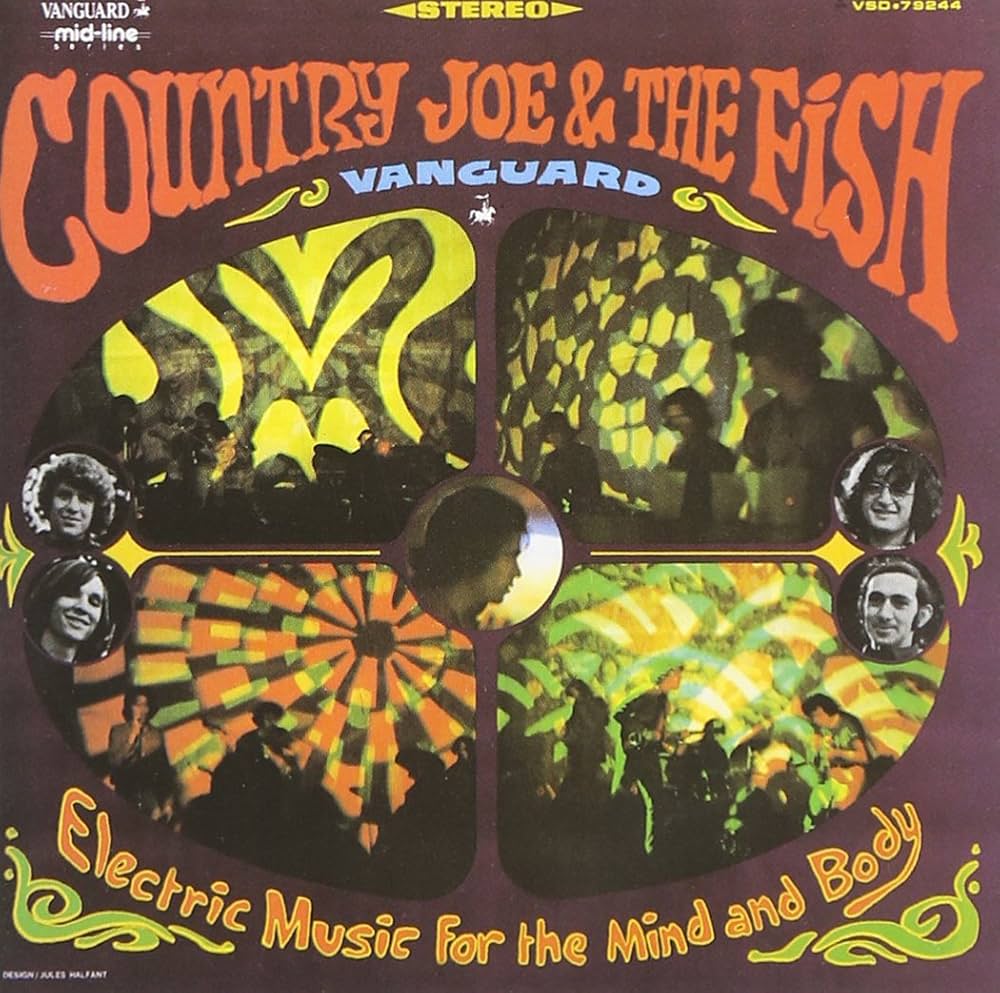
When people think of the San Francisco psychedelic scene of the late 1960s, names like Jefferson Airplane, the Grateful Dead, and Big Brother and the Holding Company usually come to mind first. Yet before the Summer of Love exploded into mainstream culture, Country Joe & the Fish were already helping define what psychedelic rock could become. Their debut album, Electric Music for the Mind and Body, released in 1967, remains one of the earliest and most fully realized examples of the genre.
Led by vocalist and songwriter Country Joe McDonald alongside guitarist Barry “The Fish” Melton, the band blended folk, blues, garage rock, acid rock, Eastern influences, political commentary, and surreal humor into an album unlike almost anything being released at the time. While many psychedelic records leaned heavily on studio experimentation, Electric Music for the Mind and Body never loses sight of the songs themselves. The strange sounds, swirling organs, and distorted guitars all serve compositions that are memorable, provocative, and surprisingly accessible.
The result is an album that captures the optimism, experimentation, and social unrest of 1967 while remaining one of psychedelic rock’s most enduring achievements.
Album Overview
Few debut albums establish such a distinct identity so quickly.
From its opening moments, Electric Music for the Mind and Body immerses listeners in a colorful musical landscape where traditional songwriting constantly collides with experimentation.
Folk melodies drift into swirling improvisation.
Blues riffs dissolve into psychedelic textures.
Garage rock energy meets dreamlike atmospheres.
The album never feels chaotic, however.
Every stylistic shift seems completely natural.
One of its greatest strengths is its remarkable balance.
The record embraces the adventurous spirit of the psychedelic movement without becoming self-indulgent.
Songs remain concise.
Hooks remain memorable.
Even the most experimental moments retain a strong melodic foundation.
Lyrically, the album reflects the counterculture beginning to reshape American society.
Anti-war sentiment.
Social criticism.
Drug culture.
Mysticism.
Satire.
Personal freedom.
All find expression throughout the record, though rarely in heavy-handed ways.
Instead, the songs invite listeners to question conventional thinking while maintaining a sense of humor and curiosity.
Songwriting
Country Joe McDonald proves himself to be one of the more underrated songwriters of the psychedelic era.
Rather than relying solely on abstract imagery, he combines vivid storytelling with biting social commentary and playful surrealism.
“Flying High” immediately establishes the album’s adventurous spirit, pairing soaring melodies with lyrics that blur the line between literal and metaphorical flight.
“Not So Sweet Martha Lorraine” remains one of the album’s masterpieces, using unusual chord progressions and shifting dynamics to create a song that feels simultaneously whimsical and unsettling.
“Death Sound Blues” combines traditional blues structures with psychedelic production, demonstrating the band’s ability to honor its roots while pushing them into new territory.
“Superbird” delivers sharp political satire aimed at Lyndon B. Johnson, making it one of the earliest and most memorable protest songs of the psychedelic movement.
“The Masked Marauder” showcases McDonald’s offbeat humor through a playful folk-rock arrangement that remains thoroughly charming.
The closing epic, “Section 43,” largely instrumental, allows the band to explore mood and atmosphere with remarkable confidence, anticipating the extended improvisations that would soon become common within psychedelic rock.
Throughout the album, the songwriting consistently balances accessibility and experimentation.
That balance remains one of its greatest achievements.
Performance
Country Joe McDonald may not possess the powerhouse voice of contemporaries like Grace Slick or Janis Joplin, but his conversational singing style perfectly complements the band’s relaxed, exploratory music.
His vocals carry warmth, intelligence, and quiet confidence.
Rather than dominating songs, he guides listeners through them.
Barry Melton provides outstanding guitar work throughout the album.
His playing alternates between bluesy restraint and explosive psychedelic improvisation without ever sounding excessive.
Keyboardist David Cohen deserves equal recognition.
His swirling organ becomes one of the album’s defining sonic elements, adding texture and atmosphere to nearly every track.
The rhythm section remains remarkably versatile.
Whether supporting folk ballads, blues grooves, or extended psychedelic explorations, the musicians maintain impressive cohesion.
Perhaps most importantly, the band consistently sounds like a true ensemble.
Individual performances are excellent, but the chemistry between the musicians elevates the material even further.
Production
Considering its era, Electric Music for the Mind and Body remains an impressively adventurous production.
Studio effects enhance rather than overwhelm the performances.
Reverb.
Tape manipulation.
Echo.
Organ textures.
Distorted guitars.
Everything contributes to the psychedelic atmosphere without obscuring the songs.
The recording successfully captures both intimacy and expansiveness.
Acoustic passages feel warm and immediate.
Full-band performances explode with colorful energy.
Unlike some psychedelic albums that now sound trapped within the production trends of the late 1960s, Electric Music for the Mind and Body retains much of its freshness because it never relies solely on studio gimmicks.
The musicianship remains the central focus.
That choice has allowed the album to age remarkably well.
Standout Tracks
Although the album maintains impressive consistency, several performances stand among the finest recordings of the psychedelic era.
“Flying High” opens the album with irresistible optimism, immediately establishing both its adventurous musical spirit and memorable songwriting.
“Not So Sweet Martha Lorraine” remains one of psychedelic rock’s true masterpieces, combining inventive arrangements with one of the band’s strongest melodies.
“Superbird” delivers biting political satire wrapped inside an infectious rock performance that remains surprisingly relevant decades later.
“Death Sound Blues” brilliantly fuses traditional blues with psychedelic experimentation, highlighting the band’s remarkable versatility.
“Section 43” closes the album with a mesmerizing instrumental journey that perfectly captures the exploratory spirit of San Francisco’s emerging psychedelic scene.
Weak Points
Although Electric Music for the Mind and Body remains remarkably strong, it occasionally reveals its place as an early psychedelic record.
Some experimental passages hint at musical ideas that later bands would develop more fully.
Listeners expecting the polished production of later psychedelic classics may also find portions of the album somewhat rough around the edges.
Additionally, Country Joe McDonald’s understated vocal style may initially seem less dramatic than many of his contemporaries.
These observations rarely diminish the album’s appeal.
Its rawness often becomes part of its charm.
Legacy
Electric Music for the Mind and Body helped establish the blueprint for psychedelic rock before the genre reached its commercial peak.
Its combination of political awareness, musical experimentation, folk influences, and electric improvisation became enormously influential throughout the late 1960s.
The album also cemented Country Joe & the Fish as one of the defining bands of the San Francisco scene, even if history has sometimes placed them in the shadow of more commercially successful contemporaries.
Its anti-war themes gained additional significance as the Vietnam War escalated, while the band’s willingness to challenge musical conventions anticipated countless psychedelic, progressive, and jam bands that followed.
Today, the album stands not only as an important historical document but as one of the most enjoyable psychedelic records ever made.
Its creativity remains infectious.
Its spirit remains unmistakably free.
Final Score: 9/10
Electric Music for the Mind and Body is one of the essential albums of the psychedelic era and an outstanding debut that successfully balances adventurous experimentation with consistently memorable songwriting. Country Joe & the Fish combine sharp political commentary, colorful musicianship, and imaginative production into a record that still feels vibrant more than half a century after its release.
While later psychedelic masterpieces would expand upon some of its ideas, few capture the excitement of a musical movement discovering itself quite as effectively. Strong performances, inventive arrangements, and a fearless willingness to explore new sounds make the album rewarding from beginning to end.
Overshadowed by some of its more famous contemporaries, Electric Music for the Mind and Body remains a landmark of 1960s rock and one of the finest introductions to the psychedelic revolution.
This post has already been read 63 times!