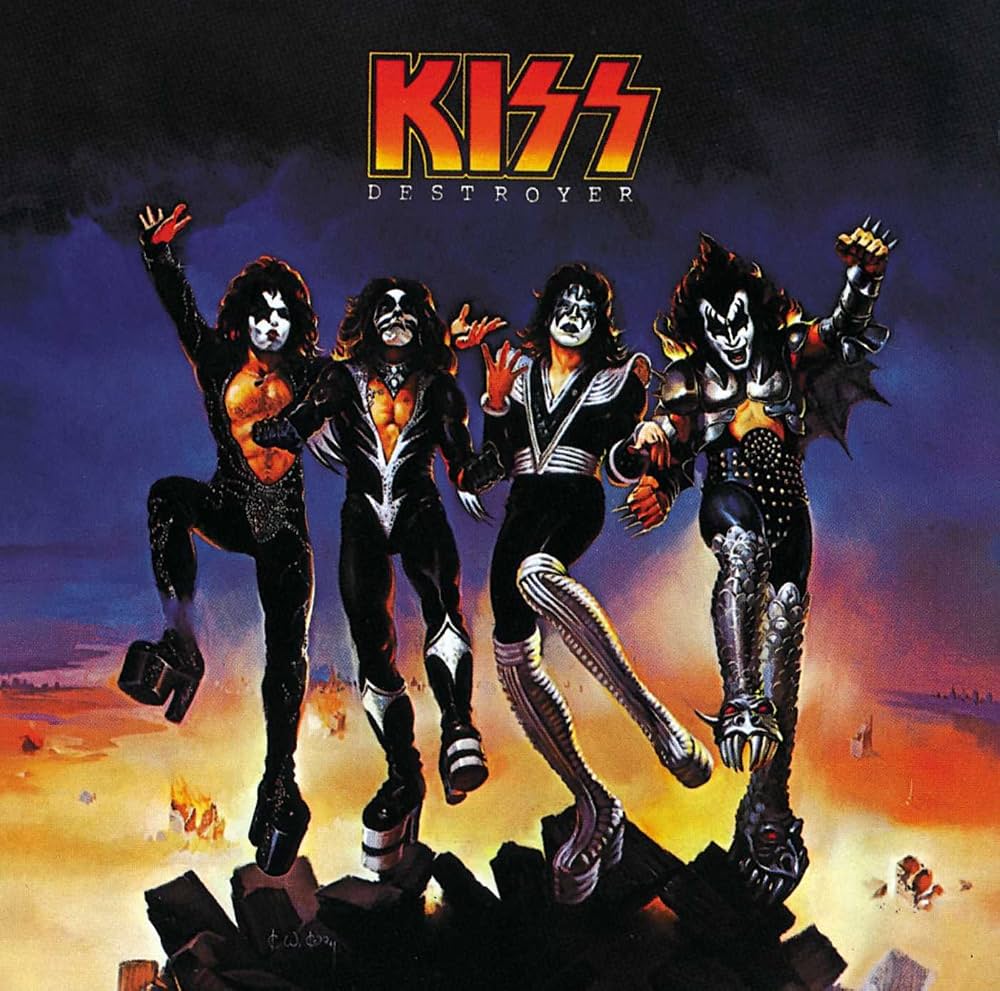
Before Destroyer, KISS was a band with a devoted fanbase but relatively modest commercial success. Their first three studio albums and the explosive live set Alive! had established them as one of the most exciting live acts in rock, thanks to outrageous costumes, fire-breathing, blood-spitting, and concerts that felt more like theatrical spectacles than traditional performances. Yet despite their reputation on stage, many critics dismissed them as style over substance.
Released in 1976, Destroyer permanently changed that perception.
Produced by Bob Ezrin, who had previously worked with Alice Cooper, the album expanded KISS’ musical ambitions dramatically. Rather than simply recreating the raw hard rock of their live shows, Ezrin encouraged the band to embrace orchestras, choirs, sound effects, layered vocal harmonies, and cinematic production. The result was an album that retained KISS’ swagger while dramatically broadening their artistic range.
The gamble paid off. Destroyer became the band’s breakthrough studio album and remains the record against which every other KISS release is measured. It contains some of their biggest hits, several of their finest deep cuts, and enough stylistic variety to prove that beneath the makeup stood four musicians capable of far more than critics had assumed.
Nearly fifty years later, Destroyer remains one of hard rock’s defining albums.
Album Overview
What immediately separates Destroyer from KISS’ earlier records is its ambition.
Everything feels larger.
The arrangements.
The production.
The performances.
The songwriting.
Bob Ezrin approaches the album almost like a film soundtrack.
Songs feature dramatic introductions.
Spoken dialogue.
Children’s choirs.
String arrangements.
Massive guitar layers.
Theatrical pacing.
Yet despite these additions, the record never loses the raw energy that made KISS famous.
The album effortlessly blends hard rock, glam rock, power pop, ballads, progressive influences, and straightforward arena anthems.
Each song possesses its own identity while contributing to the larger experience.
Unlike many ambitious rock albums of the mid-1970s, Destroyer rarely feels self-important.
Its greatest strength is that it never forgets to be fun.
The band sounds energized by the expanded musical possibilities rather than overwhelmed by them.
That enthusiasm becomes contagious.
Songwriting
One of Destroyer‘s greatest achievements is the remarkable improvement in songwriting.
Paul Stanley and Gene Simmons deliver some of the strongest material of their careers, while outside songwriter contributions fit naturally within the band’s identity.
“Detroit Rock City” opens the album with breathtaking confidence.
Inspired by the death of a fan driving to a KISS concert, the song combines cinematic storytelling with one of the greatest guitar-driven openings in rock history.
“King of the Night Time World” follows with relentless energy, perfectly capturing the larger-than-life fantasy that defined the band’s image.
“God of Thunder,” although written by Paul Stanley and ultimately transformed into Gene Simmons’ signature anthem, became one of KISS’ darkest and most memorable songs.
“Shout It Out Loud” delivers one of the greatest singalong choruses in arena rock history.
Then comes “Beth.”
Originally intended as a B-side, the gentle piano ballad became KISS’ biggest hit and demonstrated an emotional vulnerability few listeners expected.
Even deeper cuts like “Flaming Youth,” “Sweet Pain,” and “Do You Love Me” maintain impressive consistency.
There is remarkably little filler.
Every song serves a purpose.
Performance
Each member of KISS contributes significantly to the album’s success.
Paul Stanley delivers some of the strongest vocal performances of his career.
His voice balances power and melody effortlessly, particularly on “Detroit Rock City” and “Do You Love Me.”
Gene Simmons embraces his theatrical persona while delivering commanding performances throughout.
His sinister vocal style finds its perfect vehicle in “God of Thunder.”
Ace Frehley continues proving himself one of hard rock’s most underrated guitarists.
His melodic solos consistently elevate the material without resorting to unnecessary technical excess.
His playing on “Detroit Rock City” alone ranks among the finest moments of his career.
Peter Criss receives his defining vocal showcase on “Beth.”
Although his drumming remains solid throughout the album, it is his heartfelt vocal performance that provides one of the record’s emotional highlights.
Together, the four musicians sound tighter and more focused than ever before.
Ezrin’s demanding production methods clearly pushed the band toward new creative heights.
Production
Bob Ezrin’s production transforms KISS without stripping away their identity.
Everything sounds enormous.
Layered guitars.
Massive vocal harmonies.
Orchestral flourishes.
Sound effects.
Children’s choirs.
Every addition serves the songs rather than overwhelming them.
The opening of “Detroit Rock City” remains a masterclass in dramatic album sequencing.
Traffic noises.
Radio broadcasts.
Building tension.
Then one of rock’s greatest guitar riffs explodes from the speakers.
The production throughout remains remarkably detailed.
Repeated listening reveals subtle instrumental layers often hidden beneath the larger arrangements.
Even decades later, Destroyer sounds surprisingly modern.
Its ambitious production has aged far better than many of its contemporaries.
Standout Tracks
Although the album maintains exceptional consistency, several songs stand among the greatest recordings in KISS’ catalog.
“Detroit Rock City” is arguably the band’s masterpiece. Combining cinematic storytelling, unforgettable riffs, extraordinary guitar work, and towering production, it remains one of hard rock’s finest opening tracks.
“God of Thunder” perfectly establishes Gene Simmons’ demonic stage persona while delivering one of the heaviest songs in the band’s early catalog.
“Shout It Out Loud” captures everything great about KISS’ ability to write joyous, crowd-pleasing rock anthems.
“Beth” reveals an entirely different side of the band, becoming one of the most surprising and successful power ballads of the decade.
“Do You Love Me” closes the album with swagger, sharp hooks, and one final burst of arena-sized energy.
Weak Points
Despite its greatness, Destroyer is not entirely flawless.
A handful of songs, particularly “Sweet Pain” and “Great Expectations,” occasionally fall short of the astonishing standard established by the album’s strongest material.
Some longtime fans of the band’s raw early sound also viewed Bob Ezrin’s polished production as slightly overproduced compared to the straightforward energy of earlier releases.
Additionally, the album’s stylistic diversity occasionally makes it feel more like a collection of ambitious songs than a unified artistic statement.
These criticisms remain relatively minor.
The album’s strengths overwhelmingly define the experience.
Legacy
Destroyer permanently elevated KISS from cult favorites to international rock superstars.
Its commercial success established the band as arena headliners while proving they could thrive in the studio as well as on stage.
The album’s influence stretches across hard rock, glam metal, and arena rock.
Artists ranging from Mötley Crüe and Bon Jovi to Foo Fighters and Ghost have acknowledged the enormous impact of KISS’ theatrical presentation and larger-than-life songwriting.
More importantly, Destroyer demonstrated that spectacle and musicianship need not exist in opposition.
The album proved KISS could deliver memorable songs alongside unforgettable performances.
That realization helped secure their place in rock history.
Final Score: 9.5/10
Destroyer is the definitive KISS studio album and one of the great hard rock records of the 1970s. Bob Ezrin’s ambitious production, dramatically improved songwriting, outstanding performances, and fearless willingness to expand the band’s sound combine into a record that remains both immensely entertaining and artistically significant.
While a couple of deeper cuts don’t quite reach the towering heights of classics like “Detroit Rock City,” “God of Thunder,” and “Beth,” the album’s consistency and ambition remain remarkable. Every member delivers career-defining performances, and the expanded production gives KISS a scale that perfectly matches their legendary stage show.
Nearly fifty years after its release, Destroyer still feels larger than life—a thrilling blend of hard rock power, theatrical imagination, and unforgettable hooks that stands as the crowning achievement of KISS’ classic era.
This post has already been read 66 times!