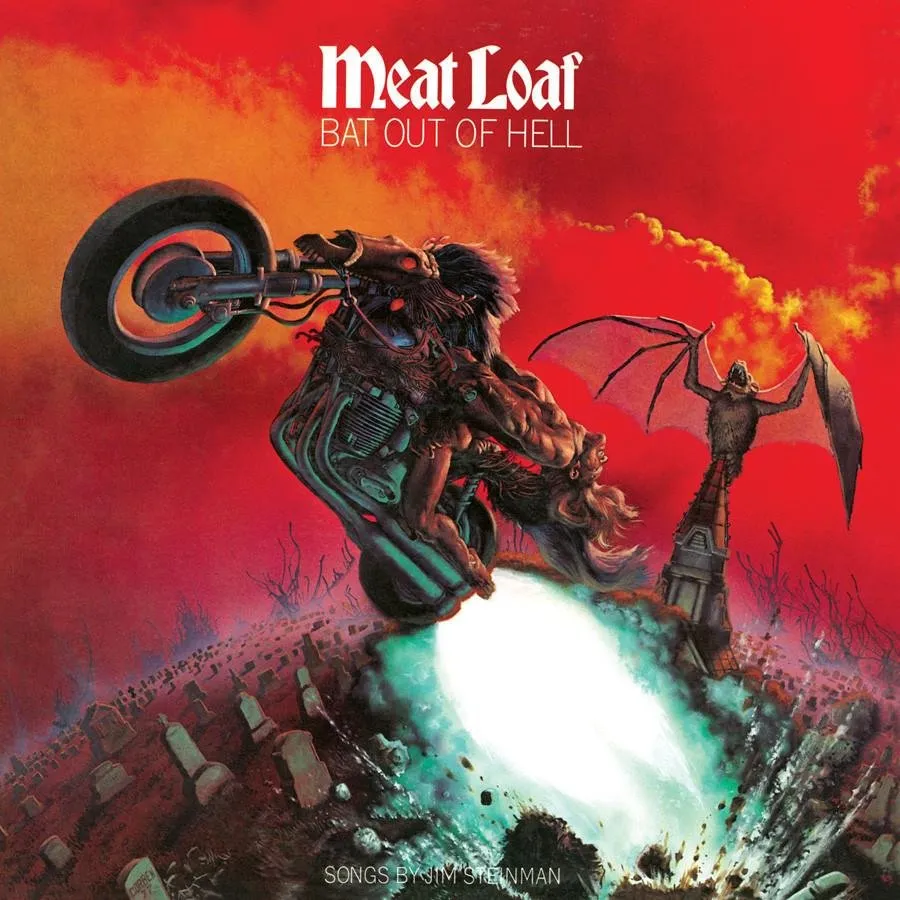
Rock albums rarely arrive with the confidence to sound like nothing else on the radio. Bat Out of Hell, released in 1977, was exactly that kind of record. At a time when punk was stripping rock down to its essentials and disco ruled the charts, Meat Loaf and songwriter Jim Steinman delivered something completely different—a wildly theatrical, larger-than-life collection of songs that borrowed as much from Broadway as it did from Bruce Springsteen, Phil Spector, and classic rock.
Initially rejected by numerous record labels, the album looked like it might never see the light of day. Once released, however, it slowly built momentum through relentless touring and word of mouth before becoming one of the best-selling albums in history. Decades later, it has sold well over 40 million copies worldwide and remains a staple of classic rock radio.
Few albums embrace excess as completely as Bat Out of Hell. Even fewer make that excess feel so exhilarating.
Album Overview
The partnership between vocalist Meat Loaf and composer Jim Steinman is one of the most distinctive in rock history. Steinman’s songs are unapologetically dramatic, overflowing with teenage romance, heartbreak, fantasy, motorcycles, fast cars, and grand declarations of love. Meat Loaf possesses the booming, theatrical voice capable of bringing those oversized emotions to life.
Every song feels cinematic.
Long instrumental passages, sudden tempo changes, layered vocal harmonies, piano flourishes, and soaring guitar solos combine to create an album that often resembles a rock opera more than a traditional studio release.
Despite running nearly 47 minutes with only seven tracks, Bat Out of Hell never feels repetitive. Each song develops its own identity while contributing to the album’s overarching themes of youthful passion, desperation, rebellion, and impossible dreams.
It’s gloriously over-the-top from beginning to end—and that’s exactly the point.
Songwriting
Jim Steinman’s songwriting is unlike almost anyone else’s.
His lyrics reject realism in favor of heightened emotion, where every relationship feels life-or-death and every romance unfolds on an epic scale. Lesser writers might have turned this material into parody, but Steinman’s complete commitment gives it surprising emotional sincerity.
The title track immediately establishes the album’s ambition. Running nearly ten minutes, “Bat Out of Hell” tells a vivid story of reckless freedom and inevitable tragedy while constantly shifting between quiet moments and explosive crescendos.
“You Took the Words Right Out of My Mouth (Hot Summer Night)” blends spoken-word theatrics with one of the album’s most memorable choruses, perfectly capturing Steinman’s flair for melodrama.
“Paradise by the Dashboard Light” remains one of rock’s greatest storytelling songs. Built as a humorous yet bittersweet tale of teenage romance, temptation, and lifelong commitment, its multiple sections never outstay their welcome despite the song’s lengthy runtime.
“Two Out of Three Ain’t Bad” provides the emotional heart of the album. Instead of theatrical bombast, it offers genuine vulnerability, demonstrating Steinman’s ability to write affecting ballads alongside his larger-than-life epics.
Even “All Revved Up with No Place to Go” and “Heaven Can Wait” contribute memorable melodies and lyrical imagery that reinforce the album’s unique personality.
Performance
Meat Loaf delivers one of the great vocal performances in rock history.
His enormous voice possesses remarkable range, power, and theatrical expression. He doesn’t simply sing these songs—he inhabits them completely, shifting effortlessly between tenderness, desperation, humor, and explosive passion.
Few vocalists could make Steinman’s ambitious compositions believable.
Meat Loaf does so with absolute conviction.
The musicians are equally outstanding.
Guitarist Todd Rundgren, who also produced the album, contributes fiery solos and muscular rhythm work throughout. Roy Bittan of the E Street Band provides elegant piano performances that often anchor the songs emotionally, while Max Weinberg’s powerful drumming adds urgency and momentum.
Every musician understands the theatrical nature of the material and performs accordingly, never holding anything back.
Production
Todd Rundgren’s production is one of the album’s greatest achievements.
Given the complexity of Steinman’s arrangements, the songs could easily have become cluttered. Instead, Rundgren creates a massive wall of sound that somehow remains remarkably clear.
The layered guitars, pianos, choirs, strings, and percussion coexist beautifully, allowing each musical idea room to breathe despite the album’s density.
The production embraces grandeur without sacrificing clarity.
Its blend of Phil Spector-inspired orchestration, hard rock energy, and theatrical dynamics remains instantly recognizable nearly fifty years later.
Even modern productions rarely achieve this level of scale while maintaining such strong musical focus.
Standout Tracks
“Bat Out of Hell”
One of the greatest opening tracks ever recorded. Its relentless energy, cinematic storytelling, and unforgettable guitar work make it a rock epic in every sense.
“Paradise by the Dashboard Light”
An extraordinary mini-musical that blends humor, romance, baseball commentary, and emotional heartbreak into one of rock’s most ambitious compositions.
“Two Out of Three Ain’t Bad”
The album’s emotional centerpiece. Meat Loaf’s heartfelt vocal transforms Steinman’s bittersweet lyrics into one of the defining power ballads of the 1970s.
“You Took the Words Right Out of My Mouth (Hot Summer Night)”
A perfect combination of theatrical flair and arena-rock hooks that remains one of Meat Loaf’s signature songs.
“Heaven Can Wait”
Gentle, reflective, and beautifully performed, this ballad provides an essential emotional counterbalance to the album’s larger, louder moments.
Weak Points
Bat Out of Hell demands that listeners embrace its theatrical style.
Those who prefer understated songwriting or concise rock songs may find the album’s dramatic performances and lengthy compositions overwhelming. There are moments where Steinman’s lyrical excess borders on melodrama, and not every listener will connect with that approach.
Additionally, because every song aims for maximum emotional impact, there are relatively few quiet moments to provide contrast.
For fans, these qualities are exactly what make the album legendary. For skeptics, they may prove exhausting.
Legacy
Very few albums have enjoyed the kind of longevity achieved by Bat Out of Hell.
Despite a slow commercial start, it eventually became one of the best-selling albums of all time, selling more than 40 million copies worldwide and remaining in print continuously since its release.
Its influence reaches far beyond classic rock. Artists across hard rock, glam metal, musical theater, and even pop have drawn inspiration from Steinman’s grand songwriting and Meat Loaf’s fearless performances.
The album also demonstrated that ambitious, theatrical rock could still thrive during an era increasingly dominated by punk’s simplicity and disco’s dancefloor appeal.
Perhaps most importantly, Bat Out of Hell remains endlessly entertaining. Its songs continue to fill arenas, karaoke bars, sporting events, and classic rock playlists because they possess an infectious enthusiasm that’s impossible to fake.
It isn’t merely an album.
It’s an experience.
Final Score
9.5/10
Bat Out of Hell is one of rock’s greatest spectacles—a thrilling fusion of arena rock, Broadway drama, and unforgettable storytelling. Jim Steinman’s extraordinary songwriting, Meat Loaf’s towering vocal performance, and Todd Rundgren’s expansive production combine to create an album unlike any other. Bold, emotional, and unapologetically excessive, it remains one of the defining rock records of the 1970s and one of the most distinctive albums ever made.
This post has already been read 62 times!