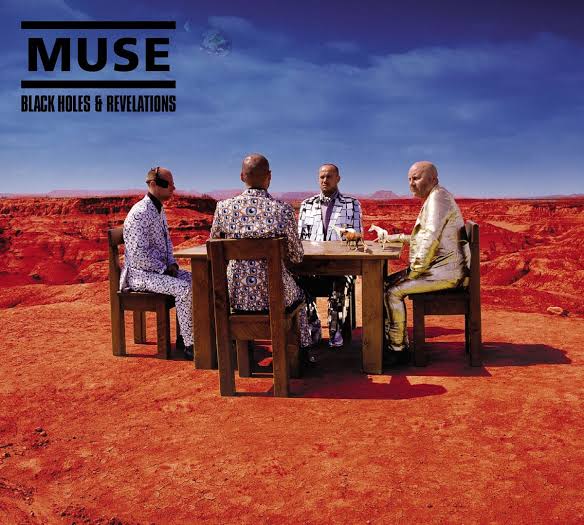
By 2006, Muse had already earned a reputation as one of rock’s most ambitious bands. Their first three albums showcased a fearless willingness to blend progressive rock, alternative rock, classical influences, and theatrical grandeur into something uniquely their own. With Black Holes and Revelations, however, the trio reached an entirely new level.
Rather than simply expanding their established formula, Muse embraced electronic music, funk, glam rock, spaghetti Western soundscapes, and political commentary without sacrificing the explosive energy that had made them one of the world’s premier live acts. The result was an album that balanced experimentation with accessibility better than any previous release.
Black Holes and Revelations remains the moment when Muse evolved from an acclaimed alternative rock band into one of the defining arena-rock acts of the 21st century.
Album Overview
What makes Black Holes and Revelations so compelling is its remarkable sense of adventure.
Few albums move this effortlessly between genres while maintaining such a cohesive identity. One moment Muse is delivering pounding hard rock, the next they’re experimenting with electronic beats, disco-inspired bass lines, orchestral arrangements, or cinematic atmospheres.
Despite these constant stylistic shifts, the album never feels disjointed.
Themes of government surveillance, war, corruption, conspiracy theories, technological anxiety, and personal resistance connect the songs into a surprisingly unified whole.
Matt Bellamy, Chris Wolstenholme, and Dominic Howard perform with complete confidence throughout, demonstrating why Muse has long been regarded as one of the tightest three-piece bands in modern rock.
Songwriting
Matt Bellamy’s songwriting reaches new heights here.
His fascination with politics, science fiction, dystopian ideas, and human resilience provides the album with an unusually ambitious lyrical scope for mainstream rock.
“Take a Bow” opens with a slow electronic build before exploding into one of the album’s most dramatic climaxes, serving as an unforgettable introduction.
“Supermassive Black Hole” shocked longtime fans upon release by incorporating dance-rock, funk, and electronic influences, yet it has since become one of Muse’s defining songs.
“Starlight” provides the album’s emotional heart. Beneath its soaring chorus lies a touching reflection on homesickness, love, and life spent constantly touring.
“Map of the Problematique” layers shimmering synthesizers with driving rhythms to create one of the band’s most atmospheric recordings.
“Knights of Cydonia” closes the album with an unforgettable fusion of surf rock, progressive rock, Western film music, and arena-sized spectacle.
It stands as one of the greatest closing tracks in modern rock history.
Performance
Matt Bellamy delivers one of the finest performances of his career.
His remarkable falsetto, emotional intensity, and virtuosic guitar playing dominate the album without ever feeling self-indulgent.
Whether singing intimate verses or soaring through enormous choruses, Bellamy constantly pushes his voice while maintaining complete control.
Chris Wolstenholme’s bass playing deserves enormous recognition.
His inventive grooves—particularly on “Supermassive Black Hole” and “Hysteria”‘s spiritual successor moments—provide much of the album’s rhythmic identity while adding tremendous melodic depth.
Dominic Howard’s drumming is equally exceptional.
His precision allows the band to navigate constant stylistic shifts without losing momentum.
Together, the trio demonstrates astonishing chemistry.
Production
Produced by Rich Costey alongside Muse, the album sounds enormous.
Every instrument occupies its own space while contributing to an expansive sonic landscape.
The guitars remain powerful without overwhelming the synthesizers.
Electronic textures blend naturally with live instrumentation.
The rhythm section retains remarkable clarity even during the album’s busiest arrangements.
Unlike many mid-2000s rock albums that suffered from overly compressed production, Black Holes and Revelations maintains excellent dynamics.
Its ambitious sound continues to feel fresh nearly two decades later.
Standout Tracks
“Knights of Cydonia”
One of the greatest rock songs of the 21st century. Epic, theatrical, endlessly inventive, and featuring one of the most exhilarating finales ever recorded.
“Supermassive Black Hole”
A fearless stylistic departure that became one of Muse’s signature songs through its irresistible groove and unforgettable hook.
“Starlight”
A beautifully written arena anthem balancing emotional vulnerability with massive melodic appeal.
“Map of the Problematique”
Hypnotic, atmospheric, and emotionally powerful, this fan favorite remains one of the band’s most underrated masterpieces.
“Take a Bow”
A dramatic opening track whose gradual escalation perfectly establishes the album’s ambitious tone.
“City of Delusion”
An adventurous blend of world music influences, orchestration, and alternative rock that showcases the band’s remarkable versatility.
Weak Points
Black Holes and Revelations occasionally embraces theatrical excess to such an extent that some listeners may find its dramatic presentation overwhelming.
Bellamy’s soaring falsetto remains one of rock’s most distinctive voices, but it can also be polarizing for those who prefer more restrained vocal styles.
Additionally, a few lyrical themes surrounding conspiracies and global politics occasionally lean toward broad symbolism rather than nuanced exploration.
These are minor criticisms of an otherwise outstanding album.
Legacy
Black Holes and Revelations elevated Muse from respected alternative rock innovators to international arena-rock superstars.
Its success paved the way for the band’s stadium-filling tours and helped establish them as one of the premier live acts of the modern era.
The album’s influence extends across alternative rock, progressive rock, and modern hard rock, inspiring bands willing to combine technical musicianship with ambitious conceptual themes and electronic experimentation.
Songs like “Supermassive Black Hole,” “Starlight,” and “Knights of Cydonia” have become defining staples of 21st-century rock radio and live performances.
Nearly twenty years after its release, Black Holes and Revelations remains one of the most exciting, inventive, and consistently rewarding rock albums of its generation.
Final Score
9.5/10
Black Holes and Revelations is a spectacular achievement that finds Muse perfectly balancing experimentation, accessibility, and breathtaking musicianship. Matt Bellamy’s ambitious songwriting, the trio’s extraordinary performances, and the album’s expansive production combine to create one of the defining rock records of the 2000s. While it occasionally flirts with excess, its originality, consistency, and lasting influence firmly establish it as one of the greatest modern rock albums.
This post has already been read 73 times!