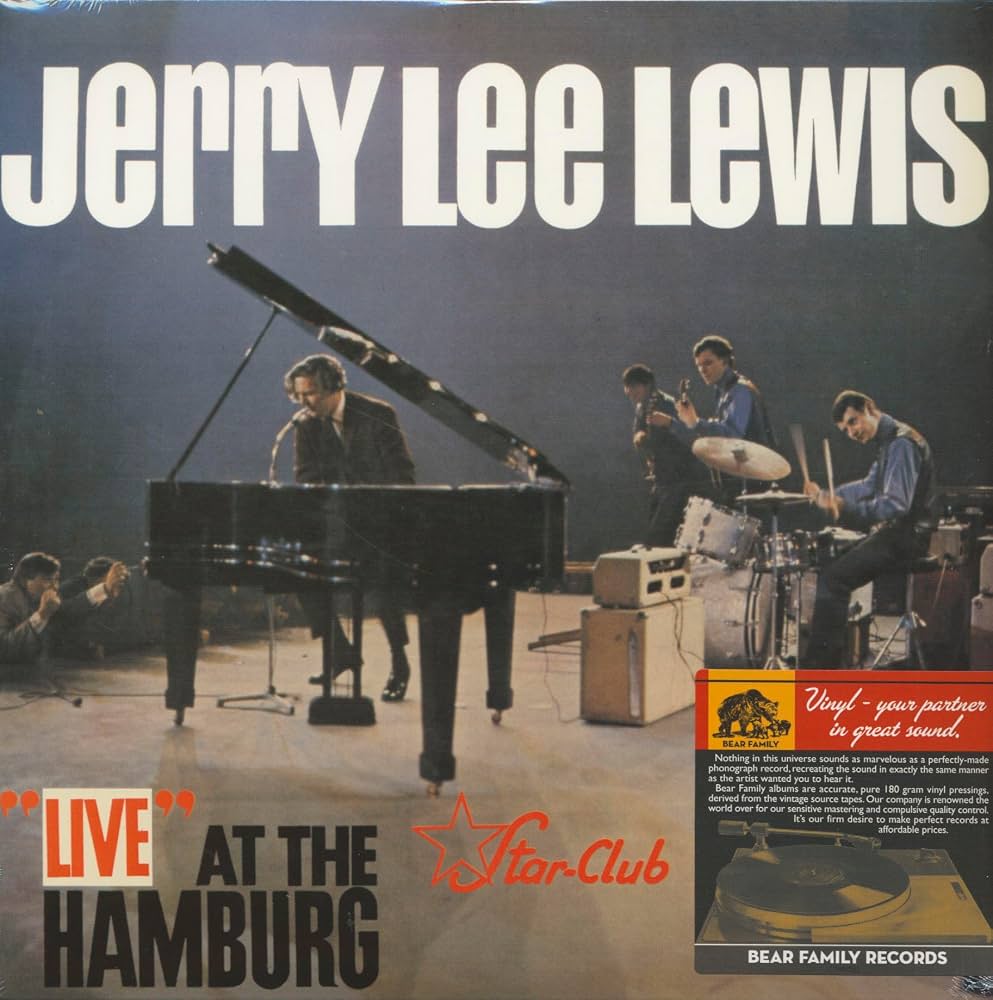
If someone wanted to understand why Jerry Lee Lewis earned the nickname “The Killer,” there may be no better place to start than Live at the Star-Club, Hamburg. Recorded in April 1964 and released the following year, it captures Lewis at perhaps the single greatest live performance of his career—an explosive, unrelenting display of rock and roll that many critics and musicians have called the finest live rock album ever recorded.
The circumstances surrounding the performance make it even more remarkable. By 1964, Lewis was no longer the chart-dominating superstar he had been during the late 1950s. His career had been devastated after revelations about his marriage to his 13-year-old cousin nearly destroyed his popularity outside the American South. While British audiences were embracing the Beatles, the Rolling Stones, and countless other new acts, Lewis arrived in Hamburg with something to prove.
He did much more than that.
For one unforgettable night, Jerry Lee Lewis reminded everyone why he had once terrified, thrilled, and inspired an entire generation of musicians. Accompanied by the Nashville Teens rather than his usual band, he delivered a performance so ferocious that it still feels dangerous more than sixty years later.
This isn’t simply a great concert recording.
It’s rock and roll at its most primal.
Album Overview
Unlike carefully polished live albums assembled from multiple performances, Live at the Star-Club, Hamburg sounds almost completely out of control.
In the best possible way.
The atmosphere is electric.
The audience roars constantly.
The band barely pauses between songs.
Lewis attacks every performance with astonishing intensity, as though determined to exhaust both himself and everyone listening.
The pacing never lets up.
There are no lengthy speeches.
No elaborate introductions.
No unnecessary breaks.
Instead, the album barrels forward with relentless momentum, one classic after another delivered at breakneck speed.
What makes the performance so compelling is its unpredictability.
Lewis constantly stretches tempos.
Changes phrasing.
Improvises lyrics.
Pushes his voice to the breaking point.
The band somehow keeps up with him.
The result feels less like a rehearsed concert than a controlled explosion.
Every second threatens to fall apart.
It never does.
Songwriting
The setlist largely draws from the foundations of American rock and roll, country, rhythm and blues, and gospel.
Although most of the material consists of familiar classics rather than original compositions, Lewis transforms nearly every song into something uniquely his own.
“High School Confidential” explodes with even greater energy than the studio version, fueled by Lewis’ relentless piano playing.
“Great Balls of Fire,” already one of rock’s defining singles, becomes almost frightening in its intensity.
“Whole Lotta Shakin’ Going On” grows even wilder, abandoning studio precision in favor of pure adrenaline.
“Hound Dog” receives one of its fiercest interpretations, while “Long Tall Sally” somehow manages to accelerate even further.
The album also includes excellent renditions of rhythm and blues standards like “Money” and “Matchbox,” demonstrating Lewis’ deep understanding of the music that shaped early rock and roll.
None of these performances attempt faithful reproduction.
Every song becomes an opportunity for reinvention.
Performance
This may be the greatest live performance by a rock singer ever captured on record.
Jerry Lee Lewis is absolutely unstoppable.
Vocally, he sounds possessed.
He growls.
Shouts.
Laughs.
Whispers.
Screams.
Often within the same song.
His voice constantly threatens to lose control but somehow never does.
Behind the piano, he is equally astonishing.
His right hand flies across the keyboard with breathtaking speed.
His left hand pounds relentless rhythms.
Every performance feels physically exhausting.
The Nashville Teens deserve enormous credit.
Keeping pace with Lewis requires extraordinary musicianship, and they respond magnificently.
Their tight, driving accompaniment allows Lewis complete freedom to push songs in unexpected directions without sacrificing momentum.
Perhaps most impressive is Lewis’ command of the audience.
Even without seeing him perform, listeners can hear the crowd reacting to every vocal flourish and piano run.
The excitement becomes contagious.
Decades later, the energy remains almost overwhelming.
Production
Technically, this is not an audiophile recording.
The sound is raw.
Occasionally distorted.
Sometimes rough around the edges.
Yet none of that diminishes the experience.
If anything, the imperfections enhance its authenticity.
The recording captures the overwhelming volume and chaos of the performance remarkably well.
Lewis’ piano cuts through the mix with tremendous force.
His vocals remain front and center.
The audience stays constantly present without overwhelming the music.
Modern recording technology could undoubtedly produce greater clarity.
It would almost certainly lose some of the danger.
The rough production becomes an essential part of the album’s identity.
Polishing it would fundamentally change its character.
Standout Tracks
Although the concert rarely drops below astonishing levels of intensity, several performances stand among the greatest live rock recordings ever made.
“High School Confidential” opens the album with breathtaking energy, immediately announcing that this will be no ordinary live recording.
“Great Balls of Fire” somehow surpasses the already legendary studio version, transforming one of rock’s defining songs into a volcanic live performance.
“Whole Lotta Shakin’ Going On” captures Lewis at his absolute wildest, pushing both his voice and piano playing to extraordinary extremes.
“Hound Dog” becomes a furious celebration of early rock and rhythm and blues, overflowing with personality and improvisation.
“Long Tall Sally” provides one final burst of seemingly impossible energy, leaving listeners wondering how anyone could sustain this level of intensity for an entire concert.
Weak Points
The album’s greatest strength is also its primary limitation.
Its relentless intensity leaves almost no room for contrast.
Listeners expecting quieter moments or emotional ballads may find the nonstop assault somewhat exhausting.
The recording quality, while historically understandable, occasionally obscures instrumental detail beneath the overwhelming volume.
Additionally, because Lewis improvises so freely, a few performances sacrifice polish for spontaneity.
These observations barely qualify as criticisms.
The album succeeds precisely because it refuses to compromise its raw energy.
Legacy
Few live albums have earned as much critical admiration as Live at the Star-Club, Hamburg.
It consistently appears on lists of the greatest concert recordings ever released and has influenced generations of rock performers.
Artists ranging from Bruce Springsteen and Elvis Costello to Joe Strummer and countless punk musicians have praised its unmatched energy and commitment.
The album also served as a powerful reminder that Jerry Lee Lewis remained one of rock’s greatest performers despite the personal controversies that had derailed his mainstream career.
In many ways, the performance anticipated the raw intensity of garage rock, punk, and heavy metal long before those genres formally existed.
It demonstrated that technical perfection mattered far less than passion.
Few albums embody that philosophy more completely.
Final Score: 10/10
Live at the Star-Club, Hamburg is not simply one of the greatest live rock albums ever recorded—it is one of the greatest live albums in any genre. Jerry Lee Lewis delivers a performance of staggering energy, supported by the outstanding Nashville Teens, creating an hour of music that remains thrilling, unpredictable, and utterly exhilarating.
The rough recording quality only enhances the sense of danger, preserving a performance that feels as though it could collapse into glorious chaos at any moment. Every song burns with urgency, every piano solo explodes with invention, and every vocal performance reminds listeners why Lewis was one of the most electrifying entertainers popular music has ever produced.
Rock and roll has produced countless legendary live recordings, but very few match the sheer ferocity of Live at the Star-Club, Hamburg. It remains a towering achievement, capturing one of music’s greatest performers at the absolute height of his powers.
This post has already been read 71 times!