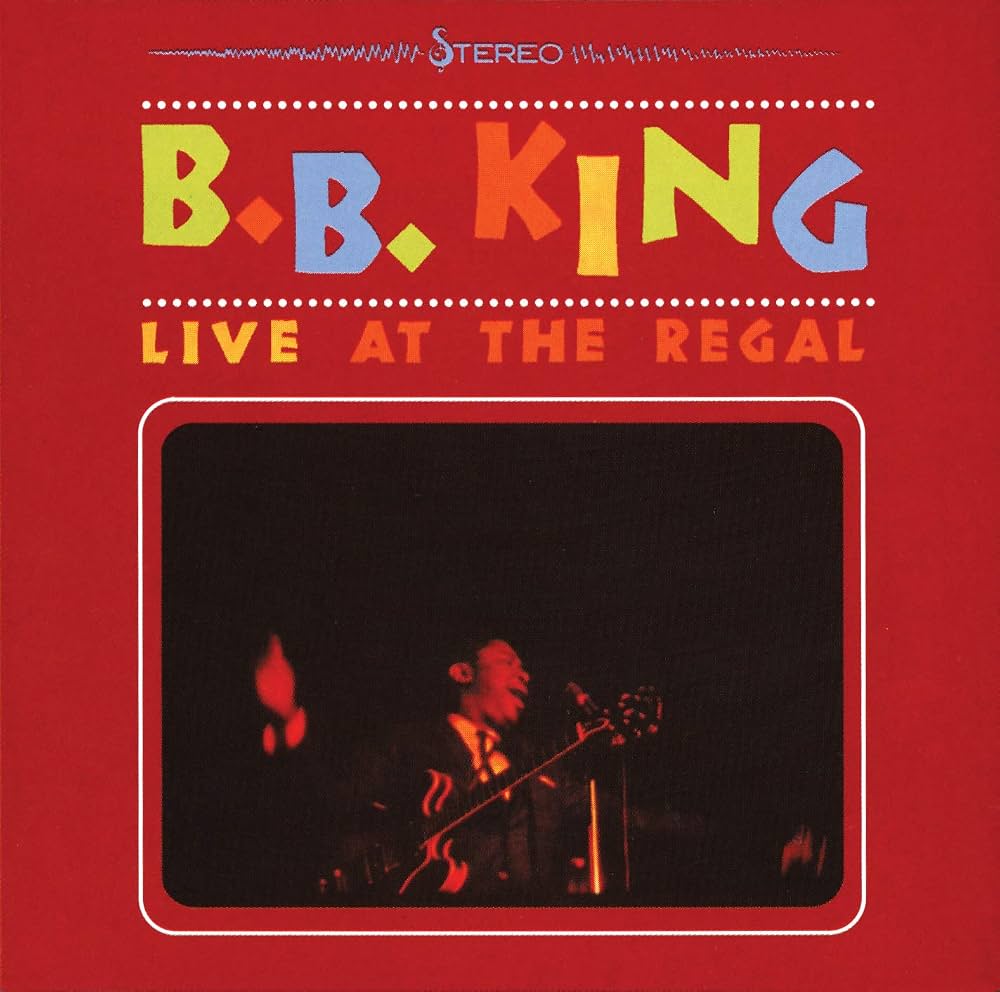
The smoky, sweat-drenched air of Chicago’s Regal Theatre on a cold November night in 1964 became the staging ground for the most definitive live statement in the history of the blues. B.B. King was already a tireless titan of the Chitlin’ Circuit, but Live at the Regal captured something far more profound than a routine tour stop. It immortalized an master communicator at the absolute absolute apex of his powers, commanding an audience with the precision of a symphonic conductor. This performance did not just capture a musical set; it documented a living, breathing dialogue between a working-class Black community and its musical monarch—a display of emotional release, sophisticated guitar economy, and vocal passion that set the gold standard for electric blues performance forever.
What makes this record a towering monument is its preservation of a pristine, high-stakes communal ritual. The Regal Theatre was the Apollo of the Midwest, populated by a sharp, highly discerning audience that expected absolute commitment. Backed by a razor-sharp, impeccably disciplined band featuring a driving horn section and a swinging rhythm unit, King stepped onto the stage not to play at his listeners, but to orchestrate a collective exorcism of their daily struggles. Live at the Regal tracks this communion with jaw-dropping fidelity, revealing a performance where the crowd’s ecstatic screams, collective groans, and vocal affirmations function as an essential, polyphonic instrument in the overall mix.
The Vibrato and the Void: The Architecture of Lucille
To fully dissect the brilliance of this performance, one must look at how King fundamentally revolutionized the language of the electric guitar. Rejecting the frantic, note-heavy chordal strumming common to early rock-and-roll, King treated his Gibson guitar—affectionately named Lucille—as a surrogate human voice. He pioneered a highly sophisticated, minimalist technique built around fluid string-bending, vocalistic phrasing, and a signature, piercing finger-vibrato that could convey a lifetime of heartbreak in a single, sustained note.
This spatial economy is the core engine of the entire performance. King understood the power of the musical void; he used silence and dramatic pauses as effectively as he used notes. He would fire off a stinging, single-note line that sliced through the horn section, let it hang in the air while his wrist vibrated the string, and then wait for the audience’s visceral reaction before delivering his next vocal line.
On the legendary opening sequence of “Every Day I Have the Blues,” this architectural precision is on full display. The horn section establishes a swinging, driving big-band groove, but the moment King strikes his first fluid, high-register note on Lucille, the entire sonic field shifts. His tone is remarkably clean, sharp, and biting, cutting through the venue with a horn-like clarity. He doesn’t play solos so much as engage in a frantic, call-and-response duet with himself, answering his own rich, gospel-inflected vocal phrases with short, weeping commentary from his guitar. It was a flawless demonstration of electric blues phrasing, proving that complexity lay not in the speed of the run, but in the emotional weight of the note.
The Symbiotic Script of Romantic Disillusionment
Lyrically and structurally, the album moves through a carefully curated narrative of romantic struggle, shifting seamlessly from vulnerable desperation to sharp, world-weary irony. King speaks directly to the shared experiences of his audience, using the blues as a tool for emotional validation and collective healing.
In the devastating mid-album suite of “Sweet Little Angel” and “It’s Our Own Fault,” King holds the theater entirely spellbound. During “Sweet Little Angel,” when he sings about his lover spreading her wings over him, he bends a high, crying note on Lucille that perfectly mimics a human sob. The crowd reacts with a literal, collective roar of recognition. King rides this wave of crowd energy with a master showman’s pacing, dropping his voice down to an intimate, conversational whisper before exploding into a full, resonant belt. He portrays a man completely exposed by love and financial hardship, yet he delivers these confessions with a dignified, majestic authority that elevates the material from standard blues cliché into high tragedy.
This emotional intensity is brilliantly balanced by King’s razor-sharp, comedic wit on tracks like “How Blue Can You Get.” Built on a slow, mounting twelve-bar blues structure, the song serves as a masterclass in dramatic tension. As the band plays a quiet, pulsing rhythm, King systematically lists the absurd, humiliating sacrifices he has made for a lover, culminating in the iconic, rising crescendo: “I gave you a brand new Ford / You said ‘I want a Cadillac’ / I bought you a ten-dollar dinner / You said ‘Thanks for the snack’.” With every line, the horns swell, the drums hit harder, and the audience grows increasingly frantic, until King delivers the final, crushing punchline—“I let you live in my penthouse / You said ‘This is a shack'”—with a roaring vocal intensity that brings the house down.
The Blueprint for the British Blues Explosion
The historical fallout of Live at the Regal reverberated across the Atlantic, functioning as the ultimate textbook for the young, white British musicians who would go on to reinvent rock music in the late 1960s. The record’s absolute mastery of tone and economy became the primary source material for an entire generation of guitar virtuosos.
Eric Clapton, Mick Taylor, Jeff Beck, and Peter Green have all cited this specific live album as the holy grail of electric guitar playing. Clapton famously noted that before his exposure to this record, he didn’t know how a guitar could truly speak to an audience. The singing, sustained lead-guitar style that defined the music of Cream, Fleetwood Mac, and Led Zeppelin is a direct, unvarnished descendant of the phrasing King executed at the Regal. Furthermore, his seamless fusion of urban big-band jazz arrangements with raw, Mississippi Delta emotionality created a crossover blueprint that helped slide the blues from the fringes of the R&B charts into the global cultural mainstream.
Conclusion: The Sovereign Achievement of Live Music
Live at the Regal remains an extraordinary, unmatched masterpiece because it captures the pure, unrepeatable lightning of a live communion that cannot be manufactured within the sterile walls of a recording studio. It stands as a timeless monument to the power of showmanship, technical discipline, and cultural authenticity.
It demands to be experienced as a singular, cohesive historical document—an immaculate preservation of an era when the blues was a vibrant, immediate, and completely contemporary urban language. In a modern musical landscape dominated by digital perfection and sterile isolation, B.B. King’s 1964 performance remains a warm, vital reminder of what music sounds like when it is forged in the fire of human connection, sweat, and absolute artistic authority. It is an flawless, genre-defining classic that remains the definitive blueprint for any musician who dares to step on a stage and pick up an electric guitar.
Final Score: 10 / 10
This post has already been read 64 times!