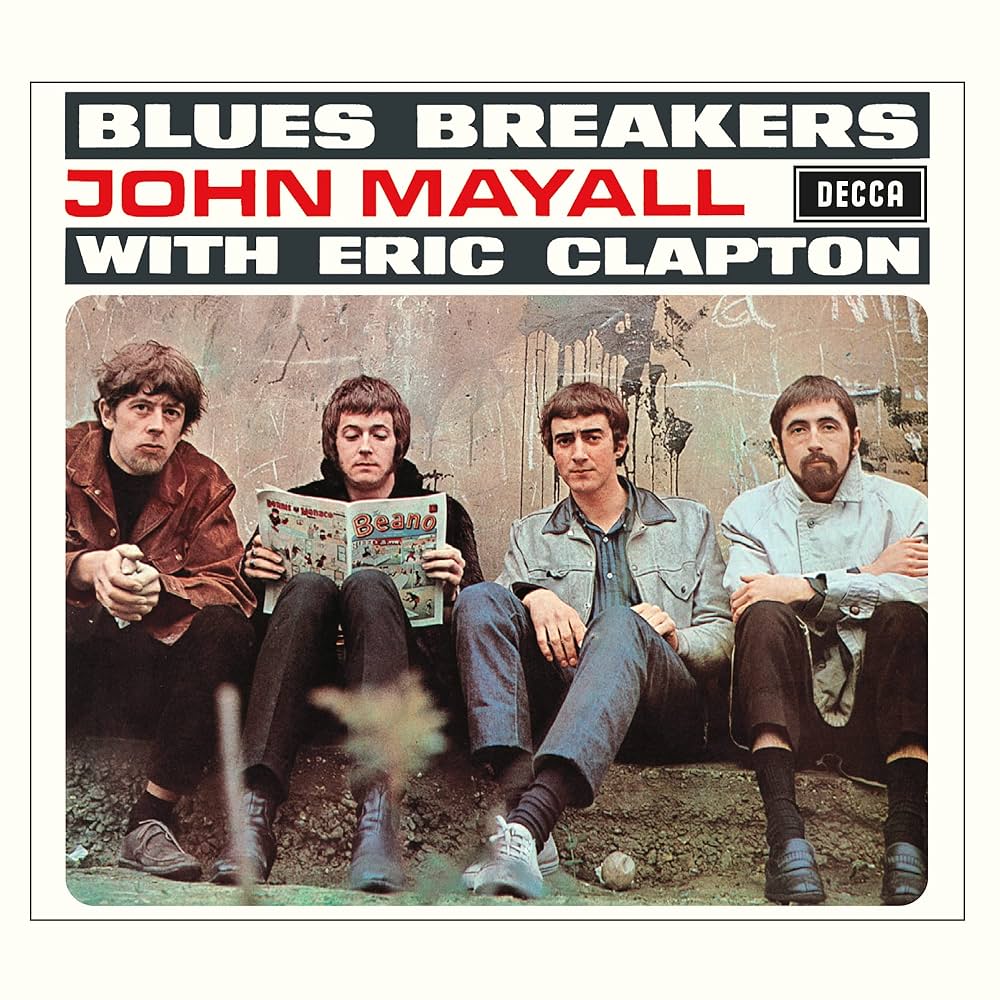
The rain-slicked streets of London’s West End became the incubator for an entirely new musical theology during the spring of 1966. For months, the phrase “Clapton is God” had been spray-painted across Islington tube stations, a piece of urban folklore referencing a twenty-one-year-old guitarist who had abandoned the pop stardom of The Yardbirds to pursue an uncompromisingly purist path. When he joined multi-instrumentalist John Mayall’s rotating collective, the stage was set to capture this underground phenomenon on magnetic tape. The resulting self-titled album, universally known as the “Beano” album due to Clapton’s choice of reading material on the cover, stands as the absolute ground zero for the British blues-rock explosion. It is the record that permanently shifted the electric guitar from an accompanying pop instrument to a soaring, heavy vehicle for existential expression.
Before this release, British blues was largely an academic, reverent exercise—a polite emulation of Chicago and Delta giants. Mayall and Clapton dismantled that acoustic conservatism by introducing an unprecedented element of sheer volume and electronic sustain. Under the guidance of producer Mike Vernon at Decca Studios, Clapton did something completely radical for the era: he plugged his 1960 Gibson Les Paul Standard directly into a Marshall Model 1962 combination amplifier and cranked the volume to its absolute threshold. This simple act of sonic defiance pushed the vacuum tubes into a natural, thick distortion that horrified the studio engineers but completely revolutionized the industry. It was a white-hot, fluid guitar tone that gave the blues a heavy, industrial power, capturing the restless angst of British youth and exporting it back to the global mainstream.
The Engineering of Sustainable Overdrive
To understand why this record shook the foundations of rock music, one must look closely at the mechanical subversion of Clapton’s studio setup. Up until 1966, recording engineers insisted that guitarists keep their amplifiers quiet, clean, and miked from a distance to prevent overloading the console. Clapton flatly refused, forcing Vernon to place the microphone across the room to capture the natural acoustic ambience of a Marshall combo running at full blast. This allowed the notes to sustain indefinitely, transforming the crisp, single-note stings of urban blues into a thick, singing wall of audio.
This heavy, saturated tone serves as the central engine for the album’s opening track, “All Your Love.” Originally a moody, minor-key rumba recorded by Otis Rush, the Blues Breakers transform it into a driving, high-voltage showcase. The track swings on John McVie’s precise, walking bassline and Hughie Flint’s sharp drumming, but it is hijacked entirely by Clapton’s guitar work. During the song’s uptempo instrumental bridge, his Les Paul cuts through the mix with a biting, overdriven attack that sounds remarkably heavy for 1966. He strings together fluid, vocalistic phrases that rely heavily on a fierce finger-vibrato, mirroring the spatial economy of B.B. King but injecting it with an unprecedented, explosive power. It was a historic recording session that established the definitive tonal template for the entire classic-rock era.
John Mayall’s Archival Vision and Dynamic Leadership
While the record is celebrated as a monumental showcase for Clapton, its architecture owes everything to the rigorous discipline and historical curation of John Mayall. Functioning as a jazz-like bandleader and a dedicated blues archivist, Mayall structured the band to support the guitar while ensuring the arrangements retained an organic, swinging authenticity. Mayall’s own contributions on Hammond organ, harmonica, and vocals provide a gritty, seasoned foundation that anchors the album’s fiery virtuosity.
In their interpretation of Freddie King’s instrumental classic, “Hideaway,” Mayall’s leadership allows Clapton to execute a flawless, high-octane guitar manifesto. Mayall’s organ padding lays down a smoky, rhythmic cushion, giving the track a driving club atmosphere. Clapton rolls through the complex, multi-part blues shuffle with a effortless, swaggering precision, altering his pick attack to coax different harmonic overtones from his Marshall speaker cones. The performance is an absolute tour de force of physical execution, demonstrating an intricate knowledge of American blues vocabulary while pushing the tempo into something far more aggressive, fast, and demanding than the original text.
Mayall pushes the band’s emotional boundaries on his original compositions, most notably the jazz-inflected “Have You Heard.” Driven by a soaring, muscular horn arrangement arranged by Mayall himself, the track moves with a slow, agonizing twelve-bar crawl. Mayall delivers a passionate, world-weary vocal about romantic isolation, answering his own verses with weeping harmonica runs. When Clapton takes the center stage for his extended solo, his tone turns remarkably fat and vocal, sustaining through minor-key lines that feel uncomfortably intimate. The interplay between Mayall’s sophisticated horn charts and Clapton’s raw, overdriven distortion creates an immense dramatic tension, proving that the blues could be elevated to a complex, symphonic level without losing its street-level grit.
Reimagining the Roots and the Solo Spotlight
The album’s second half deepens this exploration of blues history, moving from raucous garage-rock workouts to a historic, unaccompanied vocal performance that hinted at the future direction of heavy rock.
The band’s take on Robert Johnson’s “Ramblin’ on My Mind” marks a pivotal milestone in rock history: it features Eric Clapton’s very first lead vocal performance on a record. Arranged with a sparse, intimate framework, the song relies on Mayall’s gentle, rolling barrelhouse piano and a subtle acoustic guitar strum. Clapton’s vocal delivery is notably raw, unpolished, and vulnerable, lacking the confidence of his guitar playing but possessing an undeniable, earnest charm. His acoustic solos dart in and out of the steady piano rhythm, utilizing intricate fingerpicking and microtonal string bends that pay direct, humble homage to the Delta roots of the music. It was a rare, quiet moment of introspective purity on an album otherwise defined by massive electronic volume.
This restraint is violently cast aside on tracks like “Steppin’ Out,” a fast, frantic instrumental showcase written by Memphis Slim. The track functions as an absolute velocity test for the rhythm section, with Flint and McVie locking into an unyielding, driving groove that prefigures the heavy rhythm sections of late-60s arena rock. Clapton tears through the arrangement with a feral, amphetamine-fueled energy, unleashing a torrent of rapid-fire triplets, chromatic runs, and heavily distorted feedback cues. The guitar no longer sounds like a standard instrument; it growls, screams, and pushes against the boundaries of the recording tape, executing a level of pure sonic weight that left listeners completely astonished.
The Creation of the Guitar Hero Archetype
The cultural and industry fallout of the Blues Breakers album permanently transformed the sociology of popular music. By placing the lead guitarist’s tone, improvisational skill, and technical gear choices at the absolute center of the artistic presentation, the record effectively birthed the modern concept of the “Guitar Hero.”
Within months of its release, the combination of a Gibson Les Paul and a Marshall amplifier became the mandatory, holy grail rig for any aspiring rock musician, directly shaping the sonic identities of Jimi Hendrix, Peter Green, and Mick Taylor. The record served as an essential textbook for the transition from folk-based blues into the heavy psych-rock explosions of the late 1960s. After this album, Clapton would leave Mayall to form Cream, taking the overdriven, sustaining techniques he perfected on the “Beano” sessions and using them to construct the open-ended, improvisational power-trio framework that dominated the festival circuits of the late-20th century.
Conclusion: A Monument Frozen in Overdrive
John Mayall with Eric Clapton’s Blues Breakers remains an extraordinary, vital masterpiece because it captures the precise moment an underground subculture found its definitive voice. It is an album that refuses to compromise its historical roots for pop accessibility, standing as a timeless monument to technical discipline, sonic innovation, and raw emotional power.
It demands to be experienced in its original, punchy monaural format—the exact way Mike Vernon engineered it to ensure that the roaring Marshall amplifier and the driving rhythm section functioned as a singular, crushing wall of blues energy. In a historical landscape that often prioritizes the psychedelic pop of the mid-1960s, this record stands as a fierce reminder of the power of electricity, volume, and absolute commitment to a musical lineage. It is an flawless, genre-defining classic that remains the ultimate Rosetta Stone for any musician who wishes to pick up an electric guitar and speak to the world.
Final Score: 9.5 / 10
This post has already been read 66 times!