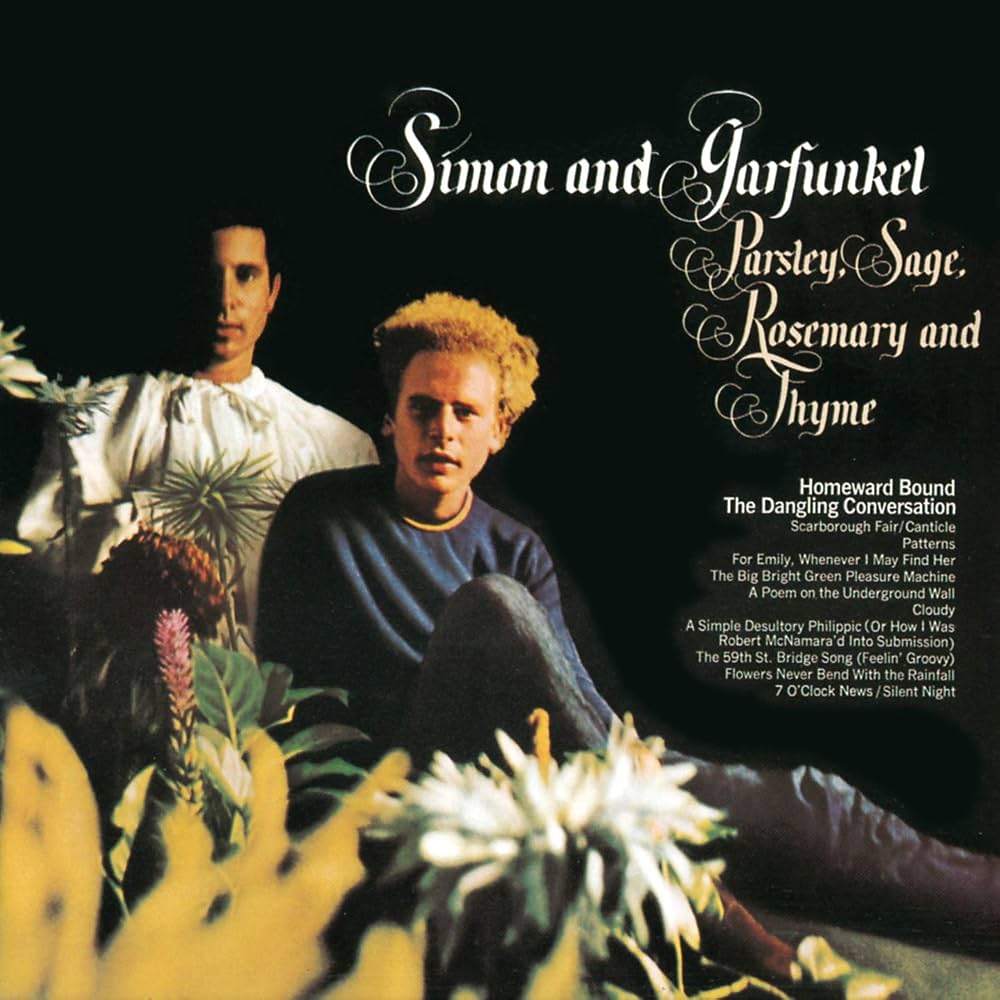
Emerging from the tail end of the folk revival, Parsley, Sage, Rosemary and Thyme stands as a breathtaking refinement of the duo’s vocal and instrumental craft. Following the studio success of their folk-rock conversion, Paul Simon and Art Garfunkel retreated to Columbia Studios in late 1966 to build a record defined by its meticulous arrangements, crystalline harmonies, and a newfound sense of atmospheric introspection. Far from the protest-driven literalism of their early work, this album represents the duo fully embracing the studio as an instrument, crafting a lush, chamber-pop soundscape that feels both ancient and remarkably modern. It is an exquisite, highly disciplined document that captured the precise moment the acoustic duo evolved into masterful, studio-savvy pop auteurs.
Production-wise, the record is a masterclass in the economy of sound. Working closely with producer Bob Johnston, the duo utilized a surprisingly sparse set of session musicians—often relying on little more than Simon’s rhythmic acoustic guitar work and the precise, understated drumming of Hal Blaine. This restraint allowed the duo’s signature vocal blending to occupy the absolute center of the mix. Their voices do not merely harmonize; they entwine, creating a singular, ethereal texture that feels both incredibly intimate and unnervingly precise. Parsley, Sage, Rosemary and Thyme proved that the most powerful tool in pop music was not volume or distortion, but the quiet, devastating tension found in two human voices singing in perfect, suspended isolation.
The Masterclass of Lyrical Miniature
At the heart of the album is Paul Simon’s burgeoning genius for the lyrical miniature—the ability to pack a complete, emotionally resonant world into a three-minute song. Eschewing the grand, sweeping narratives that defined the protest movement, Simon turned his focus inward, crafting observant, slightly surreal vignettes that felt like fleeting, high-resolution snapshots of the mid-sixties urban experience.
The opener, “Scarborough Fair/Canticle,” remains one of the most stunning achievements in folk-rock history. It is a brilliant, layered structural experiment that combines a traditional, haunting English ballad with a contemporary, politically charged counter-melody titled “Canticle.” The arrangement is an absolute marvel of studio artifice: the track is built around a complex, multi-tracked acoustic guitar figure that creates a shimmering, hypnotic drone. Above this, the voices of Simon and Garfunkel emerge like a ghostly, choral presence, layered with reverb to evoke a sense of deep, timeless space. It is a chillingly beautiful, highly literate composition that manages to link the ancient trauma of war with the immediate, simmering unrest of 1966, proving that pop music could be both intellectually rigorous and deeply mesmerizing.
This talent for atmospheric precision reaches a different, far more cynical peak on “The Dangling Conversation.” A devastatingly sharp portrait of a failing, overly intellectualized relationship, the track utilizes a stark, piano-and-strings arrangement that feels clinically precise. The song’s central metaphor—a couple trapped in an existential stalemate, unable to connect beyond the superficial safety of poetry and politics—is executed with a ruthless economy of language. Simon’s vocal is notably detached, almost weary, while Garfunkel’s harmonies provide a soft, aching bed that emphasizes the emotional distance between the two characters. It is an unflinching look at the paralysis of the urban intelligentsia, showcasing a band that had completely abandoned the romantic optimism of the early folk scene.
The Cinematic Power of the Urban Vignette
While many of the tracks lean into the melancholic and the baroque, the record also demonstrates the duo’s underrated ability to paint vivid, cinematic portraits of the everyday. Simon’s writing on this record often feels like it was lifted directly from the pages of a short-story collection, focusing on the quiet, strange, and often funny moments of human disconnection that exist on the periphery of the major cultural shifts of the era.
In “A Hazy Shade of Winter,” the band breaks away from the acoustic-focused palette for a bracing, rock-oriented punch. Driven by a fast, aggressive acoustic riff and a driving, percussive bassline, the song is a brilliant, taut exercise in rhythmic urgency. The lyrics capture the creeping, pervasive anxiety of a changing season, utilizing the cold, bleak imagery of late autumn to mirror the speaker’s own internal stagnation. It is a remarkably sophisticated piece of writing, capturing the feeling of time slipping away with an efficiency that feels almost kinetic. The vocal delivery is sharp and urgent, lacking the soft, choral sweetness of other tracks, and instead opting for a hard, angular precision that perfectly suits the song’s restless, searching energy.
This cinematic observation is turned toward the delightfully odd on “The 59th Street Bridge Song (Feelin’ Groovy).” Functioning as a perfectly timed, sun-drenched antidote to the album’s deeper existential dread, the track is a masterclass in rhythmic levity. Driven by a simple, syncopated acoustic strum and a driving, upright bass line, the song is a joyful, minimalist celebration of the simple act of slowing down in a fast-moving world. It is a song that feels entirely weightless, a perfectly crafted piece of pop that relies on the simple pleasure of a hummed melody and the shared experience of an idle, beautiful morning. It remains one of the duo’s most endearing, optimistic moments, standing as a bright, essential anchor in a record otherwise defined by its deep, baroque introspection.
The Legacy of the Chamber-Pop Standard
The long-term historical impact of Parsley, Sage, Rosemary and Thyme is etched into the very foundation of the chamber-pop and indie-folk movements. By proving that a record could be a quiet, meticulously constructed, and deeply literary statement, Simon & Garfunkel provided a roadmap for generations of artists who prioritized technical precision and lyrical intimacy over raw, arena-filling volume.
The album’s influence on the late-1960s and 1970s singer-songwriter boom cannot be overstated. The delicate, layered acoustic textures and high-fidelity vocal stacking pioneered by Simon & Garfunkel served as the primary creative benchmark for artists ranging from Nick Drake to Joni Mitchell. Later generations, including the minimalist indie-folk of Iron & Wine, the baroque sensibilities of Fleet Foxes, and the urban storytelling of Sufjan Stevens, are all direct descendants of the structural and emotional DNA codified on this record. They proved that acoustic-based music could hold as much atmospheric weight, sophistication, and narrative depth as any of the explosive rock albums of the day, successfully creating a new, permanent space for the introspective, literate pop record.
Conclusion: A Masterpiece of Suspended Intimacy
Parsley, Sage, Rosemary and Thyme remains an extraordinary, vital masterpiece because it captures the duo at the exact moment they mastered the art of studio-based storytelling. It is an album that feels perfectly composed and elegantly contained, standing as a timeless monument to the power of harmonic precision, restrained instrumentation, and deeply observant lyricism.
It demands to be experienced in its original, high-fidelity monaural mix—the exact way the engineers balanced the voices to ensure the duo’s harmonies sat within the lush, acoustic arrangements as a singular, unified force. In a historical landscape that often prioritizes the louder, more aggressive psych-rock experiments of the mid-1960s, this record stands as a fierce, necessary reminder of the power of quietude and the immense, expansive potential of the acoustic instrument. It is an flawless, genre-defining classic that remains as intricate, haunting, and beautiful today as it was the moment the final note faded into the silence.
Final Score: 9.5 / 10
This post has already been read 54 times!