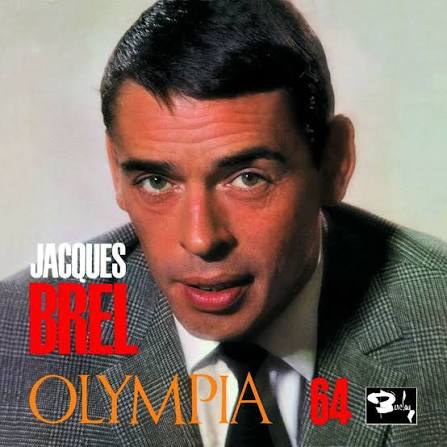
To witness Jacques Brel on a concert stage was to watch a man slowly, deliberately destroy himself for art. He did not merely interpret songs; he lived them as physical crises, sweating through immaculate suits, spitting out syllables like venom, and straining his vocal cords until they threatened to snap. Nowhere is this devastating, awe-inspiring theatricality captured more potently than on Olympia 64. Recorded over a legendary residency at Paris’s premier music hall in October 1964, this live album stands as the definitive, terrifying monument to Brel’s genius. It is the moment the Belgian master of the chanson transcended the boundaries of popular music to transform the stage into a secular confessional and a psychological battleground.
By 1964, the French chanson traditional landscape was undergoing a profound identity crisis. The clean-cut, romantic balladeers of the post-war era were being pushed aside by the tidal wave of Anglo-American rock-and-roll and the commercialized sunshine of the yé-yé movement. Amidst this backdrop of pop triviality, Brel stood as a defiant, towering anachronism. Olympia 64 is the record that effectively drew a line in the sand, proving that raw human emotion, existential dread, and unvarnished poetic truth could still hold an audience hostage. It captures an artist operating at the absolute zenith of his powers, backed by a tight, dynamic orchestra that understood his erratic, physical pacing perfectly.
The Dynamic Architecture of Live Desperation
What separates Olympia 64 from Brel’s studio recordings is the terrifying sense of immediacy. In the studio, Brel’s songs were immaculate compositions; on the stage of the Olympia, they became living, breathing entities fueled by the presence of a live audience. The sequencing of the performance mimics a psychological descent, starting with sharp, observational vignettes before plunging headfirst into the dark, churning waters of human obsession and mortality.
The true engine of this recording is the unparalleled interplay between Brel and his long-time orchestrator and pianist, Gérard Jouannest. Together, they mastered the art of the dramatic crescendo—a technique where a song begins as a quiet, conversational murmur and steadily gathers momentum until it mutates into a frantic, chaotic juggernaut.
In “Amsterdam,” a song that Brel famously chose never to record in a studio, this approach is weaponized to stunning effect. The track opens with a melancholic, rolling accordion line that evokes the gentle swaying of ships in a dark harbor. Brel begins his narrative with a rough, gravelly intimacy, painting a vivid, unglamorous picture of sailors drinking, weeping, and whoring on the docks. As the verses progress, the tempo accelerates, the orchestration swells, and Brel’s voice ascends into a feral, desperate roar. By the time he reaches the final stanzas, the song has transformed into a dizzying, carnivalesque nightmare. The sheer physical exhaustion in Brel’s delivery is palpable through the speakers; he is not just singing about the sailors, he is drowning with them.
The Fearless Anatomy of Human Frailty
Lyrically and thematically, Olympia 64 represents a ferocious interrogation of the human condition. Brel was a poet of contradictions, equally capable of profound tenderness and blistering, misanthropic cynicism. On this stage, he exposes the rot beneath bourgeois respectability, the agonizing sting of aging, and the humiliating, pathetic lengths to which a human being will go to secure love.
In the legendary “Ne me quitte pas,” Brel delivers what is arguably the most devastating exploration of romantic dependency ever captured on tape. While studio versions of the track possess a certain polished, cinematic melancholy, the 1964 live rendition is stripped of all safety nets. Brel’s voice trembles not out of technical weakness, but out of a profound, calculated vulnerability. He portrays a man completely broken by the prospect of abandonment, offering to become “the shadow of your shadow, the shadow of your dog” just to remain in his lover’s presence. The sparse accompaniment of piano and understated strings forces the listener to confront the sheer, uncomfortable pathology of the lyric. It is not a romantic ballad; it is an act of total, public capitulation.
Conversely, Brel flips this emotional coin entirely with tracks like “Les Bourgeois.” Here, his razor-sharp wit and contempt for societal conformity take center stage. The song is a raucous, theatrical middle finger to the self-righteous middle class, driven by a bouncing, sarcastic rhythm. Brel sneers, spits, and alters his vocal timbre to embody both the rebellious, drunken youth and the pompous, aging elites they eventually become. It is a brilliant, tragicomic reminder that for all of Brel’s capacity for tragedy, he possessed a wicked, satiric edge that could dismantle social structures in a single verse.
A Theatrical Masterclass in the Absence of Visuals
The true miracle of Olympia 64 as an audio artifact is its ability to convey a deeply physical, visual performance through sound alone. Brel was a master of mime and facial expression; he famously used his lanky frame, expressive hands, and distorted features to paint pictures in the air. On a purely sonic level, this physicality translates into an incredible array of vocal textures, breathing patterns, and micro-pauses that keep the listener in a perpetual state of tension.
In “Au suivant,” a harrowing critique of the dehumanizing nature of military life and institutionalized sex, the physical theater is embedded directly into the rhythm. The song marches forward with the mechanical, relentless thud of a military procession. Brel’s delivery is clipped, frantic, and biting. You can hear the venom in his plosives and the desperate gasp for air between lines as he embodies the trauma of young men being herded like cattle. The performance is so visceral that the lack of video becomes irrelevant; the sweat, the glare of the stage lights, and the claustrophobia of the brothel are completely conjured by the sheer force of his vocal choices.
Even in moments of lighter celebration, such as “Madeleine,” the audio track crackles with an almost unbearable kinetic energy. The song chronicles a hopeless romantic waiting in the rain for a date who will never show up. The music bounces with a frantic, optimistic polka rhythm that grows increasingly desperate as the minutes tick away. Brel’s voice pushes faster and faster against the beat, capturing the manic, deluded hope of the protagonist. When the orchestra hits its final, explosive chord, the eruption of applause from the Olympia crowd feels less like standard concert appreciation and more like a collective sigh of relief from an audience that has been holding its breath for three minutes.
The Undying Echo of the Chanson Concrete
The historical significance of Olympia 64 cannot be overstated. It represents the absolute zenith of the auteur-driven chanson format right before the global monoculture permanently shifted the landscape of popular music. Brel’s performance on this record established a blueprint for emotional honesty that would ripple across borders, deeply influencing iconoclastic artists for generations to come.
Without the visceral theatricality codified by Brel on the Olympia stage, the chameleonic performance art of David Bowie’s Ziggy Stardust era is difficult to imagine. Bowie was a noted disciple of Brel, famously covering “Amsterdam” and “My Death,” drawing directly from the Belgian’s dark, dramatic well. Similarly, the dramatic, literate punk-rock of artists like Scott Walker, Nick Cave, and Marc Almond flows directly from the emotional architecture laid down on this album. Brel proved that pop music did not have to be comforting or polite; it could be a dangerous, high-stakes exposure of the soul.
Conclusion: The Ultimate Document of Stagecraft
Olympia 64 remains an essential, monumental document because it captures the fleeting, volatile magic of live performance in its purest form. It is an album that refuses to serve as background music; it demands absolute attention, pulling the listener into the smoke-filled, electric atmosphere of 1964 Paris and refusing to let go until the final bow.
It stands as a stark, timeless reminder of what happens when an artist holds nothing back, burning through their own physical and emotional reserves in service of the song. Olympia 64 is not just the greatest live album in the history of francophone music—it is one of the most transcendent displays of raw human communication ever captured on magnetic tape. It is an absolute, flawless masterpiece that preserves the sweat, the tears, and the terrifying genius of Jacques Brel for eternity.
Final Score: 10 / 10
This post has already been read 53 times!