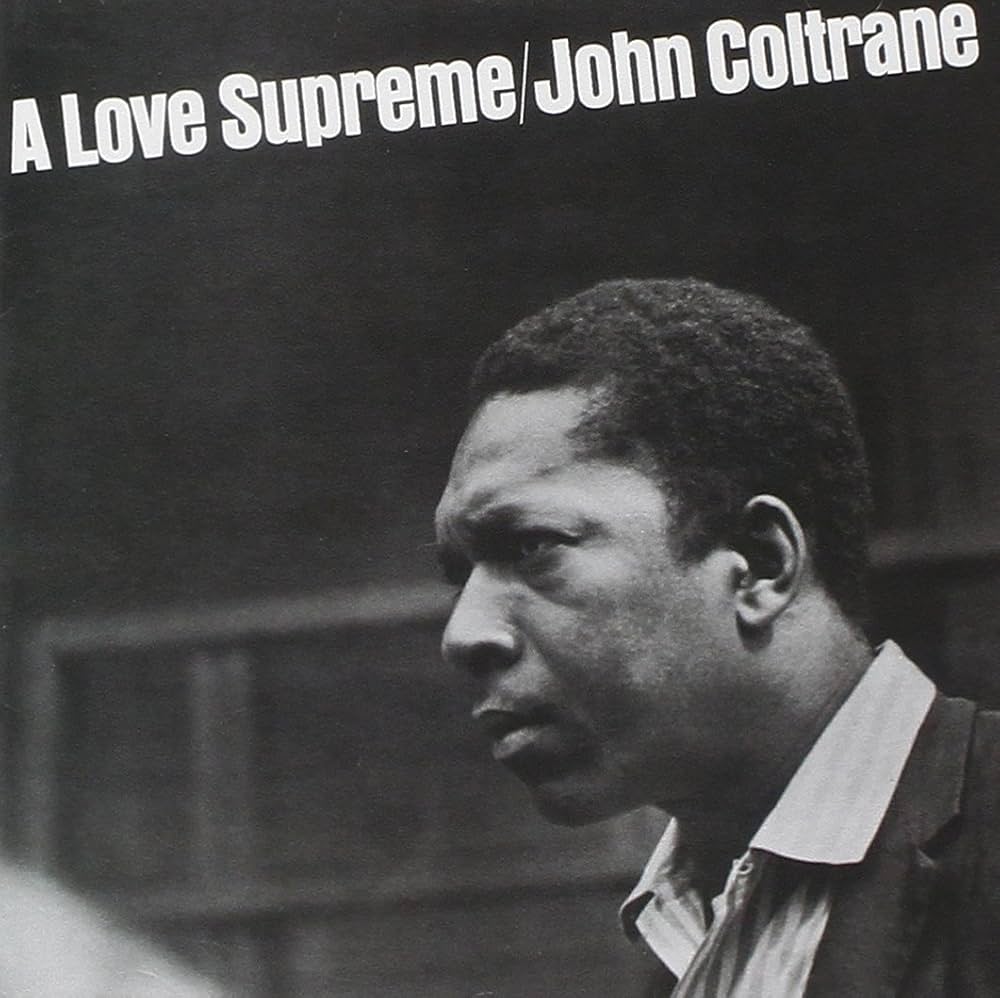
Some albums are admired for their musicianship. Others are celebrated for their innovation. A select few transcend those categories entirely, becoming deeply personal artistic statements that resonate far beyond music itself. A Love Supreme belongs firmly in that final group.
Released in 1965, A Love Supreme is more than a jazz masterpiece—it’s a spiritual testament. Following years of personal struggles and addiction earlier in his life, John Coltrane experienced a profound spiritual awakening that reshaped both his worldview and his music. This four-part suite serves as an expression of gratitude, faith, humility, and devotion, communicated through one of the most extraordinary performances in jazz history.
The remarkable thing is that you don’t need to understand jazz theory—or even Coltrane’s spiritual intentions—to feel its power. The emotion is immediate, the conviction undeniable, and the music endlessly rewarding.
Album Overview
Recorded in a single session in December 1964 and released in early 1965, A Love Supreme features what many consider John Coltrane’s greatest quartet:
- John Coltrane – tenor saxophone
- McCoy Tyner – piano
- Jimmy Garrison – bass
- Elvin Jones – drums
The album unfolds as a continuous four-part suite:
- Acknowledgement
- Resolution
- Pursuance
- Psalm
Each movement represents a different stage of Coltrane’s spiritual journey, creating an experience that feels unified rather than episodic. While individual sections contain unforgettable musical moments, the album is most powerful when heard from beginning to end.
Unlike many jazz records built around collections of standards or unrelated originals, A Love Supreme functions as a complete artistic statement. Every note contributes to a larger emotional and philosophical narrative.
Songwriting
Calling this “songwriting” almost undersells what Coltrane accomplishes here.
The compositions are remarkably economical. Rather than relying on complex melodies or elaborate harmonic progressions, Coltrane builds much of the suite from concise musical ideas that gradually evolve through improvisation and interaction.
The famous four-note bass motif introduced in “Acknowledgement” becomes one of the most recognizable themes in jazz history. Simple on paper, it serves as the foundation for an extraordinary emotional journey.
Throughout the suite, recurring motifs create cohesion while leaving enormous room for spontaneous expression. Every section develops naturally into the next, making the album feel less like four compositions and more like four chapters of the same prayer.
The final movement, “Psalm,” is especially remarkable. Coltrane’s saxophone effectively “reads” a devotional poem he had written, matching the rhythm and emotional contours of the text without using words.
It’s one of the most innovative compositional concepts ever recorded.
Performance
Every member of the quartet delivers career-defining work.
John Coltrane’s playing is breathtaking.
His tone ranges from whisper-soft lyricism to explosive sheets of sound, yet every phrase feels purposeful. Even during his most intense improvisations, there’s an underlying sense of direction that prevents the music from becoming chaotic.
McCoy Tyner provides harmonic richness through his powerful chord voicings and distinctive modal approach. His piano never competes with Coltrane but constantly elevates the emotional intensity of the music.
Jimmy Garrison anchors the suite with unwavering confidence. His opening bass solo in “Acknowledgement” introduces the album with quiet authority, while his rhythmic foundation remains indispensable throughout.
Elvin Jones delivers one of the greatest drumming performances in jazz history.
Rather than merely keeping time, Jones creates waves of rhythmic momentum that propel the quartet forward. His drumming feels simultaneously precise and completely free, constantly responding to the emotional flow of the performance.
The chemistry between these four musicians borders on telepathic.
Production
The production reflects Rudy Van Gelder’s legendary engineering.
Every instrument sounds warm, present, and beautifully balanced. Despite the quartet’s tremendous dynamic range, nothing feels crowded or artificially separated.
Coltrane’s saxophone occupies the center of the soundstage without overwhelming the ensemble. Tyner’s piano retains remarkable clarity, Garrison’s bass remains full and resonant, and Jones’ drum kit captures both subtle brushwork and thunderous crescendos with equal fidelity.
The recording also preserves the natural acoustics of the room, giving listeners the sense of witnessing a live performance rather than an overly constructed studio creation.
For an album recorded in 1964, its sonic quality remains exceptional.
Standout Tracks
Although A Love Supreme is best experienced as a complete suite, each movement offers unforgettable moments.
“Acknowledgement” introduces the iconic four-note motif before building toward Coltrane’s famous vocal chant of the album’s title. It’s one of the most instantly recognizable openings in jazz.
“Resolution” increases the emotional intensity, featuring one of Coltrane’s most focused and exhilarating solos alongside magnificent work from McCoy Tyner.
“Pursuance” provides the album’s most explosive energy. Elvin Jones’ opening drum performance is astonishing, while Coltrane’s improvisation pushes technical brilliance and spiritual expression into perfect alignment.
“Psalm” closes the suite with quiet reverence. Rather than ending in virtuosic fireworks, Coltrane offers a deeply personal meditation that leaves a lasting emotional impact.
Taken together, the four movements form one of the most satisfying artistic journeys ever recorded.
Weak Points
Very few genuine criticisms can be made.
Listeners new to jazz may initially find portions of the improvisation challenging, particularly during the more intense passages of “Pursuance.” This is music that rewards patience and repeated listening rather than immediate accessibility.
The album’s deeply spiritual focus may also feel distant to listeners seeking conventional entertainment. Coltrane’s intentions are profoundly personal, and the emotional weight demands active engagement.
These characteristics are not flaws so much as reflections of the album’s uncompromising artistic vision.
Legacy
Few albums have influenced jazz as profoundly as A Love Supreme.
It became a landmark of modal jazz, spiritual jazz, and modern improvisation, inspiring generations of musicians across genres. Its impact extends beyond jazz into rock, classical music, ambient music, experimental music, and countless other styles.
More importantly, it demonstrated that jazz could function as an intensely personal vehicle for spiritual and philosophical expression without sacrificing musical brilliance.
Many great jazz albums showcase extraordinary technical ability.
A Love Supreme achieves something rarer.
It transforms technical mastery into genuine emotional transcendence.
More than sixty years after its release, it remains a record that listeners return to not merely for enjoyment but for reflection, comfort, inspiration, and renewal.
Very few albums possess that kind of lasting power.
Final Score
10.0/10
A Love Supreme is one of the defining achievements in the history of jazz and one of the greatest artistic statements ever committed to record. John Coltrane and his legendary quartet combine flawless musicianship, inspired improvisation, profound spiritual depth, and timeless composition into a work that continues to grow with every listen. Under a stricter scoring scale, this is an unquestionable masterpiece—an album whose influence, emotional impact, and artistic significance place it among the very greatest recordings ever made.
This post has already been read 53 times!