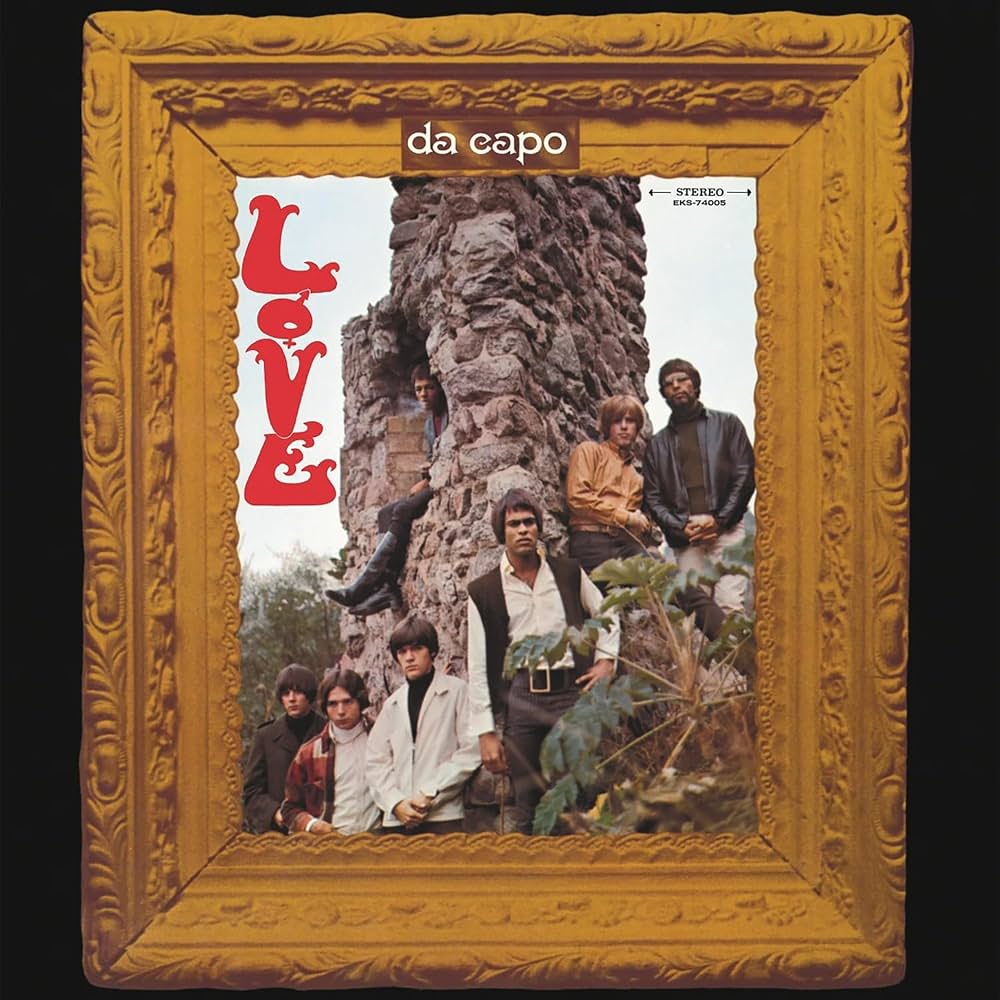
Love’s debut album announced that Los Angeles had produced a band unlike any other. Fronted by the charismatic and unpredictable Arthur Lee, the group blended garage rock, folk, rhythm and blues, and psychedelia into something that already felt distinctive. Only months later, Da Capo pushed that sound much further, embracing brass arrangements, jazz influences, Latin rhythms, and increasingly adventurous songwriting. It wasn’t always a smooth journey, but it was a fearless one.
Overshadowed by the masterpiece that would follow—Forever Changes—Da Capo has often been treated as a stepping stone rather than a major achievement in its own right. That’s unfortunate, because it captures Love at one of the most fascinating moments in their evolution. It’s experimental without becoming self-indulgent, melodic without chasing commercial trends, and unpredictable in ways that still feel refreshing nearly sixty years later.
It’s an album that rewards listeners willing to embrace its eccentricities.
Album Overview
Released in 1966, Da Capo arrived during one of the most creatively explosive years in rock history. Psychedelia was beginning to flourish, folk rock was evolving rapidly, and artists everywhere were expanding the possibilities of the studio.
Love responded by refusing to fit neatly into any single category.
The album’s first side is packed with concise, imaginative songs that move effortlessly between garage rock, baroque pop, jazz, flamenco, and psychedelia. Arthur Lee’s songwriting becomes noticeably more adventurous, while guitarist Johnny Echols and the rest of the band expand the group’s sonic palette through inventive arrangements.
Then comes Side Two.
Occupying the entire second half of the album is “Revelation,” a nineteen-minute improvisational jam unlike anything else in Love’s catalog. It’s ambitious, divisive, occasionally exhilarating, and one of the boldest artistic gambles of the era.
Whether it succeeds depends largely on the listener’s patience.
Songwriting
Arthur Lee takes a substantial leap forward as a songwriter on Da Capo.
His lyrics become more abstract, emotionally layered, and often tinged with subtle humor. Rather than relying on straightforward storytelling, Lee explores shifting moods and fragmented imagery, giving many songs a dreamlike quality.
“Stephanie Knows Who” is one of the album’s finest moments, pairing haunting melodies with enigmatic lyrics that linger long after the song ends.
“Orange Skies” offers a completely different mood, blending jazz-inflected harmonies with one of Lee’s warmest melodies.
“¡Que Vida!” combines Latin influences with philosophical reflections on existence, all wrapped inside an irresistible groove.
Even the album’s more playful moments reveal sophisticated songwriting beneath their surface charm.
“Revelation” is the obvious outlier. Built more around improvisation than traditional composition, it sacrifices memorable melodies in favor of spontaneous exploration. While historically interesting, it doesn’t possess the lasting songwriting strength of the album’s first six tracks.
Performance
Love had become an exceptional ensemble by this point.
Arthur Lee delivers one of his strongest vocal performances, shifting effortlessly between soulful intensity, understated melancholy, and playful confidence. His voice never sounds overly polished, but that’s part of its appeal. There’s always an edge of unpredictability.
Johnny Echols deserves enormous praise for his guitar work.
Whether delivering sharp garage-rock riffs, elegant acoustic passages, or fluid jazz-inspired lines, his playing constantly enriches the arrangements without becoming flashy.
Bryan MacLean provides valuable songwriting and vocal support, helping create the lush harmonies that distinguish Love from many of their contemporaries.
The rhythm section remains equally impressive, adapting comfortably to the album’s constantly changing styles.
Even during “Revelation,” where structure largely disappears, the musicians demonstrate impressive chemistry despite occasionally drifting into repetition.
Production
Producer Bruce Botnick captures the band’s adventurous spirit with remarkable clarity.
The album sounds noticeably more ambitious than Love’s debut without losing its raw energy.
Brass instruments, acoustic guitars, electric fuzz tones, percussion, and layered vocals all coexist naturally within the mix. The arrangements feel expansive but rarely cluttered.
The production particularly shines on songs like “Orange Skies,” where delicate orchestration enhances the mood without overwhelming it.
“Revelation” benefits from a spacious live feel that allows the improvisation to unfold organically, though its extended length naturally exposes the limitations of recording an extended jam in the mid-1960s.
Overall, the production successfully balances polish and spontaneity.
Standout Tracks
“Stephanie Knows Who” is one of Arthur Lee’s finest early compositions. Mysterious, melodic, and emotionally complex, it remains one of the hidden gems of 1960s psychedelia.
“Orange Skies” is breathtakingly beautiful, blending jazz harmonies, gentle brass arrangements, and one of the album’s most memorable melodies.
“¡Que Vida!” showcases Love’s remarkable ability to fuse Latin rhythms, psychedelic textures, and sophisticated songwriting into something entirely their own.
“Seven and Seven Is” is arguably the album’s defining moment. Driven by frantic energy, explosive drumming, and one of rock’s most famous climactic endings, it remains one of the greatest garage-psychedelic singles ever recorded.
“She Comes in Colors” delivers elegant baroque-pop with gorgeous harmonies and subtle instrumental detail that rewards repeated listening.
Weak Points
The album’s greatest strength is also its biggest flaw.
The first side is so consistently brilliant that “Revelation” struggles to justify consuming the entire second side. While its improvisational spirit was daring for 1966, the performance lacks the focused development found on landmark extended pieces by artists like John Coltrane or, later, The Grateful Dead.
The jam contains intriguing moments but also extended stretches that feel repetitive, slightly disrupting the album’s otherwise exceptional pacing.
Some listeners may also find the constant stylistic shifts slightly less cohesive than the unified vision presented on Forever Changes.
Neither issue diminishes the brilliance of the album’s strongest material, but they do prevent it from reaching the absolute highest tier.
Legacy
Although often overshadowed by Forever Changes, Da Capo played an important role in expanding the possibilities of psychedelic rock.
Its fearless blending of folk, jazz, Latin music, garage rock, and orchestral pop anticipated many of the genre-crossing experiments that would define the late 1960s.
“Seven and Seven Is” became Love’s biggest hit and remains one of the essential psychedelic rock singles of the decade, influencing generations of punk, garage, and alternative bands with its relentless energy.
The album also captures Arthur Lee at a pivotal point in his artistic development. His confidence as both songwriter and bandleader grows dramatically here, laying the groundwork for the masterpiece that would follow just one year later.
While Da Capo may not possess the flawless cohesion of Forever Changes, it stands as one of the most adventurous and rewarding psychedelic albums of its era.
Final Score
8.5/10
Da Capo is an ambitious, imaginative, and frequently brilliant album that showcases Love’s rapid artistic evolution. Its exceptional first side contains some of the band’s finest songs, blending psychedelia, folk, jazz, and garage rock with remarkable confidence. Although the sprawling improvisation of “Revelation” ultimately feels more historically interesting than consistently compelling, it reflects a band unafraid to take risks. Under a stricter scoring scale, Da Capo earns a well-deserved 8.5/10—an outstanding album that points directly toward the masterpiece Love would soon create with Forever Changes.
This post has already been read 69 times!