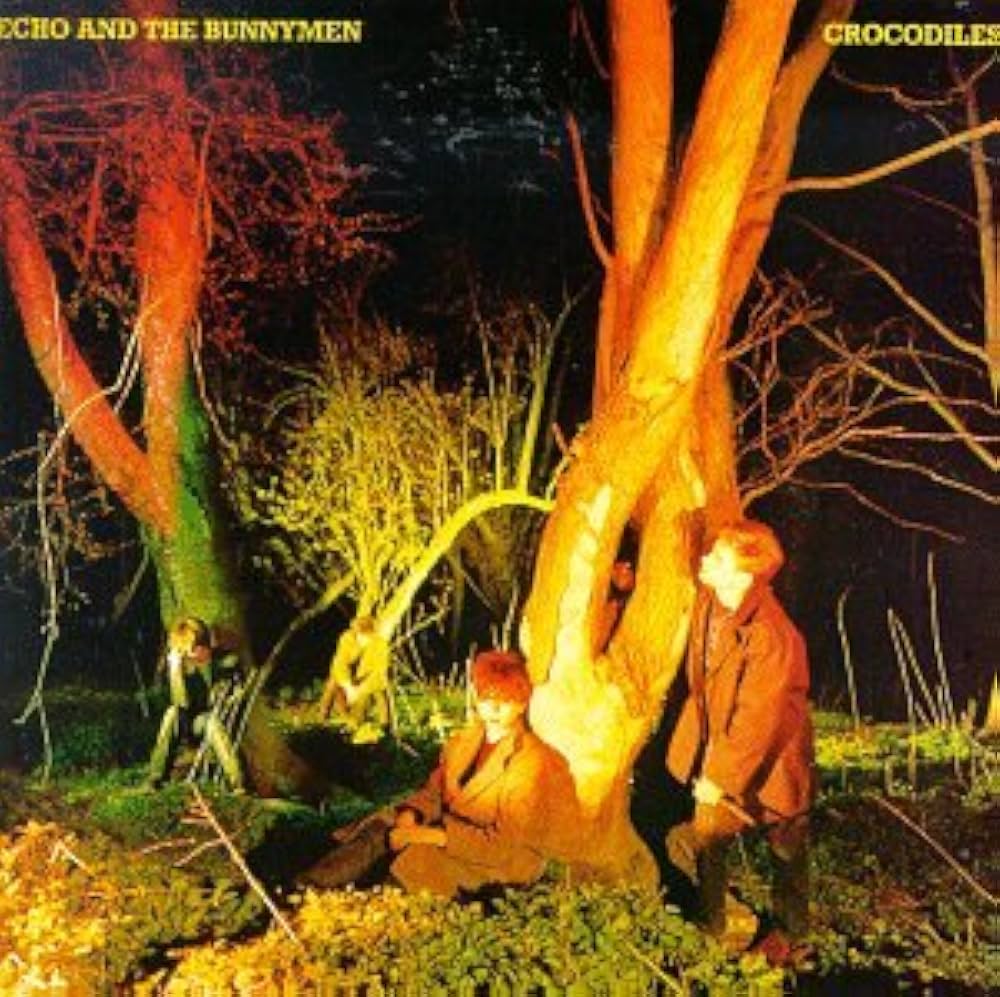
The late 1970s and early 1980s produced an extraordinary wave of British post-punk bands determined to move beyond the raw simplicity of punk. While groups like Joy Division, Gang of Four, Wire, and Siouxsie and the Banshees each carved out distinctive identities, Echo & the Bunnymen occupied a unique space. They embraced post-punk’s atmosphere and experimentation while never abandoning soaring melodies, classic songwriting, and an almost cinematic sense of drama.
Released in 1980, Crocodiles introduced the Liverpool quartet to the world with remarkable confidence. Built around Ian McCulloch’s commanding vocals, Will Sergeant’s shimmering guitar work, Les Pattinson’s melodic bass lines, and Pete de Freitas’ driving drumming, the album established nearly every element that would define the band’s career. Dark without becoming oppressive, mysterious without becoming inaccessible, and ambitious without losing its immediacy, Crocodiles announced the arrival of one of Britain’s most important alternative bands.
Although later albums like Heaven Up Here, Porcupine, and Ocean Rain often receive greater critical attention, Crocodiles remains one of the strongest debut albums of the post-punk era and one of the defining records of early 1980s alternative rock.
Album Overview
From its opening moments, Crocodiles establishes an unmistakable atmosphere.
Everything feels urgent.
Yet strangely dreamlike.
The guitars shimmer rather than roar.
The bass frequently drives the melodies.
The drums provide constant forward momentum.
Ian McCulloch’s vocals float above the arrangements with dramatic confidence.
Unlike many post-punk records built around minimalism, Crocodiles feels surprisingly full.
Layers of guitar create rich textures without overwhelming the songs.
Every arrangement leaves room for individual instruments to breathe.
The pacing remains exceptional.
Fast, energetic tracks naturally give way to more reflective moments before building back toward explosive climaxes.
The album constantly balances youthful excitement with emotional complexity.
It captures a young band already possessing remarkable artistic self-assurance.
Very few debut albums sound this complete.
Songwriting
Echo & the Bunnymen arrived with an unusually mature songwriting approach.
Rather than relying on straightforward narratives, many songs function through evocative imagery and emotional suggestion.
McCulloch’s lyrics remain intentionally ambiguous, inviting listeners to discover their own meanings.
“Going Up” opens the album with infectious optimism wrapped inside shimmering guitar textures.
“Pride” combines driving rhythms with one of the band’s earliest unforgettable choruses.
“Rescue” became the group’s first major single for good reason, pairing urgent energy with irresistible melodic hooks.
“Stars Are Stars” demonstrates the band’s remarkable ability to blend atmosphere with accessibility.
“Villiers Terrace,” inspired by the Liverpool street where several band members once lived, balances mystery and nostalgia through one of the album’s strongest arrangements.
“Happy Death Men” introduces darker emotional territory while maintaining the band’s melodic focus.
Throughout the album, the songwriting consistently avoids cliché.
Even when meanings remain elusive, the emotional impact remains immediate.
That combination gives the record lasting fascination.
Performance
Every member of Echo & the Bunnymen contributes significantly to the album’s success.
Ian McCulloch immediately establishes himself as one of Britain’s most distinctive vocalists.
His rich baritone carries equal measures of confidence, vulnerability, and theatrical flair.
Rather than imitating punk’s aggressive shouting, he sings with genuine emotional depth.
Will Sergeant delivers one of the defining guitar performances of early post-punk.
His shimmering, echo-drenched style creates atmosphere while remaining deeply melodic.
Rather than relying on flashy solos, he builds emotional landscapes through texture and repetition.
Les Pattinson’s bass playing often serves as the melodic backbone of the songs.
His inventive lines constantly push the music forward without overwhelming the arrangements.
Pete de Freitas, who joined shortly after the album’s initial sessions, would later become central to the band’s sound, though drummer Dave Barbarossa contributes several powerful performances here, bringing a sharp rhythmic edge that perfectly complements the band’s evolving style.
The chemistry throughout the album feels effortless.
Even this early, the band sounds like a unified musical force.
Production
Produced by Bill Drummond and David Balfe, Crocodiles captures the band’s raw energy while hinting at the lush production that would characterize later releases.
The recording remains remarkably spacious.
Guitars shimmer beautifully.
Bass remains clear and prominent.
The drums possess tremendous punch without becoming overpowering.
McCulloch’s vocals sit comfortably within the mix rather than dominating it.
Unlike some early post-punk albums that sound constrained by limited budgets, Crocodiles feels surprisingly expansive.
Its production avoids excessive studio effects while still creating an unmistakable atmosphere.
The recording has aged exceptionally well.
Its clarity and balance continue sounding fresh more than four decades later.
Standout Tracks
Although the album remains consistently excellent, several songs rank among the finest recordings of Echo & the Bunnymen’s career.
“Rescue” remains one of the defining singles of the post-punk era, combining unforgettable hooks with extraordinary guitar textures and one of Ian McCulloch’s finest vocal performances.
“Pride” captures the band’s remarkable balance of urgency and melody through one of the album’s most infectious arrangements.
“Stars Are Stars” brilliantly blends shimmering guitars with emotional depth, demonstrating the band’s remarkable songwriting maturity.
“Villiers Terrace” stands among the album’s most atmospheric compositions, pairing cryptic lyrics with beautiful instrumental interplay.
“Going Up” provides a perfect introduction to the band’s sound, immediately announcing their arrival through irresistible energy and memorable melodies.
Weak Points
As impressive as Crocodiles is, it occasionally reveals the rough edges of a young band still refining its identity.
A handful of songs hint at ideas that would receive fuller development on later masterpieces like Heaven Up Here and Ocean Rain.
The production, while excellent, lacks some of the grand cinematic scope that would soon become one of the band’s trademarks.
Additionally, McCulloch’s intentionally cryptic lyrics may leave some listeners searching for clearer emotional narratives.
These observations hardly diminish the album’s achievements.
Instead, they highlight just how extraordinary the band’s subsequent growth would become.
Legacy
Crocodiles helped establish Echo & the Bunnymen as one of the leading bands of the post-punk movement while laying the groundwork for much of alternative rock during the following decades.
Its shimmering guitar textures, atmospheric songwriting, and emotional intensity influenced artists ranging from The Smiths and U2 to Radiohead, Interpol, Editors, and countless indie rock bands.
The album also demonstrated that post-punk could embrace beauty, melody, and ambition without sacrificing its adventurous spirit.
That balance became one of the defining characteristics of 1980s alternative music.
Today, Crocodiles stands as one of the era’s finest debut albums—a record that announced the arrival of a remarkable band while remaining endlessly rewarding in its own right.
Final Score: 9.5/10
Crocodiles is a magnificent debut that established Echo & the Bunnymen as one of the most original and exciting bands of the post-punk era. Combining shimmering guitar work, powerful vocals, memorable songwriting, and evocative production, the album captures a group already operating with extraordinary confidence and artistic vision.
While later releases would expand the band’s sonic palette even further, Crocodiles possesses a youthful urgency and immediacy that remains uniquely compelling. Every performance contributes to an atmosphere that is mysterious, emotionally rich, and consistently engaging from beginning to end.
Overshadowed only by the remarkable albums that followed, Crocodiles remains one of the essential post-punk records of the early 1980s and one of the strongest debut albums in alternative rock history.
This post has already been read 52 times!