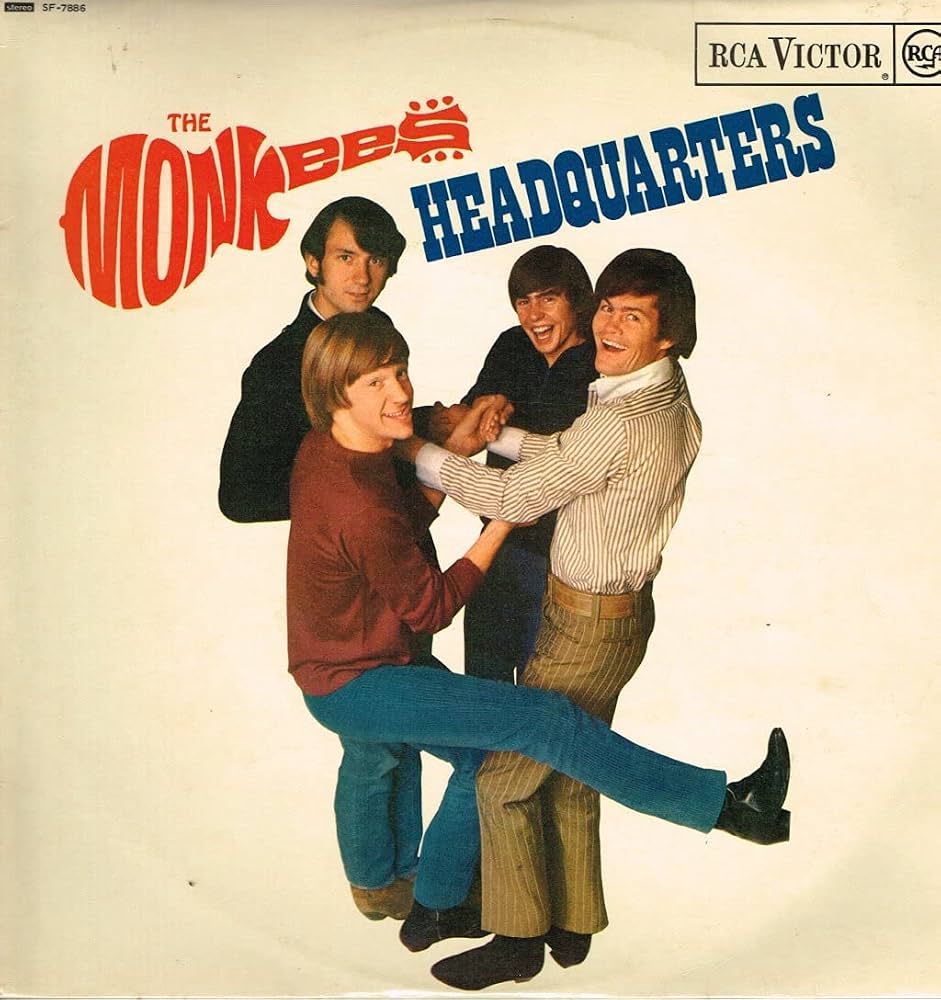
The Monkees spent much of their early career fighting a reputation they didn’t entirely deserve. Created for television and initially relying heavily on session musicians, they were often dismissed by critics as a manufactured pop act with little artistic credibility. That perception began to change dramatically with Headquarters. Released in 1967, the album marked the moment when Micky Dolenz, Michael Nesmith, Peter Tork, and Davy Jones took creative control of their music, performing the vast majority of the instrumentation themselves and proving they were far more than television personalities.
The timing couldn’t have been better. Popular music was entering one of its most adventurous periods, with bands increasingly viewed as self-contained creative units. Rather than remaining content to record songs assembled by producers, the Monkees insisted on becoming a genuine band. The result is an album filled with personality, charm, and surprising musical depth.
Although Headquarters may not possess the revolutionary ambition of some of 1967’s landmark releases, it succeeds because of its honesty. It captures four musicians eager to establish their identity while producing some of the strongest music of their career.
More than fifty years later, the album remains one of the most satisfying chapters in the Monkees’ remarkable story.
Album Overview
Headquarters immediately feels different from the Monkees’ earlier releases. The polished sheen of their first albums gives way to a warmer, more organic sound built around acoustic guitars, keyboards, bass, drums, and vocal harmonies performed primarily by the group itself.
That shift creates a stronger sense of cohesion. Rather than sounding like a collection of studio productions assembled by outside musicians, the album has the feel of an actual band playing together.
Stylistically, the record comfortably blends sunshine pop, folk rock, country influences, British-inspired pop, and psychedelic touches. The variety keeps the album engaging without sacrificing its overall identity.
Perhaps its greatest strength is its enthusiasm. Every performance conveys the excitement of musicians proving something—not only to critics but also to themselves.
The pacing is excellent, balancing upbeat pop songs with reflective ballads and playful experiments that capture the optimistic spirit of 1967.
Songwriting
The songwriting represents one of the album’s strongest qualities.
“You Just May Be the One,” written by Michael Nesmith, introduces a country-rock flavor that would later become one of his defining musical trademarks.
“For Pete’s Sake” combines memorable melodies with an uplifting message and eventually became familiar to television audiences as the closing theme of the Monkees’ television series.
“Shades of Gray” stands among the group’s most thoughtful recordings, exploring maturity and changing perspectives with lyrical sophistication rarely associated with the band.
The album also benefits from outstanding contributions from professional songwriters, particularly “Randy Scouse Git,” one of Micky Dolenz’s most inventive compositions, and “Sunny Girlfriend,” another excellent Nesmith original.
While not every song reaches the same level, the overall quality is impressively consistent and demonstrates that the Monkees were developing into capable recording artists in their own right.
Performance
One of the greatest pleasures of Headquarters is hearing the Monkees perform as an actual band.
Peter Tork’s musicianship provides an especially important foundation. His keyboard and bass work adds warmth and authenticity throughout the album, while Michael Nesmith’s guitar playing reveals his growing confidence as both musician and songwriter.
Micky Dolenz continues to emerge as one of the era’s most underrated pop vocalists. His energetic delivery gives the album much of its personality, particularly on the more upbeat material.
Davy Jones contributes his trademark charm and melodic sensitivity, bringing balance to the group’s overall sound.
The vocal harmonies are consistently excellent. While perhaps not as technically polished as those of the Beach Boys or the Mamas & the Papas, they possess an infectious enthusiasm that perfectly suits the material.
Most importantly, the performances feel genuine. There is an undeniable sense of four musicians discovering what they are capable of together.
Production
Produced by Chip Douglas, Headquarters embraces a noticeably more natural recording style than the Monkees’ earlier albums.
The production avoids excessive studio polish, allowing the band’s performances to remain front and center. Instruments sound warm and immediate, while the vocal arrangements retain excellent clarity.
Douglas deserves considerable credit for encouraging the group’s independence rather than simply recreating the formula that had already proven commercially successful.
Although the production lacks some of the elaborate experimentation heard on other albums released during the Summer of Love, its straightforward approach complements the music perfectly.
The recording has aged well, retaining an inviting analog warmth that continues to appeal to modern listeners.
Standout Tracks
The album features several songs that rank among the finest recordings of the Monkees’ career.
“You Just May Be the One” is one of Michael Nesmith’s earliest masterpieces, blending folk rock and country influences into an effortlessly catchy performance.
“For Pete’s Sake” remains one of the group’s most enduring songs, combining memorable harmonies with an uplifting spirit.
“Randy Scouse Git” showcases Micky Dolenz’s growing confidence as a songwriter while embracing the psychedelic experimentation of the era.
“Shades of Gray” provides the album’s emotional centerpiece, while “Sunny Girlfriend” further highlights Nesmith’s increasingly sophisticated songwriting.
The consistency across the album is one of its greatest strengths.
Weak Points
While Headquarters represents a major artistic leap forward, it is not without imperfections.
The band’s relative inexperience as instrumentalists occasionally shows when compared with the polished studio musicians who played on earlier releases. While this gives the album greater authenticity, it also results in performances that are occasionally less refined.
A few songs fall slightly short of the group’s biggest hits, and the album never quite reaches the consistently extraordinary level of the era’s most groundbreaking releases.
Additionally, listeners expecting the polished pop perfection of the Monkees’ earliest singles may initially find the more organic approach somewhat understated.
These are relatively modest criticisms of a record whose strengths easily outweigh its weaknesses.
Legacy
Headquarters fundamentally changed the way the Monkees were viewed.
The album proved they were capable musicians who deserved to be taken seriously, helping dismantle the criticism that they were merely actors miming to someone else’s recordings.
Its blend of folk rock, country influences, and melodic pop anticipated elements of later work by artists such as The Byrds, Big Star, and R.E.M., while Michael Nesmith’s songwriting pointed toward the country-rock movement that would soon flourish.
Although it was overshadowed commercially by some of the landmark albums released in 1967, Headquarters has steadily grown in critical reputation and is now widely regarded as the Monkees’ finest artistic statement.
It remains one of the most rewarding surprises of the psychedelic era.
Final Score
8.5/10
Headquarters is the album where the Monkees became a real band in every meaningful sense. Excellent songwriting, genuine performances, warm production, and infectious enthusiasm combine to create one of the strongest pop albums of 1967. While it lacks the groundbreaking innovation of the era’s greatest masterpieces and occasionally reveals the band’s inexperience as instrumentalists, its sincerity and consistently enjoyable music make it one of the Monkees’ essential recordings and a landmark in their artistic evolution.
This post has already been read 60 times!