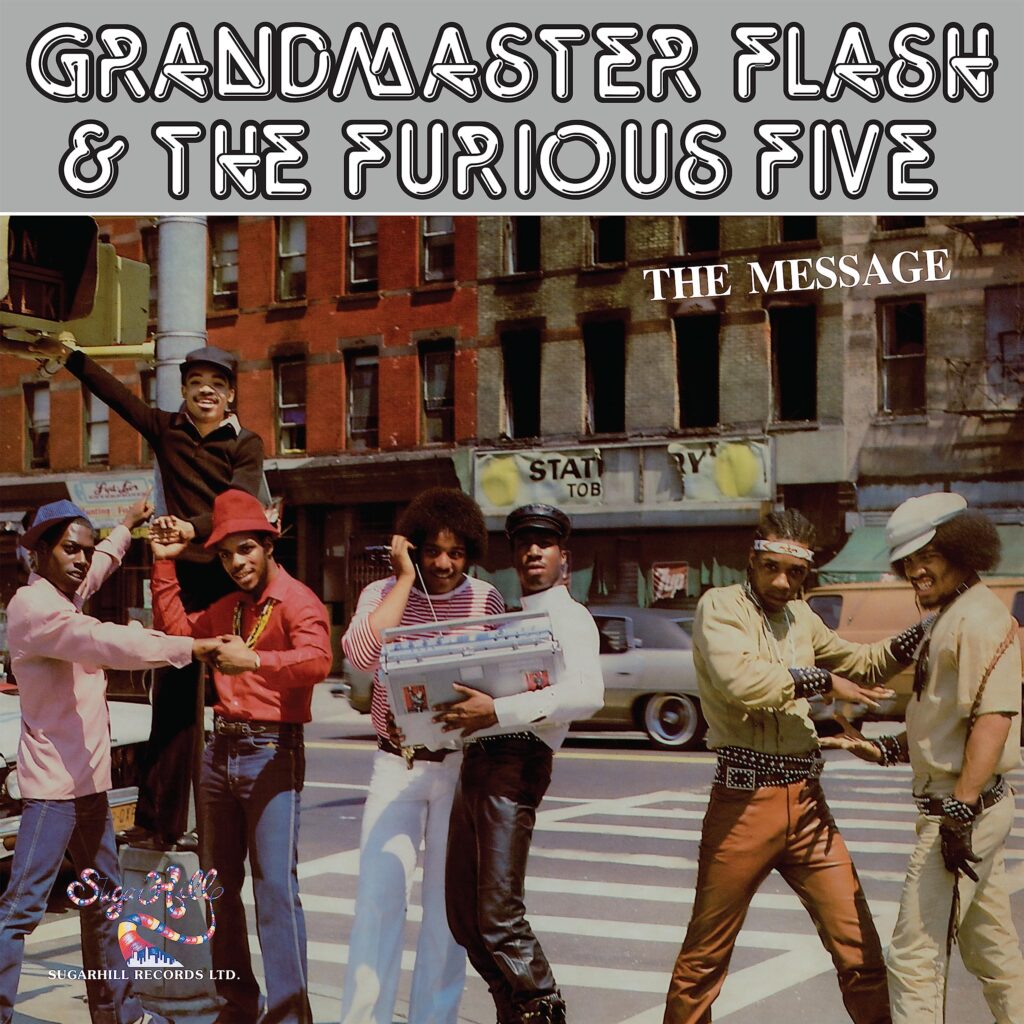
Hip-hop changed forever in 1982.
Before The Message, rap records were largely built around party anthems, boasts, and dancefloor energy. They celebrated DJs, MCs, and having a good time. Then came a song that completely altered the possibilities of the genre. “The Message” proved that hip-hop could confront poverty, violence, hopelessness, and social inequality with the same power that folk, soul, or rock music had long possessed.
Although the album itself contains a mix of styles—including the group’s earlier party-oriented material—it remains a landmark release because it captured rap music at a critical turning point. The title track became one of the most influential songs ever recorded, while the album helped establish socially conscious hip-hop as a legitimate artistic force.
More than forty years later, The Message remains an essential chapter in the history of popular music and one of the defining records of hip-hop’s formative years.
Album Overview
Released in 1982, The Message arrived while hip-hop was still in its infancy. Most commercial rap records were built around simple drum machine grooves, energetic chants, and routines inspired by live DJ performances. Grandmaster Flash & The Furious Five had already become pioneers through their live shows and innovative turntablism, but this album expanded the genre’s emotional and lyrical boundaries.
One important distinction is that Grandmaster Flash himself contributes relatively little musically to several of the album’s best-known tracks, including the title song. Much of the songwriting and production came from Ed “Duke Bootee” Fletcher alongside MC Melle Mel, while producer Sylvia Robinson helped shape the final recordings.
Even so, the album represents the collective’s legacy and captures the transition from old-school party rap toward more ambitious storytelling.
While stylistically uneven, it offers a fascinating snapshot of hip-hop’s rapid evolution.
Songwriting
The album’s reputation rests largely on one extraordinary composition.
“The Message” remains one of the greatest songs in hip-hop history.
Melle Mel’s vivid depiction of inner-city hardship shattered expectations of what rap music could accomplish. Rather than celebrating success or entertaining audiences through clever rhymes alone, he described broken neighborhoods, unemployment, crime, addiction, and psychological exhaustion with remarkable honesty.
Its famous refrain—
“Don’t push me ’cause I’m close to the edge…”
—became one of the most recognizable lines ever written in popular music.
The influence of that single song cannot be overstated.
Elsewhere, “It’s Nasty (Genius of Love)” blends playful rhymes with a groove borrowed from Tom Tom Club, becoming one of the defining crossover hits of early hip-hop.
“Scorpio” showcases the group’s instrumental ambitions through extended funk and electronic experimentation, while “New York New York” celebrates the city’s growing hip-hop culture.
Some earlier tracks still reflect rap’s party-oriented origins, making the album feel less cohesive than later classics. Nevertheless, they provide valuable historical context for understanding where hip-hop came from before conscious rap emerged.
Performance
Melle Mel delivers one of the most important vocal performances in rap history.
His commanding voice possesses extraordinary authority without relying on exaggerated aggression. Every line of “The Message” feels urgent and believable, allowing the song’s social commentary to land with devastating impact.
The remaining members of The Furious Five contribute energetic performances throughout the album, displaying the rhythmic precision and crowd-moving chemistry that made them legendary live performers.
Musically, the production is understandably sparse by modern standards.
Drum machines, synthesizers, bass grooves, and minimalist arrangements dominate the album, allowing the lyrics to remain the primary focus.
While later hip-hop records would develop more sophisticated production techniques, these performances helped establish many of the genre’s foundational conventions.
Production
The production reflects hip-hop’s early studio limitations while simultaneously pushing those boundaries.
Minimal drum machine patterns, simple synthesizer lines, and stripped-down arrangements create a directness that perfectly suits the material.
“The Message” in particular benefits from its restrained production.
Rather than distracting listeners with elaborate instrumentation, every musical decision emphasizes the emotional weight of the lyrics.
Some of the album’s other tracks inevitably sound dated due to rapidly advancing production technology during the 1980s.
Even so, the album’s raw simplicity remains part of its enduring charm.
Its historical importance far outweighs any technical limitations.
Standout Tracks
“The Message”
One of the most influential songs ever recorded in any genre. Its groundbreaking social commentary permanently changed the direction of hip-hop and inspired generations of lyricists.
“It’s Nasty (Genius of Love)”
A playful, infectious crossover hit built around one of the most recognizable grooves of the early 1980s.
“Scorpio”
An adventurous instrumental showcasing electronic experimentation and the group’s connection to DJ culture.
“New York New York”
A spirited celebration of the city where hip-hop was born, filled with infectious energy and memorable performances.
“The Adventures of Grandmaster Flash on the Wheels of Steel” (included on some later editions)
One of the earliest recorded demonstrations of live DJ mixing and turntablism, illustrating why Grandmaster Flash became such a legendary figure in hip-hop history.
Weak Points
Viewed as a complete album rather than through the lens of its iconic title track, The Message shows its age.
Several songs remain rooted in early party-rap traditions and don’t possess the lyrical sophistication that later hip-hop masterpieces would achieve. This creates an uneven listening experience, particularly after the emotional impact of the title song.
Additionally, some production techniques inevitably sound primitive compared to the richly layered hip-hop albums that would emerge later in the decade.
These limitations reflect the genre’s early developmental stage rather than shortcomings unique to this record.
Legacy
Few albums have altered the course of an entire genre as dramatically as The Message.
Its title track established that rap could be a vehicle for serious storytelling, political commentary, and social criticism. Without it, landmark albums by artists such as Public Enemy, N.W.A., KRS-One, Tupac Shakur, Nas, Kendrick Lamar, and countless others would almost certainly have looked very different.
The album also helped legitimize hip-hop in the eyes of critics who had previously dismissed it as a passing fad.
Today, “The Message” regularly appears on lists of the greatest songs ever recorded, regardless of genre. Its influence extends far beyond rap, inspiring musicians, filmmakers, journalists, and writers to confront difficult social realities through art.
While later hip-hop albums would surpass it in technical sophistication and consistency, few have matched its historical significance.
It remains one of the foundational pillars upon which modern hip-hop was built.
Final Score
8.5/10
The Message is an enormously important album whose historical impact exceeds its consistency as a complete listening experience. While several tracks remain rooted in hip-hop’s early party-rap traditions, the groundbreaking title song permanently transformed the possibilities of the genre. For its fearless social commentary, pioneering performances, and immeasurable influence on generations of artists, The Message stands as one of the essential recordings in the history of hip-hop.
This post has already been read 47 times!