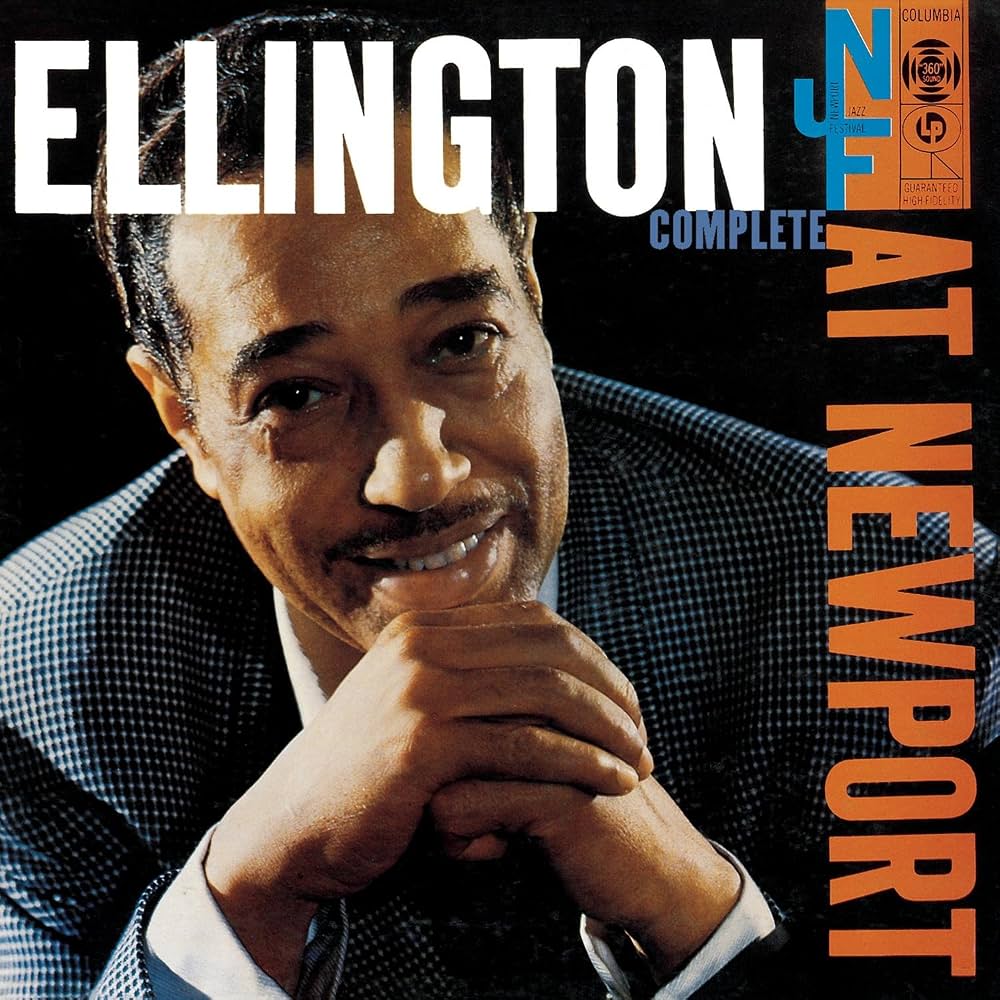
Few live albums have altered the course of a musician’s career quite like Ellington at Newport. Recorded on July 7, 1956, at the legendary Newport Jazz Festival, the album captured more than a great performance—it documented one of the most remarkable comebacks in music history. By the mid-1950s, Duke Ellington was already considered one of jazz’s greatest composers and bandleaders, but the big band era had faded, and his orchestra was no longer the dominant cultural force it had been in the 1930s and 1940s. Many critics believed his finest days were behind him.
Then came Newport.
What unfolded that evening became the stuff of jazz legend. Fueled by an electrifying performance of “Diminuendo and Crescendo in Blue” featuring tenor saxophonist Paul Gonsalves, the audience erupted into an ecstatic frenzy. People danced in the aisles, festival organizers struggled to contain the excitement, and Ellington suddenly found himself at the center of the jazz world once again. The performance revitalized his career, introduced him to a younger generation of fans, and demonstrated that the Duke Ellington Orchestra remained one of the greatest ensembles in American music.
While the original LP has since been supplemented by expanded editions that restore much of the concert as it actually occurred, the original Ellington at Newport remains one of the defining live jazz albums ever recorded. It captures a legendary orchestra performing at full strength while reminding listeners that jazz, at its best, is as much about spontaneous inspiration as careful composition.
Album Overview
Unlike many live albums that simply document a concert, Ellington at Newport feels like a dramatic narrative unfolding in real time. The opening selections establish the orchestra’s elegance and precision before gradually building toward the explosive climax that has become one of jazz’s most celebrated moments.
Ellington understood pacing better than almost any bandleader of his era. Rather than overwhelming listeners with constant intensity, he allows the music to breathe. Sophisticated arrangements alternate with fiery improvisation, creating a dynamic listening experience that rarely lets the energy stagnate.
The orchestra itself is extraordinary. Every section—from the trumpets and trombones to the reeds and rhythm section—performs with astonishing cohesion while leaving room for individual personalities to shine. Unlike smaller jazz groups that depend primarily on soloists, the Ellington Orchestra succeeds through the balance between collective discipline and individual brilliance.
The atmosphere of the Newport Jazz Festival also becomes an essential part of the album. Audience reactions, applause, and mounting excitement contribute to the experience without distracting from the music. Rather than merely hearing a performance, listeners feel as though they are witnessing history unfold.
Even decades later, the recording retains an undeniable sense of occasion.
Songwriting
One of Duke Ellington’s greatest gifts was his ability to compose music that combined sophisticated harmonic language with immediate emotional appeal. Ellington at Newport highlights that talent beautifully.
Rather than relying on standards or popular songs, much of the material comes directly from Ellington’s own remarkable catalog. Pieces like “Festival Junction” and “Blues to Be There” showcase his gift for memorable melodies while providing fertile ground for improvisation.
The centerpiece, however, is “Diminuendo and Crescendo in Blue.” Originally composed in 1937, the work became something entirely new at Newport. Built around contrasting musical sections connected through extended improvisation, it demonstrates Ellington’s understanding that composition and spontaneous creativity could coexist seamlessly.
His writing avoids unnecessary complexity for its own sake. While harmonically rich and structurally inventive, the music remains deeply accessible, inviting both casual listeners and experienced jazz musicians into its world.
The result is an album that rewards repeated listening, revealing new orchestral details and compositional subtleties with every return.
Performance
The performances on Ellington at Newport are nothing short of extraordinary.
Ellington himself remains the orchestra’s guiding force. Although his piano playing is often understated, his real instrument was the band itself. His leadership, timing, and instinct for shaping musical drama are evident throughout the concert.
The evening belongs, however, to tenor saxophonist Paul Gonsalves.
His legendary solo during “Diminuendo and Crescendo in Blue” has entered jazz history for good reason. Stretching across an astonishing 27 choruses, Gonsalves gradually transforms a strong performance into an unforgettable event. Rather than relying on flashy virtuosity, he builds tension through rhythmic invention, melodic variation, and relentless momentum until both the band and audience reach an almost unbelievable level of excitement.
Elsewhere, trumpeter Cat Anderson dazzles with his impossibly high notes, while Jimmy Hamilton, Harry Carney, Russell Procope, and the rest of the orchestra remind listeners why Ellington consistently assembled some of the finest musicians in jazz.
Perhaps most impressive is the ensemble’s ability to respond collectively to the growing energy of the performance. As the audience becomes more animated, the musicians rise alongside them, creating a feedback loop of excitement that few live recordings have ever captured so vividly.
Production
For a live recording made in 1956, Ellington at Newport sounds remarkably vibrant.
That said, the album’s production has an unusual history. The original LP famously incorporated some recreated material recorded later in a studio to compensate for technical limitations and incomplete live recordings. For years, most listeners believed they were hearing the actual Newport performance in its entirety when portions had actually been reconstructed.
Despite that controversy, the original album remains highly enjoyable. The edits were skillfully executed, and they preserved the excitement that made the concert legendary.
Later archival releases restored more of the authentic performance, providing an even clearer picture of what transpired that evening. Those expanded editions arguably represent the definitive historical document, but the original album still stands as a landmark release in its own right.
Sonically, the orchestra is captured with impressive balance. Brass sections retain their brilliance, reeds remain warm and expressive, and the rhythm section provides a solid foundation without becoming muddy. Considering the technological limitations of outdoor festival recording during the 1950s, the sound quality remains remarkably satisfying.
Standout Tracks
Although every performance contributes to the album’s success, several moments have become legendary.
“Diminuendo and Crescendo in Blue” is unquestionably the centerpiece. Paul Gonsalves’ marathon solo remains one of the defining moments in live jazz history, transforming an already excellent performance into an unforgettable musical event.
“Festival Junction” provides a powerful demonstration of the orchestra’s precision and Ellington’s gift for large-scale composition.
“Blues to Be There” showcases the band’s remarkable swing while allowing individual soloists ample opportunity to shine.
“Jeep’s Blues” offers a more relaxed atmosphere, highlighting the orchestra’s ability to create intimacy without sacrificing sophistication.
Throughout the album, the real standout may actually be the orchestra itself. Every section contributes to a level of ensemble playing that remains astonishing nearly seventy years later.
Weak Points
There are surprisingly few weaknesses to discuss, though a couple are worth mentioning.
The original LP’s reconstructed production, while historically understandable, means listeners are not always hearing the concert exactly as it occurred. Purists may prefer later restored editions that present a more accurate representation of the evening.
The album also assumes some familiarity with jazz performance conventions. Extended improvisations, while thrilling for jazz enthusiasts, may require patience from listeners accustomed to shorter pop songs.
Additionally, because the album focuses heavily on the excitement of live performance, it lacks some of the compositional breadth found on Ellington’s larger studio works such as Such Sweet Thunder or Far East Suite.
These are relatively minor concerns for an album whose greatest strength lies in capturing an unforgettable moment of musical history.
Legacy
Few concerts have had a greater impact on an artist’s career than the Newport Jazz Festival performance immortalized on this album.
Ellington at Newport reignited Duke Ellington’s commercial and critical fortunes, leading to renewed recording opportunities, international tours, and a remarkable creative renaissance that would continue for nearly two decades. It also demonstrated that big band jazz remained artistically vibrant even as musical tastes shifted toward rock and roll.
The album has influenced countless live jazz recordings by showing how spontaneity, audience interaction, and improvisation could elevate a concert into something historically significant.
Musicians ranging from Charles Mingus and Wynton Marsalis to Maria Schneider have cited Ellington’s orchestral vision as foundational to their own work. The Newport performance, in particular, remains a masterclass in balancing carefully arranged music with exhilarating improvisation.
More broadly, the album helped establish the live jazz LP as an important artistic format. It proved that the energy of a concert could be every bit as compelling as a meticulously crafted studio recording.
Today, Ellington at Newport remains essential listening not simply because of its historical importance, but because it captures one of the greatest orchestras in jazz history at the exact moment everything came together.
Final Score
9.5/10
Ellington at Newport is one of the greatest live jazz albums ever recorded and one of the defining moments of Duke Ellington’s extraordinary career. While the original LP’s reconstructed production keeps it just shy of absolute perfection, the brilliance of the performances, the legendary Paul Gonsalves solo, and the infectious energy of the Newport audience make this an unforgettable listening experience. It stands as both a thrilling concert recording and a testament to Ellington’s genius as a composer, bandleader, and architect of modern jazz.
This post has already been read 60 times!