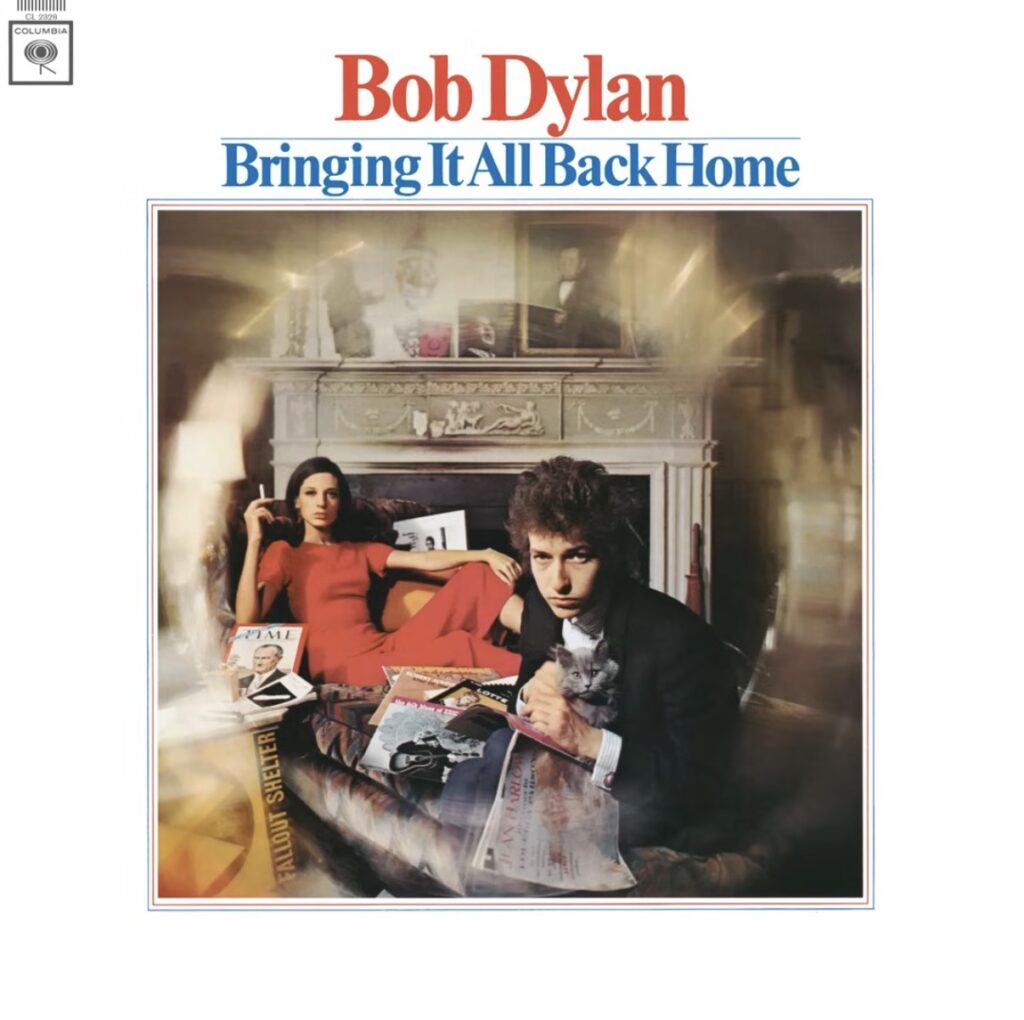
n March 1965, the American folk revival was delivered a beautifully chaotic, plugged-in death blow. Bob Dylan, the undisputed prophet of the acoustic protest movement, chose to plug an electric guitar into an amplifier and rewrite the parameters of popular music. Bringing It All Back Home stands as the precise line of demarcation where Dylan discarded the suffocating mantle of the generational voice to become a rock-and-roll visionary. It is a record split completely down the middle—one half backed by a raucous, improvisational rock band, the other a stark, hypnotic acoustic landscape. By severing his ties to the purist folk orthodoxies of Greenwich Village, Dylan did not just alienate his core audience; he engineered a seismic shift that permanently expanded what a rock album could say, think, and feel.
The transition was not merely a matter of changing instruments; it was an entire psychological overhaul. Dylan was outgrowing the literal, topical protest song that had defined his early career. He was no longer interested in writing straightforward broadsides about systemic injustice; he wanted to map out the surreal, paranoid landscape of his own mind. Bringing It All Back Home represents the exact moment where his lyrics turned inward, morphing into a kaleidoscopic blur of literary allusions, stream-of-consciousness beat poetry, and bitter, razor-sharp ironies. It was a declaration of total independence, executed with the swagger of a man who knew he was leaving his peers lightyears behind.
The Audacity of the Electric Side
The first half of the album is an unmitigated shock to the system, an aggressive explosion of rhythm and blues that caught the acoustic folk community completely off guard. Backed by a loose, kinetic ensemble of studio musicians, Dylan tackles the blues with a manic, amphetamine-fueled energy that felt dangerous and entirely unpredictable.
The opening track, “Subterranean Homesick Blues,” serves as the definitive manifesto for this new era. Driven by a relentless, chucking rockabilly groove and a deep, bouncing bassline, Dylan delivers a rapid-fire, syncopated vocal performance that predates the cadence of hip-hop by decades. The lyrics are a dizzying, street-smart mosaic of counterculture warnings, political paranoia, and anti-establishment code words. When he snarls the iconic phrase, “You don’t need a weatherman to know which way the wind blows,” he was explicitly telling the old-guard activists that the cultural revolution had outgrown their rigid manifestos. It was fast, dirty, and exhilarating pop music used as a vehicle for complex, avant-garde poetry.
This sonic audacity deepens on “Maggie’s Farm,” which functions as a thinly veiled, loud middle finger to the folk establishment itself. Nominally a song about refusing to do manual labor, the track is actually a fierce rejection of the expectations placed upon him by the political left. The garage-rock arrangement bounces with a defiant, jagged rhythm as Dylan barks out his independence from the folksingers who wanted to keep him trapped in a box of acoustic purity. It is a declaration that he will no longer sing what he is “supposed” to sing, delivered with a fierce, electrified bite that proved he was fully prepared to burn his bridges down to ash.
The Monolithic Weight of the Acoustic Twilight
If the electric first side of the album shattered Dylan’s sonic reputation, the acoustic second side completely reconstructed his literary legacy. Stripped of the backing band, Dylan returns to the acoustic format, but the songs he plays bear absolutely no resemblance to the traditional folk music of his past. Armed with just an acoustic guitar, a harmonica, and the occasional haunting bass line from Bruce Langhorne, he transforms the second half of the record into a massive, hallucinatory hall of mirrors.
The undisputed centerpiece of this side is “Mr. Tambourine Man,” a song of pure, crystalline escapism and poetic transcendence. The tracking is incredibly beautiful, anchored by Langhorne’s swirling, counter-melodic electric guitar, which floats behind Dylan’s acoustic strumming like a ghost. The lyric is a surrealist prayer, a desperate plea to a mystical musician to lead the singer out of the exhausted, mundane reality of the everyday world and into a timeless, dreamlike state. Dylan’s vocal performance is uniquely warm and yielding, rolling through the complex, multi-layered internal rhymes with a effortless grace. It is the exact moment that rock music claimed its place as legitimate literature.
This dreamscape darkens significantly on “It’s Alright, Ma (I’m Only Bleeding),” a monolithic, seven-minute indictment of American consumerism, hypocrisy, and existential dread. The song is a staggering structural achievement, built on a tense, repetitive, driving acoustic riff that offers absolutely no melodic resolution. Dylan delivers a relentless, metronomic stream of apocalyptic aphorisms, systematically dismantling the hollow illusions of commercial society, organized religion, and political authority. Every verse lands like a hammer blow, culminating in the devastating, timeless realization that “he not busy being born is busy dying.” It remains one of the most intellectually demanding and philosophically heavy songs ever recorded.
The Finality of Farewell
The album draws to a close with “It’s All Over Now, Baby Blue,” a heartbreakingly beautiful, elegiac song that serves as the final, definitive goodbye to his former life. The arrangement is simple and stately, driven by a weeping harmonica and a gentle, rolling acoustic strum.
Lyrically, the song is an instruction manual for survival in a world that is actively collapsing around you. While it can be read as a standard breakup song, the subtext is overwhelmingly cultural; Dylan is telling the folk movement, his old lovers, and his former self that the past is a sinking ship that must be abandoned. When he sings, “Leave your stepping stones behind, something calls for you / Forget the dead you’ve left, they will not follow you,” he is offering a cold, compassionate blueprint for constant self-reinvention. It is a stunningly poetic conclusion to an album that spent its entire runtime blowing up its own foundations.
The Birth of Folk-Rock and the Legacy of Distortion
The cultural fallout of Bringing It All Back Home permanently altered the trajectory of global popular music. Within months of its release, The Byrds took a electrified version of “Mr. Tambourine Man” to the top of the charts, effectively birthing the folk-rock movement overnight and changing the sonic landscape of the mid-1960s.
The structural blueprint established here—pairing highly literate, surrealist, and deeply personal poetry with the visceral, raw energy of rock-and-roll—became the foundational DNA for the entire counterculture movement. Everyone from The Beatles and The Rolling Stones to Jimi Hendrix and Lou Reed found their creative parameters expanded by the doors Dylan kicked open on this record. He proved that rock music did not have to be lightweight or transient; it could hold the same weight, complexity, and artistic ambition as the finest poetry and literature in the world.
Conclusion: The Ultimate Transmutation
Bringing It All Back Home remains an astonishing, vital piece of art because it captures the terrifying thrill of a genius actively undergoing a mutation in real time. It is an album that refuses to compromise, standing as a monument to the necessity of artistic evolution, regardless of the personal or professional cost.
It demands to be heard as a singular, cohesive piece of work—a brilliant bridge spanning the gap between the acoustic purity of Greenwich Village and the wild, mercury-thin sound of the electric revolution that would culminate in Highway 61 Revisited later that year. It is a pristine, timeless masterwork of human reinvention, an immaculate document of the exact moment Bob Dylan stepped up to the microphone, plugged into the wall, and changed the world forever.
Final Score: 10 / 10
This post has already been read 67 times!