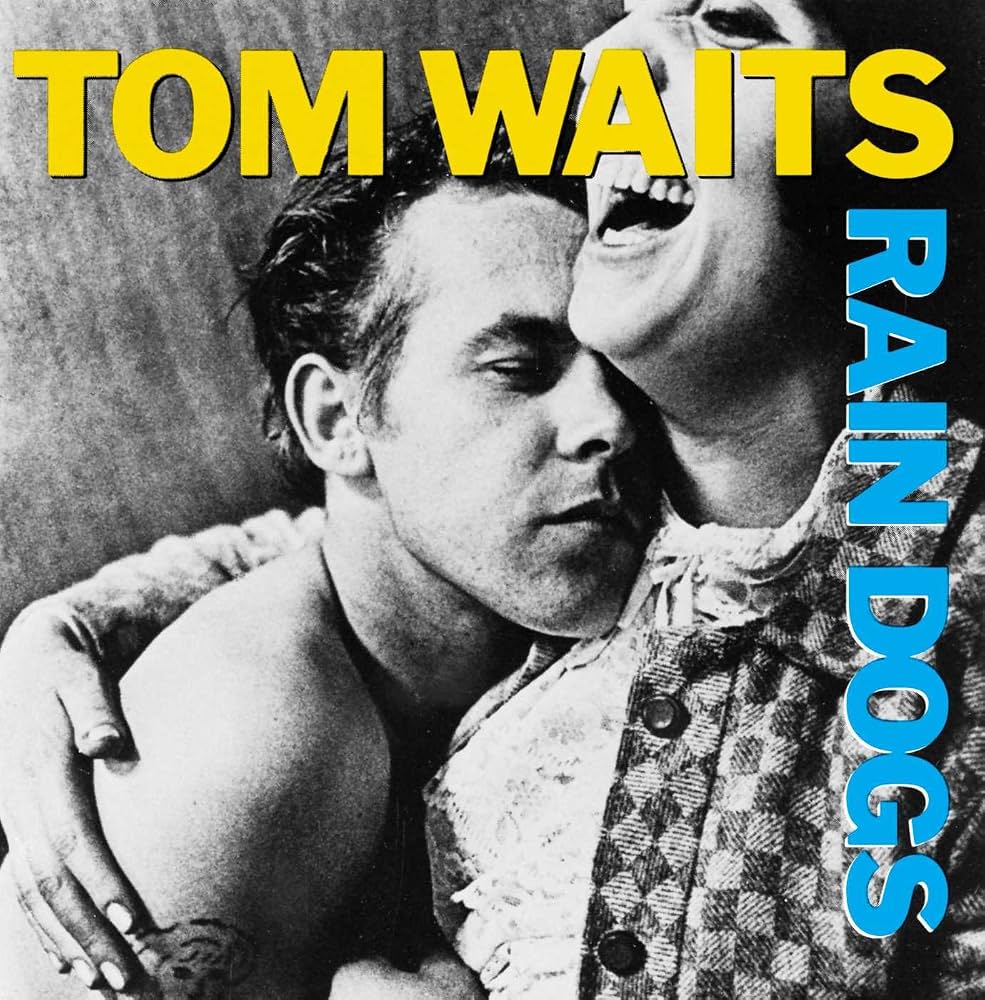
There are great albums, and then there are albums that seem to exist in their own universe. Tom Waits’ Rain Dogs is one of those rare creations. Released in 1985, it is less a conventional rock record than a collection of strange, beautiful stories told by forgotten characters wandering through rain-soaked streets, dimly lit bars, abandoned warehouses, and crumbling neighborhoods. Every song feels like another chapter in a novel that could only have been written by Tom Waits.
The album arrived during perhaps the most remarkable creative period of Waits’ career. Following the groundbreaking Swordfishtrombones, he abandoned the jazz-infused singer-songwriter style that had defined his early work in favor of an adventurous blend of blues, cabaret, folk, avant-garde experimentation, world music, gospel, and junkyard percussion. Rain Dogs expanded that vision even further, creating an album that somehow feels ancient and modern at the same time.
The title refers to dogs lost in the city after heavy rain washes away familiar scents, unable to find their way home. That image perfectly captures the album’s emotional core. Its characters drift through life searching for belonging, redemption, companionship, or simply another place to sleep.
Nearly forty years after its release, Rain Dogs remains one of the most original and influential albums ever recorded.
Album Overview
Few albums create such a vivid sense of place.
Although inspired largely by New York City, Rain Dogs feels almost mythical.
Every street corner.
Every alley.
Every barroom.
Every hotel.
Seems populated by unforgettable characters.
Musically, the album refuses to recognize boundaries.
Blues collides with Irish folk.
Cabaret meets rock.
Latin rhythms blend with experimental percussion.
Accordion.
Marimba.
Pump organ.
Banjo.
Bagpipes.
Scrap metal.
Nearly every imaginable sound finds its place.
Yet despite this extraordinary variety, the album never feels unfocused.
Every arrangement serves the songs.
Every unusual instrument deepens the atmosphere.
The pacing is remarkable.
Rowdy drinking songs naturally lead into heartbreaking ballads.
Chaotic celebrations dissolve into lonely reflections.
The result feels less like a playlist and more like a late-night walk through an endlessly fascinating city.
Songwriting
Tom Waits stands among the greatest songwriters in American music, and Rain Dogs may represent his finest collection of compositions.
“Singapore” opens the album with theatrical intensity, immediately transporting listeners into Waits’ strange and wonderful world.
“Clap Hands” creates astonishing tension through little more than percussion and atmosphere.
“Cemetery Polka” combines dark humor with unforgettable imagery.
“Jockey Full of Bourbon” became one of Waits’ signature songs, balancing hypnotic rhythms with mysterious storytelling.
“Time” ranks among the most beautiful songs he ever wrote.
Its meditation on memory, aging, and loss unfolds with breathtaking poetic grace.
“Downtown Train” later became a major hit for Rod Stewart, but Waits’ original remains the definitive version, filled with longing and quiet heartbreak.
“Tango Till They’re Sore” perfectly captures the album’s ragged elegance through one of Waits’ finest vocal performances.
The closing “Anywhere I Lay My Head” transforms resignation into something strangely uplifting, ending the album on one of its most emotionally satisfying notes.
Throughout the record, Waits demonstrates an extraordinary gift for creating unforgettable characters with only a handful of carefully chosen details.
Very few lyricists possess such economy.
Performance
Tom Waits delivers one of the defining performances of his remarkable career.
His famously gravelly voice has never sounded more expressive.
He growls.
Whispers.
Laughs.
Barks.
Croons.
Every vocal choice serves the emotional needs of each song.
Rather than chasing technical perfection, Waits pursues emotional truth.
His performances feel lived rather than performed.
The supporting musicians are equally remarkable.
Keith Richards contributes outstanding guitar work on several tracks, perfectly complementing Waits’ weathered aesthetic.
Marc Ribot’s inventive guitar playing constantly surprises without drawing unnecessary attention to itself.
The rhythm section embraces unconventional percussion, creating grooves from sounds that many musicians would never consider using.
Every performer understands the assignment.
Nobody seeks the spotlight.
Everyone contributes to the strange magic of Waits’ musical world.
Production
Produced by Tom Waits and Kathleen Brennan, Rain Dogs remains a masterpiece of unconventional production.
The album embraces imperfection.
Rusty percussion.
Loose performances.
Unexpected instrumental combinations.
Everything contributes to its distinctive character.
Despite the apparent chaos, every sound is meticulously placed.
Nothing feels accidental.
The recording possesses remarkable warmth.
Acoustic instruments remain rich and intimate.
Percussion explodes with startling realism.
Waits’ voice remains front and center without overwhelming the arrangements.
Even today, the album sounds unlike anything else.
Its refusal to follow contemporary production trends has made it virtually timeless.
There is simply nothing else that sounds quite like Rain Dogs.
Standout Tracks
Although Rain Dogs rewards complete album listening, several songs rank among the greatest of Tom Waits’ extraordinary career.
“Singapore” opens the album with astonishing theatrical flair, immediately immersing listeners in Waits’ surreal urban landscape through unforgettable rhythms and vivid storytelling.
“Jockey Full of Bourbon” perfectly captures the album’s hypnotic atmosphere, pairing mysterious lyrics with one of Waits’ most infectious grooves.
“Time” stands among the most beautiful songs Waits ever wrote. Its poetic reflections on memory and loss remain quietly devastating.
“Downtown Train” is one of the greatest love songs of the 1980s, balancing romantic longing with remarkable lyrical imagery and emotional restraint.
“Anywhere I Lay My Head” closes the album with extraordinary warmth and acceptance, providing one of the most satisfying finales in modern songwriting.
Weak Points
Rain Dogs intentionally challenges conventional expectations.
Listeners seeking straightforward rock songs or traditional pop structures may initially find its fragmented storytelling and unusual arrangements difficult to navigate.
The album’s enormous stylistic variety occasionally demands patience before revealing its deeper coherence.
Additionally, Waits’ distinctive vocal style remains an acquired taste for some listeners.
These observations are less criticisms than acknowledgments of the album’s uncompromising artistic vision.
Rain Dogs never attempts to meet listeners halfway.
It invites them into its world instead.
Legacy
Rain Dogs has grown steadily in stature and is now widely regarded as one of the greatest alternative albums ever recorded.
Its influence stretches across countless genres.
Alternative rock.
Americana.
Indie folk.
Experimental music.
Singer-songwriters.
Artists ranging from Nick Cave, PJ Harvey, and Elvis Costello to The Decemberists, Andrew Bird, and countless others have drawn inspiration from Waits’ fearless songwriting and unconventional arrangements.
The album also helped redefine what a singer-songwriter record could be.
Rather than relying on polished confession or radio-friendly production, Waits demonstrated that deeply personal art could emerge through fictional characters, unusual instrumentation, and fearless experimentation.
Few albums have expanded the possibilities of songwriting so dramatically.
Final Score: 10/10
Rain Dogs is Tom Waits’ masterpiece and one of the greatest albums of the 1980s. It combines extraordinary songwriting, unforgettable performances, fearless experimentation, and brilliant production into a record that remains utterly unique. Every song introduces another unforgettable character, another haunting melody, or another astonishing lyrical image, creating a world that feels endlessly alive.
Waits’ gravelly voice, unconventional instrumentation, and poetic storytelling come together with astonishing confidence, proving that artistic ambition and emotional accessibility can coexist beautifully. The album rewards repeated listening perhaps more than almost any other record of its era, revealing new details and deeper emotional layers every time it plays.
Very few albums create an entire universe that listeners can step inside. Rain Dogs accomplishes exactly that, standing as one of the defining masterpieces of American music and one of the most imaginative records ever made.
This post has already been read 61 times!