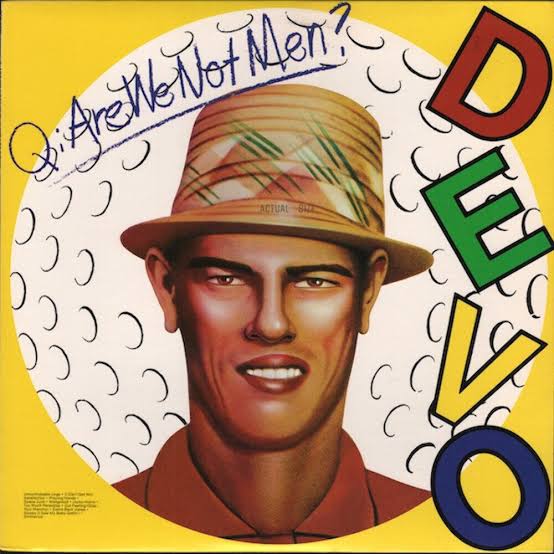
No band arrived with a debut album quite like Devo. Emerging from Akron, Ohio, the group wasn’t simply trying to make catchy rock songs—they were presenting a philosophy. Inspired by the concept of “de-evolution,” Mark Mothersbaugh, Gerald Casale, Bob Mothersbaugh, Bob Casale, and Alan Myers argued that society was regressing rather than progressing. Their music reflected that worldview through angular guitars, mechanical rhythms, nervous vocals, surreal humor, and a visual identity unlike anything else in rock.
Released in 1978 and produced by Brian Eno, Q: Are We Not Men? A: We Are Devo! challenged nearly every convention of popular music. It fused punk’s energy with art rock’s experimentation, electronic music’s precision, and pop’s gift for memorable hooks. At a time when many bands were looking backward to classic rock traditions, Devo sounded as though they had arrived from another planet.
Initially, the album puzzled many listeners, but its reputation has grown enormously over the decades. Today, it stands as one of the defining debut albums of the late 1970s and one of the most influential records in new wave history.
Album Overview
From its opening moments, Q: Are We Not Men? A: We Are Devo! announces that ordinary rules no longer apply. The songs are built around repetitive rhythms, clipped guitar riffs, quirky synthesizers, and abrupt changes that constantly keep listeners off balance.
Brian Eno’s production helps shape the band’s futuristic sound without smoothing away its eccentricities. Instead of making Devo more conventional, he amplifies their uniqueness.
The album constantly balances opposites. It is catchy but unsettling, humorous yet intellectually ambitious, robotic yet surprisingly emotional. Every song contributes to a larger artistic statement about conformity, consumer culture, and modern society.
Despite its experimental reputation, the album remains remarkably accessible thanks to memorable melodies and infectious rhythms.
Songwriting
Devo’s songwriting rejects traditional rock clichés in favor of irony, satire, and unconventional structures.
The opening “Uncontrollable Urge” immediately establishes the band’s identity with frantic energy, jagged guitars, and Mark Mothersbaugh’s wonderfully anxious vocal performance. It remains one of the greatest opening tracks of the new wave era.
“Praying Hands” and “Shrink” continue the album’s nervous momentum while introducing increasingly bizarre lyrical ideas that somehow remain oddly relatable.
One of the album’s defining moments is “(I Can’t Get No) Satisfaction.” Rather than simply covering the Rolling Stones classic, Devo completely reconstructs it. The familiar riff is transformed into a stiff, mechanical groove that turns the original’s swagger into nervous tension. Initially controversial, it has become one of rock’s greatest reinterpretations.
“Mongoloid” remains one of Devo’s signature songs, built around hypnotic repetition and razor-sharp satire. Meanwhile, “Jocko Homo” introduces the album’s famous call-and-response title phrase while serving as the band’s manifesto on de-evolution.
Tracks like “Too Much Paranoias,” “Gut Feeling,” and “Come Back Jonee” demonstrate remarkable variety despite the band’s highly distinctive style.
Every song feels unpredictable without becoming chaotic.
Performance
The musicianship throughout the album is exceptional.
Mark Mothersbaugh delivers one of rock’s most distinctive vocal performances. His nervous, almost robotic delivery perfectly matches the band’s themes while remaining surprisingly expressive.
Bob Mothersbaugh and Bob Casale create a unique guitar partnership built around angular riffs rather than traditional blues-based rock playing. Their precision gives every song a sharp, mechanical edge.
Gerald Casale’s bass work anchors the arrangements with repetitive but highly effective grooves, while Alan Myers delivers one of the finest drum performances of the new wave era. His precise, almost machine-like timing provides the perfect foundation for the band’s unusual compositions.
Perhaps the album’s greatest strength is the complete commitment of every member. Devo never sounds as though they’re performing a gimmick. They fully inhabit their artistic vision, making even their strangest musical ideas feel completely convincing.
Production
Brian Eno’s production is one of the album’s greatest assets.
Rather than overwhelming the songs with elaborate studio effects, Eno emphasizes clarity and precision. Every instrument occupies its own space, allowing listeners to appreciate the intricate arrangements beneath the apparent simplicity.
The guitars are sharp without becoming abrasive, the rhythm section sounds tight and controlled, and the synthesizers add futuristic textures without dominating the mix.
The production also perfectly complements the band’s concept of de-evolution. The slightly mechanical atmosphere creates an unsettling mood that reinforces the album’s themes while remaining surprisingly fun to listen to.
Decades later, the record still sounds remarkably fresh because it refused to follow contemporary trends.
Standout Tracks
“Uncontrollable Urge”
A brilliant opener that introduces Devo’s nervous energy, unforgettable hooks, and unconventional style in spectacular fashion.
“Jocko Homo”
The band’s philosophical centerpiece. Built around hypnotic repetition and audience participation, it remains one of Devo’s defining statements.
“(I Can’t Get No) Satisfaction”
One of the boldest cover versions ever recorded. By completely reinventing the Rolling Stones classic, Devo transforms familiar material into something entirely their own.
“Mongoloid”
Minimalist, hypnotic, and strangely catchy, this remains one of the band’s signature songs and an early demonstration of their satirical brilliance.
“Gut Feeling”
A slow-building masterpiece that gradually evolves into one of the album’s most rewarding and emotionally engaging performances.
Weak Points
Q: Are We Not Men? A: We Are Devo! demands a willingness to embrace the unusual.
Listeners expecting conventional rock structures or emotionally direct lyrics may initially struggle with the band’s detached vocals, repetitive arrangements, and deliberately awkward presentation.
The album’s relentless angularity can also become overwhelming during a full listen. There are relatively few moments where the tension fully relaxes, making the experience intentionally demanding.
Finally, some of the lyrical satire depends on irony and absurdity that may not immediately connect with every listener. Fortunately, repeated listens often reveal just how carefully constructed the songs truly are.
These are less flaws than characteristics that define the album’s unique identity.
Legacy
Few debut albums have had such a lasting influence on alternative music.
While Q: Are We Not Men? A: We Are Devo! achieved only modest commercial success initially, it became one of the foundational records of new wave. Its influence can be heard in artists ranging from Talking Heads, Oingo Boingo, and They Might Be Giants to Nine Inch Nails, The Flaming Lips, Beck, LCD Soundsystem, and countless indie rock bands.
The album also helped normalize the use of synthesizers alongside guitars without abandoning rock music’s energy. Its combination of performance art, satire, multimedia presentation, and experimental songwriting anticipated many developments that would define alternative music throughout the following decades.
Perhaps its greatest achievement is proving that intelligence, humor, and originality could coexist with infectious pop songwriting. Devo created music that was challenging without becoming inaccessible, encouraging listeners to think while making them want to dance.
Today, Q: Are We Not Men? A: We Are Devo! is rightly regarded as one of the essential albums of the new wave movement and one of the boldest debut records ever released.
Final Score: 9.5/10
Q: Are We Not Men? A: We Are Devo! is a fearless, inventive debut that completely reimagined the possibilities of rock music. Brilliant songwriting, exceptional performances, Brian Eno’s inspired production, and a fully realized artistic vision combine to create an album that remains unlike anything before or since. While its eccentric approach may challenge first-time listeners, its originality, influence, and endless replay value make it one of the defining albums of the late 1970s and a cornerstone of new wave music.
This post has already been read 86 times!