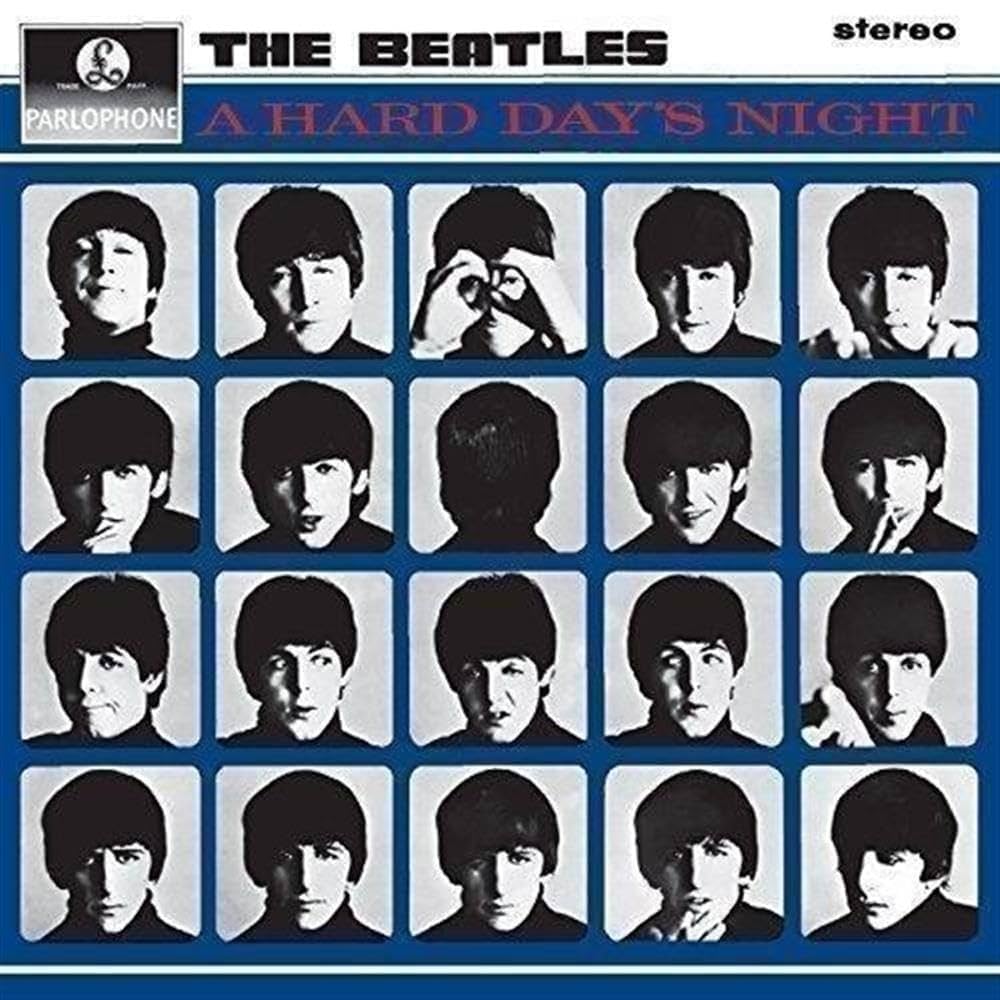
By the summer of 1964, Beatlemania had become a worldwide phenomenon. The Beatles were no longer simply a successful British band—they were the biggest musical act on the planet. Success that overwhelming could have easily encouraged them to play it safe, relying on cover songs and familiar formulas to satisfy an audience that seemed willing to buy anything with their name attached.
Instead, they did the opposite.
A Hard Day’s Night represents the moment The Beatles stopped being an outstanding pop group and started becoming one of the greatest songwriting partnerships in music history. For the first time, every song on the album was written by John Lennon and Paul McCartney, an extraordinary achievement considering how quickly they were expected to produce new material. Rather than exposing creative limitations, the decision revealed just how deep their well of inspiration had already become.
The result is one of the finest pop albums ever recorded—a joyful, endlessly melodic collection that still sounds remarkably fresh more than six decades later.
Album Overview
Released in 1964 as both the soundtrack to the band’s first feature film and a standalone studio album, A Hard Day’s Night captures The Beatles at an incredible pace of artistic growth.
Only a year separates it from Please Please Me, yet the difference is remarkable. The band sounds more confident, more adventurous, and considerably more sophisticated. The raw enthusiasm of their early recordings remains intact, but it is now paired with increasingly refined songwriting and musicianship.
The album balances infectious rock and roll with acoustic ballads, folk influences, and polished pop craftsmanship. Nearly every song contains a memorable hook, yet the record never feels repetitive.
Its sequencing also deserves praise. Upbeat numbers naturally give way to quieter moments before the energy rises again, making the album flow effortlessly from beginning to end.
At just over thirty minutes, it never wastes a second.
Songwriting
This is where A Hard Day’s Night truly separates itself from most albums of its era.
John Lennon and Paul McCartney deliver fourteen original compositions without a noticeable drop in quality. That’s astonishing by any standard, but especially for a band working under relentless touring, recording, filming, and promotional schedules.
Lennon’s songs generally lean toward sharper rock and emotional introspection, while McCartney contributes his trademark melodic optimism. Together they create an ideal balance that would define the band’s golden years.
The title track opens with one of the most famous guitar chords in rock history before launching into a chorus that remains irresistible decades later.
“If I Fell” showcases surprising emotional maturity, built around intricate vocal harmonies and vulnerable lyrics.
“And I Love Her” strips away much of the band’s rock and roll energy in favor of understated beauty, proving that subtlety could be just as powerful as excitement.
“Can’t Buy Me Love” remains one of the defining pop singles of the decade, driven by a simple but unforgettable message and an explosive chorus.
Even the deeper album cuts maintain an incredibly high standard. There are no obvious filler tracks—a rarity for mid-1960s pop albums.
Performance
The Beatles had grown tremendously as musicians in a remarkably short period.
John Lennon’s rhythm guitar playing is tighter than ever, while his vocals combine power with increasing emotional nuance.
Paul McCartney delivers several outstanding vocal performances, demonstrating the versatility that would soon make him one of popular music’s greatest singers. His bass playing also becomes noticeably more melodic and inventive throughout the record.
George Harrison contributes tasteful lead guitar work that perfectly complements the songs without overshadowing them. His distinctive twelve-string Rickenbacker sound gives much of the album its shimmering character, influencing countless guitarists in the years that followed.
Ringo Starr continues proving why he was the ideal drummer for The Beatles. His playing is economical, musical, and endlessly supportive of the songs. He never overplays, yet every beat feels exactly right.
The vocal harmonies deserve special mention. Few groups have ever blended voices as naturally as Lennon, McCartney, and Harrison, and this album contains some of their finest early work.
Production
Producer George Martin was becoming an indispensable creative partner.
While the recording techniques remain relatively straightforward compared to the band’s later studio innovations, Martin’s arrangements and production choices elevate every performance.
The album sounds bright, clean, and remarkably vibrant for 1964.
Acoustic guitars sparkle, electric guitars retain warmth without becoming harsh, and the vocal mixes allow the harmonies to shine. The balance between instruments feels effortless, even though recording technology of the era imposed significant technical limitations.
The use of George Harrison’s twelve-string electric guitar deserves enormous credit. Its chiming tone became one of the defining sounds of the album and helped shape the emerging folk-rock movement.
Although later Beatles albums would push studio technology much further, A Hard Day’s Night demonstrates how effective simplicity can be when paired with exceptional songs.
Standout Tracks
“A Hard Day’s Night” remains one of the greatest opening tracks in rock history. Its legendary opening chord immediately grabs attention before giving way to an exhilarating performance packed with unforgettable melodies.
“If I Fell” showcases the emotional sophistication that was beginning to emerge in Lennon’s songwriting. Its delicate harmonies remain breathtaking.
“Can’t Buy Me Love” is pure pop perfection—energetic, joyful, and impossible not to sing along with.
“And I Love Her” reveals an entirely different side of the band. Elegant and understated, it remains one of McCartney’s finest early ballads.
“Things We Said Today” often receives less attention than the major singles but stands among the album’s strongest compositions, pairing thoughtful lyrics with an unusually sophisticated structure.
“I’ll Be Back” closes the album on a reflective note, hinting at the increasingly complex songwriting that would soon define Beatles for Sale, Help!, and beyond.
Weak Points
Finding genuine weaknesses is difficult, but the album isn’t completely flawless.
Its running time, while perfectly paced, leaves listeners wanting more. That’s hardly a criticism, but it does make the album feel almost too brief.
Some of the lyrical themes remain rooted in youthful romance, lacking the broader emotional and philosophical depth the band would explore later in the decade.
The production, although excellent for its time, naturally lacks the sonic experimentation that would characterize albums like Revolver and Sgt. Pepper’s Lonely Hearts Club Band. Listeners approaching the record expecting psychedelic innovation may find it comparatively straightforward.
These criticisms are minor and largely reflect how astonishingly high The Beatles would later raise their own standards.
Legacy
A Hard Day’s Night changed the perception of what a pop band could achieve.
Writing an entire album of original material was still relatively uncommon in mainstream pop, and The Beatles proved that commercial success and artistic ambition could coexist. Their example encouraged countless bands to write their own songs instead of relying primarily on outside composers.
The album also played a significant role in the development of folk rock, power pop, and jangle pop, thanks largely to George Harrison’s influential guitar work.
Many later artists—including members of The Byrds, Tom Petty and the Heartbreakers, R.E.M., and countless others—would build upon the sound introduced here.
More importantly, A Hard Day’s Night marks the point where The Beatles became more than a cultural phenomenon.
They became truly great artists.
Final Score
9.5/10
A Hard Day’s Night is one of the defining pop albums of the 1960s and the first undeniable masterpiece in The Beatles’ extraordinary catalog. Its astonishing consistency, timeless songwriting, impeccable vocal performances, and effortless charm make it an album that remains every bit as enjoyable today as it was upon release. While later Beatles records would become even more ambitious and groundbreaking, few albums capture the pure excitement and melodic brilliance of popular music quite as perfectly as A Hard Day’s Night. Under a stricter scoring scale, this comfortably earns its place among the greatest albums ever made.
This post has already been read 63 times!