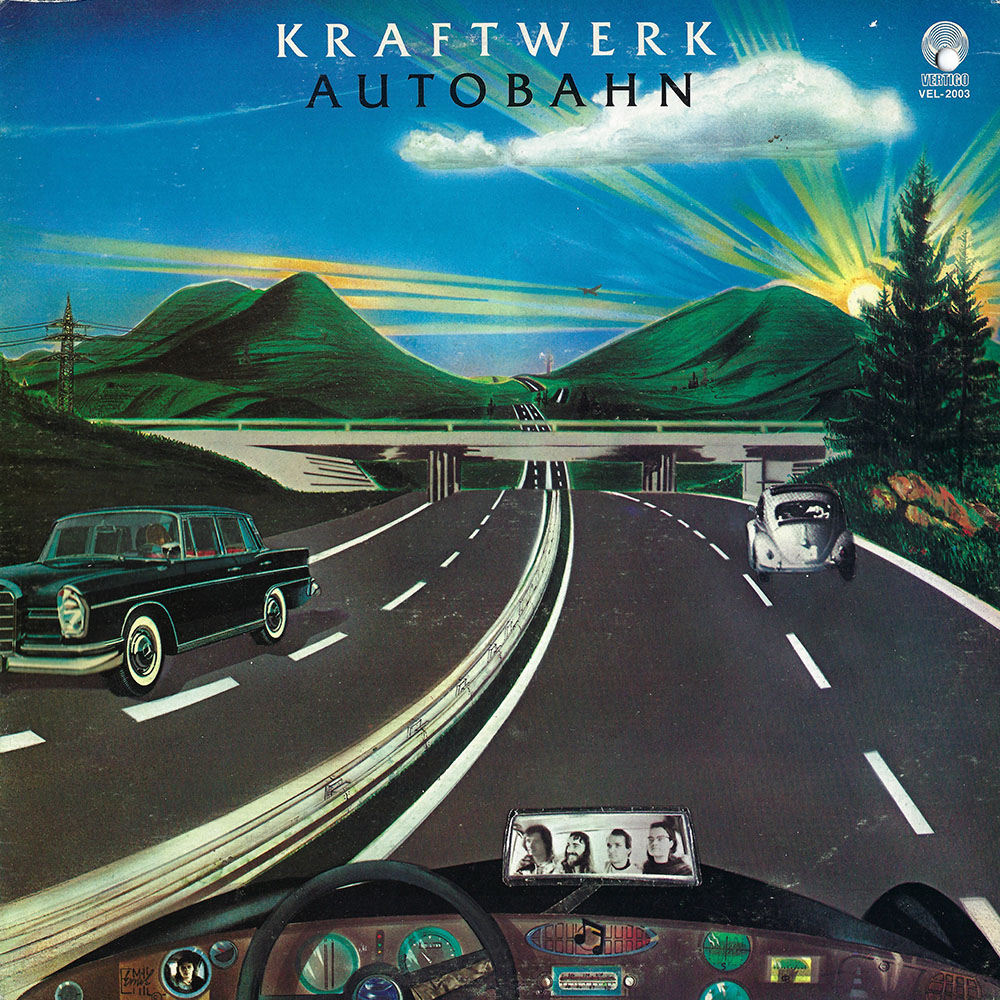
Released in November 1974, Kraftwerk’s landmark fourth studio album, Autobahn, marks the exact historical pivot point where electronic music ceased to be a mere academic novelty or an avant-garde studio experiment and transformed into the rhythmic blueprint for the modern world. Following a series of increasingly abstract, guitar-and-flute-heavy ambient records, masterminds Ralf Hütter and Florian Schneider completely stripped away traditional rock instrumentation, locking themselves into their Düsseldorf Kling Klang studio with an arsenal of newly acquired synthesizers, custom-built vocoders, and drum machines. By embracing the monotonous cadence of West Germany’s newly expanded highway system, the duo crafted a revolutionary manifesto of machine-age pop that abandoned blues-derived idioms entirely in favor of looped, mechanical precision. The resulting record is not only the birth certificate of synth-pop, techno, and ambient music, but an audacious, futuristic celebration of post-war mobility that permanently rewired the trajectory of global popular culture.
The record opens with its legendary, twenty-two-minute title track, a monolithic suite that single-handedly redefined the boundaries of song structure and sonic narrative. Kicking off with the authentic sound of a car door slamming, an engine ignition, and tires gripping pavement, the track immediately immerses the listener in a cross-country driving simulation. Driven by an infectious, synthesized bassline and Hütter’s bright, soaring synthesizer melodies that mimic passing scenery, the music captures the hypnotic, trance-inducing flow of long-distance transit. When the processed vocals sing the iconic, deadpan refrain “Wir fahren, fahren, fahren auf der Autobahn,” the track achieves a strange, beautiful synthesis of human leisure and industrial efficiency. Far from feeling cold or sterile, the composition utilizes minimalist repetition and gentle electronic textures to create an expansive, euphoric landscape that transforms the mundane act of highway driving into a transcendent, cinematic voyage across the European plains.
Flipped over to the original vinyl’s second side, the album shifts gears into a suite of shorter, more pastoral compositions that explore the quieter, more contemplative side of the duo’s relationship with modern technology. “Klingklang” serves as an eerie, captivating soundscape that mimics the inner workings of an automated factory or a computerized forest, relying on shifting rhythmic pulses, electronic bleeps, and subtle tape delays to generate an unsettling yet fascinating atmosphere. It acts as a direct bridge between their earlier, more challenging avant-garde output and the pristine, melodic pop minimalism they would perfect later in the decade. The mood lightens considerably with “Cometenmelodie 1” and “Cometenmelodie 2,” a two-part celestial journey inspired by the passing of Kohoutek’s Comet. The first movement drifts through dark, spacious cosmic gloom using shimmering synthesizer pads, while the second movement bursts forth with a bright, crystalline melody propelled by an early electronic rhythm pattern that feels like watching a spaceship accelerate into the stratosphere.
The journey concludes with “Mit dem Auto auf der Autobahn,” a breezy, lighthearted reprise that mirrors the opening epic while offering a more relaxed, wind-down perspective on the mechanical road trip. Across the entire record, Kraftwerk weaponized repetition as a tool for liberation rather than confinement, proving that rhythm and tone color could carry a narrative just as effectively as traditional lyrical storytelling. Autobahn ultimately endures because it successfully predicted our current, screen-and-speed-obsessed reality decades before it fully materialized, packaging the hum of the modern engine into an endlessly listenable, deeply influential work of electronic art.
This post has already been read 91 times!