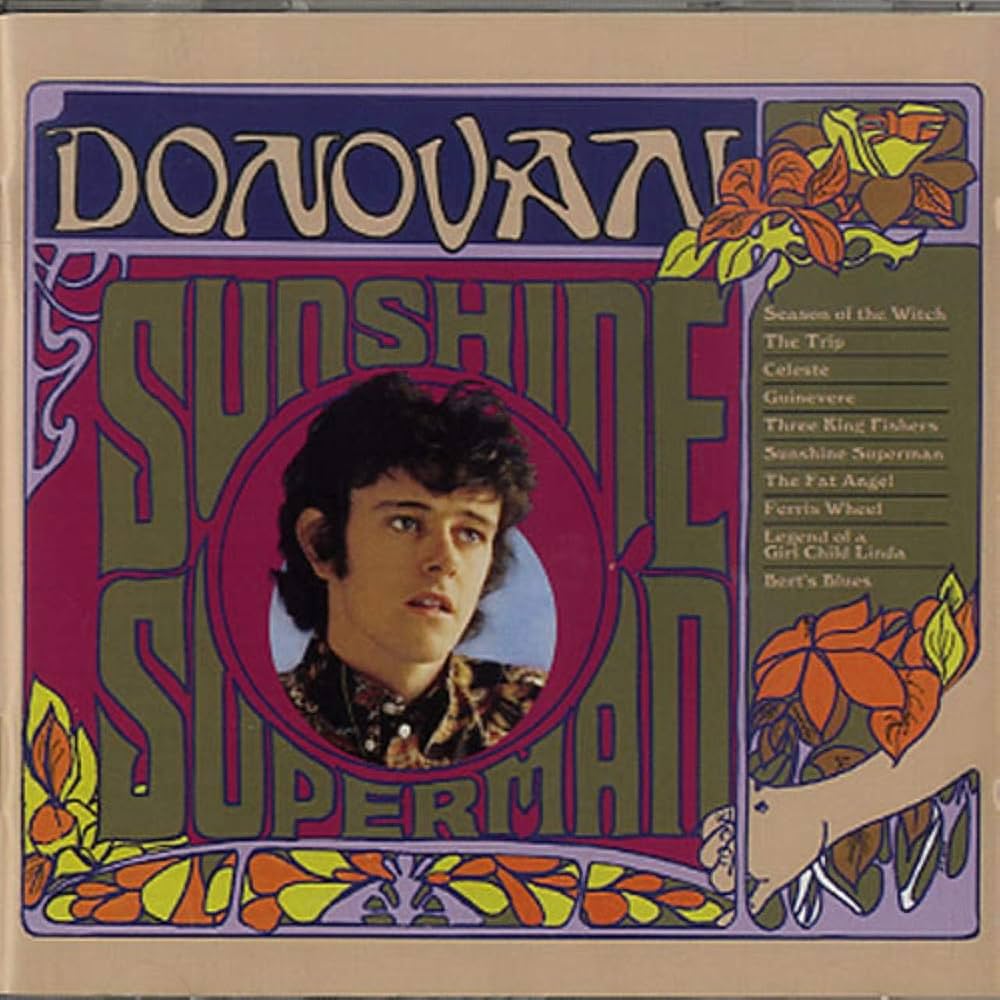
By the mid-1960s, Donovan had earned a reputation as Britain’s answer to Bob Dylan, a label that was never entirely fair. While his earliest recordings leaned heavily on folk traditions, Donovan was already developing a voice of his own—one that embraced mysticism, Eastern philosophy, psychedelia, jazz, and an almost childlike sense of wonder. With Sunshine Superman, he left comparisons behind for good.
Released in 1966, Sunshine Superman is one of the earliest and finest psychedelic pop albums ever made. Arriving before Sgt. Pepper’s Lonely Hearts Club Band and alongside the birth of the psychedelic movement, it blends folk, jazz, blues, Indian music, and rock into a sound that was both adventurous and effortlessly melodic. Rather than overwhelming listeners with studio excess, Donovan lets atmosphere and imagination guide the music.
The result is an album that feels timeless—dreamy, colorful, and endlessly inviting.
Album Overview
Sunshine Superman marked a major turning point in Donovan’s career. Legal disputes delayed its release in the United Kingdom, but the album appeared in the United States during the summer of 1966, quickly establishing Donovan as one of the most creative artists of the era.
The record balances radio-friendly pop with increasingly experimental arrangements. Acoustic guitars sit comfortably beside electric riffs, harpsichords, sitars, jazz rhythms, and orchestral flourishes. The album never feels cluttered, however. Every new instrument serves the mood rather than existing simply to sound unusual.
Donovan’s gentle vocal style also distinguishes the album from many of its contemporaries. Even during the record’s most psychedelic moments, there’s a calmness and warmth that keeps everything grounded.
It’s less about exploding your mind than quietly expanding it.
Songwriting
Donovan’s songwriting reaches a remarkable level of maturity here.
His lyrics often blur the line between romance, fantasy, spirituality, and surrealism, yet they remain surprisingly accessible. Rather than relying on obscure symbolism, Donovan paints vivid images that invite interpretation without demanding it.
The title track perfectly captures this balance. “Sunshine Superman” combines playful romantic imagery with a hypnotic groove, creating one of the defining psychedelic singles of the decade.
“Season of the Witch” moves in the opposite direction, replacing sunshine with tension and mystery. Its repetitive structure builds hypnotic momentum while its cryptic lyrics remain endlessly intriguing.
Elsewhere, Donovan demonstrates his gift for melodic folk-pop.
Songs like “The Fat Angel” and “Three King Fishers” showcase thoughtful storytelling and beautiful melodies, while “Ferris Wheel” brings a playful innocence that perfectly complements the album’s dreamlike atmosphere.
Unlike many psychedelic records that prioritize experimentation over songwriting, Sunshine Superman succeeds because the songs themselves are consistently excellent.
Performance
Donovan’s understated vocal delivery is one of the album’s greatest strengths.
He rarely raises his voice, instead relying on subtle phrasing, gentle melodies, and effortless charm. His performances feel conversational rather than theatrical, making even the album’s most fantastical lyrics sound sincere.
Instrumentally, the supporting musicians are outstanding.
The rhythm section maintains relaxed but precise grooves throughout, while the guitar work shifts seamlessly between folk fingerpicking, blues influences, and emerging psychedelic textures.
One of the album’s most memorable features is the interplay between acoustic and electric instruments. Rather than competing for attention, they complement one another beautifully.
The occasional use of sitar, harpsichord, and jazz-inspired instrumentation adds texture without distracting from Donovan’s songwriting.
Every performance serves the mood.
Production
Producer Mickie Most deserves enormous credit for crafting one of the most sophisticated pop productions of 1966.
The album sounds rich without becoming overly ornate.
Layered instrumentation creates depth while preserving remarkable clarity. Every acoustic guitar sparkles, bass lines remain warm and melodic, and subtle orchestral elements blend naturally into the arrangements.
The title track features one of the earliest successful uses of psychedelic production techniques in mainstream pop, yet it never feels gimmicky.
Even the more experimental moments retain an organic quality that has helped the album age gracefully.
Compared to later psychedelic records filled with tape manipulation and elaborate studio effects, Sunshine Superman feels almost restrained.
That restraint works in its favor.
Standout Tracks
“Sunshine Superman” remains Donovan’s signature song for good reason. Built around a hypnotic bass line, shimmering guitars, and an unforgettable chorus, it perfectly captures the optimism and imagination of the psychedelic era.
“Legend of a Girl Child Linda” is hauntingly beautiful, pairing delicate melodies with one of Donovan’s most poetic lyric sheets.
“Three King Fishers” demonstrates Donovan’s remarkable gift for combining folk traditions with rich melodic invention.
“Season of the Witch” is the album’s masterpiece. Dark, mysterious, and endlessly influential, it stands as one of the defining songs of 1960s psychedelia.
“The Fat Angel” pays tribute to Bob Dylan while simultaneously proving that Donovan had fully emerged from Dylan’s shadow.
“Ferris Wheel” closes the album with warmth and gentle optimism, providing a satisfying conclusion to the journey.
Weak Points
Although consistently engaging, Sunshine Superman occasionally feels more atmospheric than emotionally profound.
Donovan’s relaxed vocal style, while perfectly suited to the material, sometimes lacks the dramatic intensity found in contemporaries like Bob Dylan or Van Morrison.
A few of the album’s quieter folk-oriented tracks can blend together during casual listening, especially compared to the unforgettable impact of the title track and “Season of the Witch.”
Additionally, the differences between the original U.S. and U.K. releases have created some confusion over the years regarding the definitive track listing, though this has little effect on the quality of the music itself.
These remain minor concerns on an otherwise remarkable record.
Legacy
Sunshine Superman helped establish the blueprint for psychedelic pop before many of the genre’s defining classics had even appeared.
Its influence can be heard in artists ranging from The Beatles and Pink Floyd to modern indie-folk and psychedelic revival bands. Donovan demonstrated that experimentation didn’t require abandoning melody, and that imaginative songwriting could remain welcoming rather than intimidating.
The album also marked Donovan’s artistic independence. No longer dismissed as a Dylan imitator, he emerged as one of the most distinctive voices of the 1960s, creating music that balanced innocence, sophistication, and quiet eccentricity.
While later psychedelic albums would become more elaborate, few captured the genre’s sense of wonder as naturally as Sunshine Superman.
It’s an album that still feels like sunlight filtering through colorful stained glass—warm, mysterious, and endlessly beautiful.
Final Score
9.0/10
Sunshine Superman is a landmark of early psychedelic pop and one of Donovan’s greatest achievements. Its imaginative songwriting, elegant production, memorable melodies, and understated performances combine to create an album that remains both adventurous and deeply enjoyable. While it occasionally favors atmosphere over emotional intensity, its influence on the development of psychedelic music and the enduring strength of its best songs make it one of the essential albums of the 1960s. Under a stricter scoring scale, it comfortably earns an outstanding 9.0/10.
This post has already been read 44 times!